Why Wall-Broken Herbal Powders Improve Applications
Wall-broken herbal powders represent a real shift in how traditional botanicals perform inside modern formulations. Huajuhong wall-broken raw powder is one typical wall-broken herbal powder. By physically rupturing plant cell walls through low-temperature mechanical processing, active compounds that were previously locked inside fibrous structures become immediately accessible. For procurement managers sourcing respiratory wellness ingredients, this matters.
Huajuhong wall-broken raw powder — derived from authentic Citrus grandis var. tomentosa grown in Huazhou, Guangdong — delivers naringin and related flavonoids at a release rate significantly higher than standard ground powder, making it a preferred raw material for throat-care tablets, lung-support supplements, and herbal tea formulations.
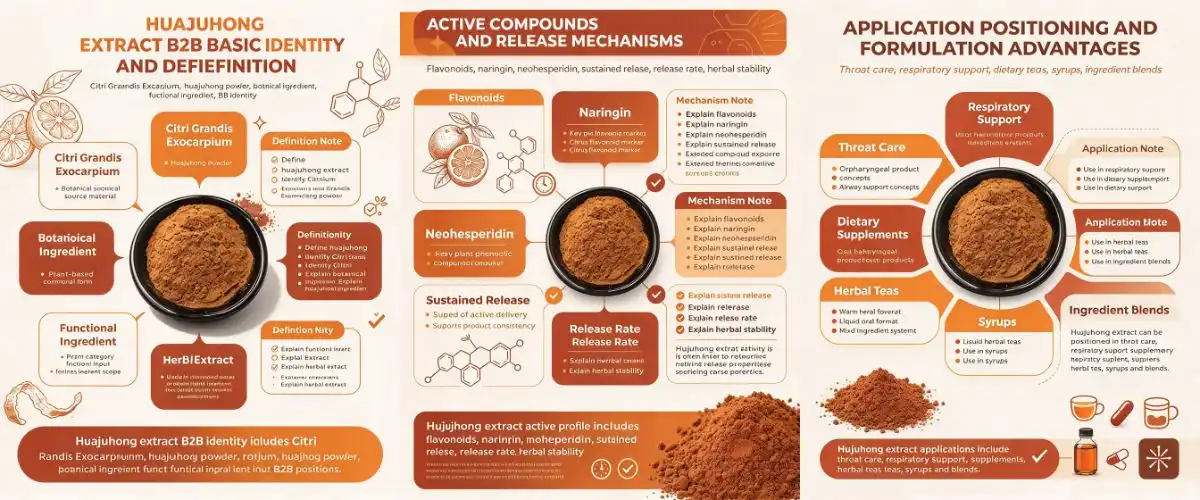
Understanding Wall-Broken Herbal Powders and Their Advantages
What "Wall-Breaking" Actually Does at the Cellular Level
Plant cell walls are mostly made up of lignin and cellulose, which are structural materials that are hard to break down and make it take longer for bioactives inside cells to be released. Using normal tools to grind a dried plant, you reduce the particle size but leave most of the cells whole.
Wall-breaking technology, especially low-temperature air-flow milling, breaks down those cell membranes, letting the cytoplasm contents show through. According to a study in the Journal of Food Engineering, breaking down plant cell walls improves the amount of phenolic compounds that can be extracted by 40 to 80%, based on the type of plant and how it is processed.
Why Particle Size Below 200 Mesh Changes Formulation Outcomes
The size of the particles directly affects how fast they dissolve. At 200 mesh (about 75μm or smaller), powder particles spread out more widely in water-based systems. This means that less powder settles to the bottom of liquids and tablets are easier to compress.
For herbal tea sachets, finer particle spread means that the tea will brew faster and have more uniform taste and strength per cup. For solid dosage forms that are taken by mouth, like throat lozenges or chewable tablets, consistent particle size helps make the active compound amount per unit more reliable. This is something that makers who care about quality can't skimp on.
The Specific Advantage of Low-Temperature Processing
Heat is the main thing that hurts flavonoids and volatile chemicals in plants from the orange family. Grinding at high temperatures causes friction, which can break down heat-sensitive materials before the powder even gets to the production line. Low-temperature wall-breaking, which is done at temperatures below atmospheric, keeps the whole range of phytochemicals in the source material. This isn't just a marketing claim; any manufacturer who wants to deliver a product whose lab analysis matches what it says on the label must follow this process engineering rule.
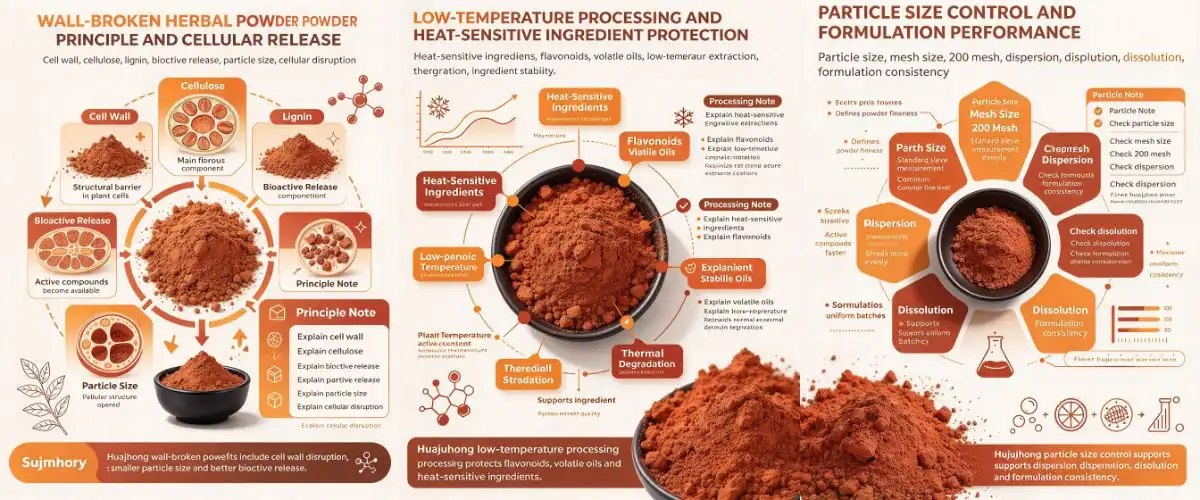
Comparing Huajuhong Wall-Broken Raw Powder with Traditional Powders
The Core Problem with Conventional Pomelo Peel Powder
Standard pomelo peel powder, which is sold at 80–120 mesh, keeps most of the cell walls whole. The active ingredient naringin stays hidden inside flexible matrix structures. This means that it is not easily absorbed by the body when it is used as an end product. Huajuhong wall-broken raw powder solves this absorption limitation.
There is also species swapping in the market, where common pomelo peel (Citrus grandis) is often mistaken for real Huajuhong wall-broken raw powder (Citrus grandis var. tomentosa).The two types are structurally and phytochemically different. Genuine "Zhengmao" Huajuhong has a tomentose (hairy) skin on the immature fruit and a unique flavonoid profile with higher naringin amounts. This is an important difference in both clinical and business settings.
Technical Specifications That Separate Quality Products
Here are the tested technical specs of a Huajuhong wall-broken powder that was made correctly:
- Appearance: Looks like fine light yellow powder with a uniform color; no clumps or dark spots can be seen.
- Mesh Size: Minimum mesh size of 200 mesh, which ensures enough particle reduction for industrial uses
- Loss on Drying: ≤5%, which controls the amount of water in the food, which directly impacts its shelf life
- Ash Content: ≤5% shows the mineral load and processing cleanliness.
- Microbial Compliance: Meets safety standards for food
- Certifications: ISO 22000, HACCP, and Halal—needed to follow the rules in both China's home market and Southeast Asia's export markets
These factors can't be switched out for regular orange peel powder. Each standard is important for the next step in the manufacturing process, and not following any of them can lead to formulation failures or not meeting legal requirements.
Value Proposition for B2B Bulk Buyers
When you figure out dose effectiveness, it's easy to see why wall-broken powder is a better value for money than regular ground material. If the bioavailability of the active ingredient is 40–60% higher per gram of wall-broken powder, you need less raw material to make your end product work as well. When companies make a lot of herbal tea sachets or throat-care pills, the lower dose directly balances out the higher unit cost of the raw materials, which often leads to net savings at scale.
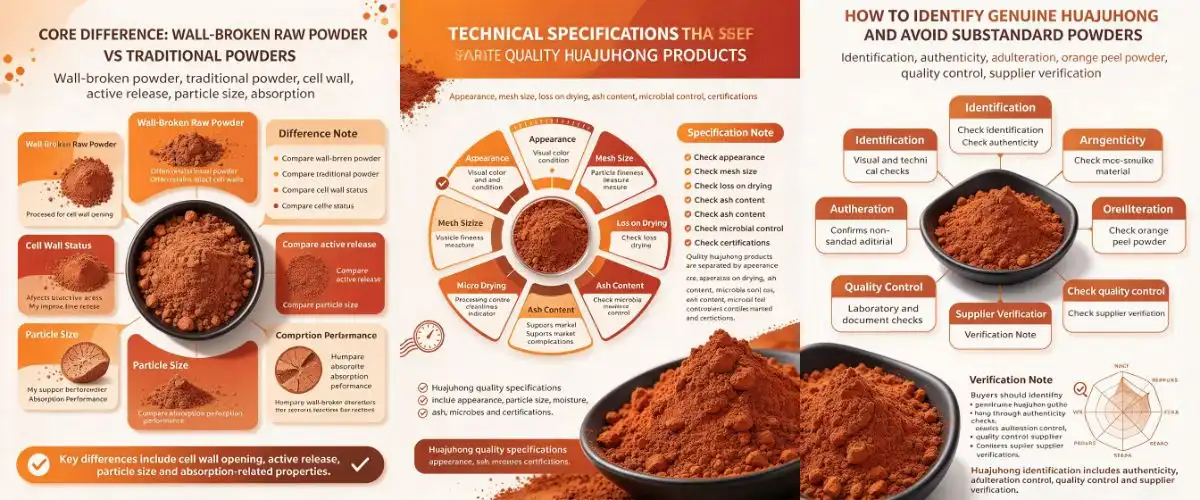
Practical Applications and Usage Guidelines
Herbal Tea Sachets and Instant Beverages
When used in daily herbal tea, Huajuhong wall-broken raw powder works clearly better than coarser options. It dissolves quickly in hot water, makes a stable suspension without a lot of heavy sediment, and gives a constant taste that customers associate with high-quality products. Most of the time, inclusion rates for herbal tea formulations should be between 0.5g and 2g per sachet. However, the final dosage should be confirmed with your R&D team based on the amount of naringin you want in each serving.
Throat-Care Tablets and Respiratory Supplements
The 200-mesh particle size works well for solid dosage forms that are taken by mouth, like lozenges, chewable tablets, and hard-pressed tablets. It lets the particles be compressed easily and spread out evenly within the tablet matrix. The slight bitterness of the powder, which is caused by naringin, isn't too bad at standard medicinal doses and can be hidden with standard fillers. Since the cell walls are already broken, dissolution tests usually show faster active-compound release than with regular plant powders. This backs up claims about throat and lung health.
Storage and Handling Requirements
Wall-broken powders have more surface area than regular ground material, which makes them more hygroscopic. Keep in a cool, dry place below 25°C in sealed, moisture-barrier packaging. When working in a humid environment, don't open bulk bags over and over again. For manufacturers in Southeast Asian climates with high humidity, nitrogen-flushed aluminum foil packaging is strongly suggested to keep the ≤5% moisture level for the whole shelf life.
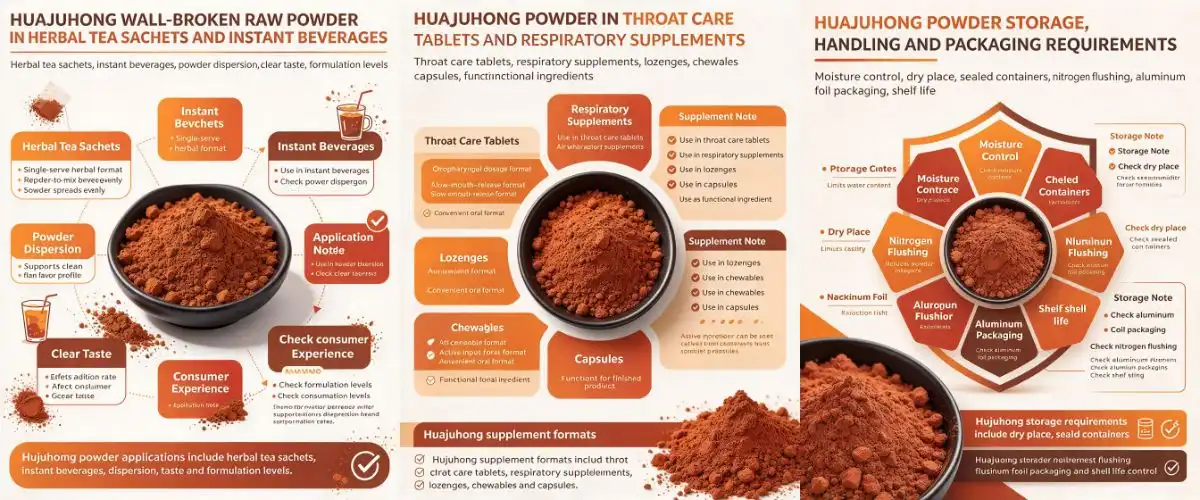
Procurement Guide for Huajuhong Wall-Broken Raw Powder
How to Verify Authenticity Before You Order
Verification of species is the most important thing that needs to be done for purchase. Ask for a Certificate of Analysis (COA) that lists the plant name, the amount of naringin found by HPLC, the amount of sulfur dioxide residue found, the amount of heavy metals found, and the results of the pesticide residue test. If a supplier can't give all five papers for a certain batch of production, they shouldn't move on to the sample step. Real "Zhengmao" Huajuhong from Huazhou, Guangdong, will have paperwork that shows where it came from; make sure you ask for it.
Supplier Evaluation Criteria
There are four main things that industrial buyers look at when comparing Huajuhong wall-broken raw powder suppliers:
- Wall-breaking rate: Aim for ≥95% cell destruction; find out how this is measured and confirmed.
- Batch-to-batch consistency: To check if naringin content stays the same from batch to batch, ask for COA data from three or more production batches in a row.
- Certifications on file: At the very least, ISO 22000 and HACCP; Having a halal certificate is important for getting into Southeast Asian markets.
- Stock availability: Seasonal botanical supply causes gaps; check current store levels and wait times before setting production plans.
By regularly checking these criteria, the chance of supply problems during production or quality problems during incoming inspection goes down.
Typical Decision Timeline for Mid-Scale Buyers
For this type of goods, the buying process usually takes five to eight weeks. This includes one week to set specs, one to two weeks to compare suppliers, two weeks for lab testing of samples, and two to three weeks for a trial order of 25–50 kg to make sure it works with the production line. This deadline should be built into your product launch plan so that you don't have to make hasty decisions that lower the quality of your product.
Future Trends in Botanical Powder Processing
Dual-Technology Processing Approaches
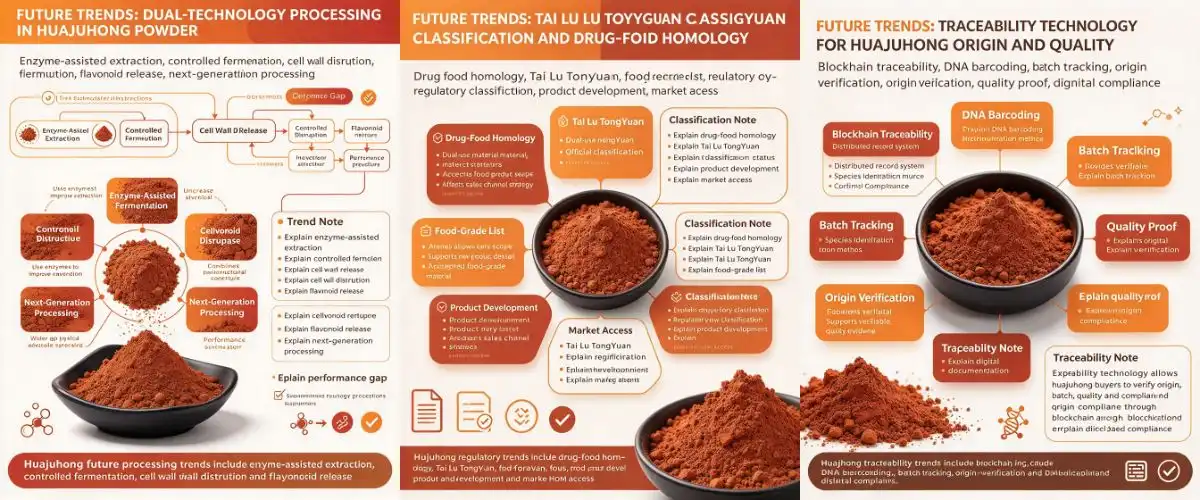
Breaking down cell walls with enzymes or controlled fermentation is part of the next wave of plant raw material innovations. Early study shows that breaking down some of the pectin in orange peel with enzymes before mechanically disrupting it can make it easier to extract flavonoids. This means that over the next five years, the performance gap between wall-broken powders and regular powders will continue to grow.
Regulatory Tailwinds in Drug-Food Homology Categories
The list of plants that can be used in listed food items in China keeps growing thanks to the country's drug-food homology policy framework. Huajuhong wall-broken raw powder was officially added to the national drug-food homology list. This made it legal for it to be used in food-grade product development, which was only possible in pharmaceutical channels before. Manufacturers who have already invested in this area of raw materials will be able to reach a much larger market thanks to this change in regulations.
Traceability Technology Adoption
Blockchain-based tracking of botanical origin and DNA barcoding for plant identification are moving from test projects to full-scale use by bigger Chinese companies that make herbal ingredients. If buyers are worried about species substitution, which is a real issue in this group, these tools provide proof of origin that can be checked without relying only on seller paperwork.
Conclusion
It's not a special function just because it breaks the wall. It fixes specific, measured issues: the inability of plant compounds to be used by the body, uneven release of active ingredients, and formulation problems caused by large particle size. When companies make respiratory health products, throat-care tablets, or lung-support supplements, they should switch from using regular ground botanicals to using a properly verified, 200-mesh Huajuhong wall-broken raw powder from real material from Huazhou. The investment in procurement is small compared to the benefits in product effectiveness and customer satisfaction that come later.
FAQ
Is wall-broken Huajuhong powder the same as Huajuhong extract?
No, wall-broken powder is made from the whole plant. All of the natural fibers, flavonoids, and polysaccharides are still there, but they are broken up physically. An extract is a chemically separated part that concentrates certain chemicals while leaving out the whole phytochemical environment.
How do I confirm I am getting genuine Huazhou-origin material?
Request that the supplier provide you with proof of botanical species identification and origin certificates. Citrus grandis var. tomentosa from Huazhou that is truly authentic has different naringin concentration ranges that can be measured by HPLC. Compare the COA data to values that have already been released for the variety.
Does low-temperature processing affect sulfur dioxide levels?
Low-temperature mechanical processing doesn't add sulfur dioxide on its own. SO₂ contamination comes from sulfur fumigation that happens when raw plant material is first dried. You should ask your supplier's COA for a specific SO₂ residue test result (ideally ≤150 mg/kg) for each production batch.
What packaging format is best for humid climates?
Aluminum foil bags that are vacuum-sealed and flushed with nitrogen can keep the ≤5% wetness level even in Southeast Asian production settings where humidity levels are high. When storing a lot of things, don't use regular plastic bags.
Can this powder be used directly in capsule filling?
Yes. A good wall-broken powder with particles that are 200 mesh and good flow properties supports straight capsule filling processes. Before full production runs, make sure you and your supplier agree on the bulk density so that you can accurately calibrate capsule fill weights.
Request Samples from Sigma — Your Trusted Huajuhong Wall-Broken Raw Powder Supplier
Sigma sells confirmed Huajuhong wall-broken raw powder from Huazhou to companies that make food and health products in China, Southeast Asia, and other countries. Our product is certified by ISO 22000, HACCP, and Halal, and each production batch comes with full COA paperwork that shows the amount of naringin, SO₂ waste, heavy metals, and pesticides that were tested. The stock is ready to be shipped right away. You can email our team at sarah@sxsigma.com or go to sxsigma.com to ask for a free sample and talk about your needs for big purchases.
References
1. Journal of Food Engineering — "Effect of Cell Wall Disruption on Phenolic Extractability from Citrus Peel," 2019.
2. Food Chemistry — "Naringin Content Variation in Citrus grandis var. tomentosa and Common Pomelo Peel: A Comparative Study," 2021.
3. Industrial Crops and Products — "Low-Temperature Ultrafine Grinding of Botanical Materials: Impact on Bioactive Compound Retention," 2020.
4. Journal of Ethnopharmacology — "Traditional Uses and Phytochemical Profile of Huajuhong (Citrus grandis var. tomentosa) in Chinese Medicine," 2018.
5. LWT — Food Science and Technology — "Particle Size Reduction and Its Effect on Dissolution Rate and Bioavailability of Herbal Powders," 2022.
6. Chinese Journal of Natural Medicines — "Drug-Food Homology Policy and Market Expansion of Approved Botanical Ingredients in China," 2023.