Why Choose OEM Soybean Peptide for Beverage Formulation at Scale?
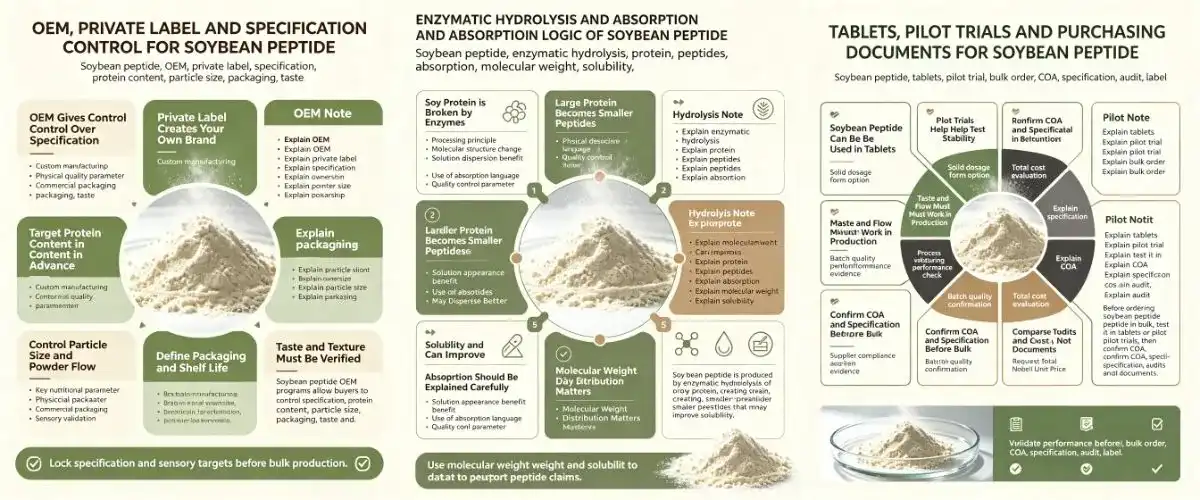
Choosing OEM soybean peptide for beverage formulation at scale gives brands control over the specification, taste, and supply of a key protein ingredient. A soybean peptide is a short-chain protein fragment made by enzymatic hydrolysis of soy protein, so it mixes into water more easily than intact soy protein. With an OEM program, you can set targets for protein content, particle size, and packaging. You then confirm them in pilot trials before bulk orders. I find this approach lowers reformulation risk, keeps batches consistent, and gives purchasing teams clear documents for audits and US labeling.
What Soybean Peptide Is and Why It Matters in Beverage Formulation
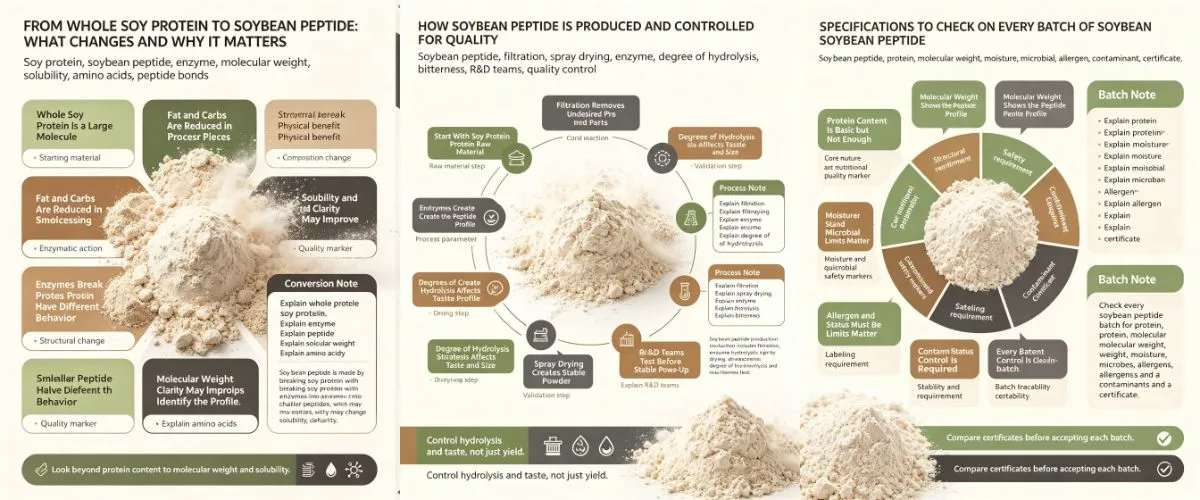
From Whole Soy Protein to Soybean Peptide
Whole soy protein folds into a big molecule to make small shapes. It gets rid of most of the fat and carbs, but it still gets less water-soluble as it gets closer to its isoelectric point, which is around pH 4.5. Kinsella's well-known work on the usefulness of soy proteins talks about this. When water hits it, this changes. Safe for food enzymes break down the protein into small pieces that are two to six amino acids long and have some free amino acids in them. A soybean peptide that is much easier to spread out in water is what comes out of it. Because different suppliers use different enzymes and levels of hydrolysis, the names of the products don't tell you much. I tell buyers to look at more than one molecular weight report. It takes about 1000 Da to make our soybean peptide powder.
How Soybean Peptide Is Produced
Usually, the first steps in production are picking out the soy raw materials and getting the protein out of them. The stuff is filtered, compressed, sprayed dry, and then tested after the enzymes break it down. Scientist Adler-Nissen studied how enzymes break down proteins in food. They found that the type of enzyme and the amount of hydrolysis change how well the protein dissolves, how bitter it is, and how much it gives. This means that two powders with the same name can behave in very different ways when mixed with water. R&D teams should ask each source what steps they take to make sure each lot is safe before sharing it. They should also ask how they get rid of bitterness. Most of the time, clear answers to these questions can tell you if a program is stable at volume.
Specifications to Check on Every Batch
There's more to a good buy criteria than just the amount of protein. As for each lot, you should ask for the molecular weight distribution, moisture, microbiological limits, allergen status, contaminant results, and certificates. The soybean peptide we sell is a fine, off-white powder that mixes completely with water and has at least 80% protein in it. It has a molecular weight of about 1000 Da and parts that are 80 mesh in size. The thing that makes it work is soybean oligopeptide. For each package, ask for an analysis certificate. This way, your quality team can compare each lot to the agreed-upon limits. If you don't write that down, you might not notice when a recipe or the taste of the drink you make changes.
Why Standard Soy Protein May Not Be Enough for Beverage Production at Scale?
Common Problems With Intact Soy Protein in Liquids
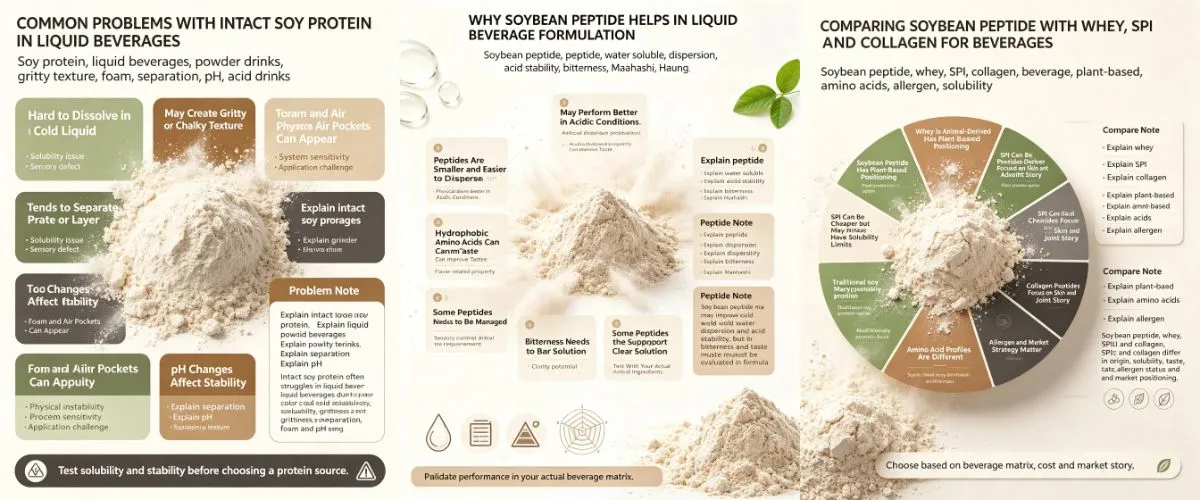
It can be hard for liquid and powdered drinks to mix with whole soy protein. As an example, it can settle, become grainy, foam, separate into phases, or have a flavor that tastes like beets. pH, heat treatment, dose, nutrients, and sweeteners can also change how well something works. Near pH 4.5, soy proteins don't have much of an electric charge, so they tend to stick together and settle. For acidic drinks, this is a bad thing. Because of short holding times and gentle mixing, settling isn't as noticeable. This means that a small pilot may hide these problems. They are easier to see because they are kept in buildings, have bigger tanks, and can hold more. To save money, catch them early. If you wait too long, you lose both supplies and line time.
Where Soybean Peptide Helps and Where It Falls Short?
Peptide pieces that are smaller are easier to break up and spread out. Builders have more freedom with ready-to-mix powders and light-colored drinks. However, hydrolysis isn't always the best way to go. Maehashi and Huang's review of bitter peptides says that peptides that are high in hydrophobic amino acids can taste bad. They also soak up water easily, and some acid systems may change the way they taste. Our one-of-a-kind debittering technology is meant to give you a clean, fresh taste. Still, I believe you should test the taste and smell of your own base using your own sugar and flavoring. That test is the best way to be sure that people will agree with it.
Comparing Soybean Peptide With Whey, SPI, and Collagen
That's right, each protein has its own job to do. It's not possible for soybean protein concentrate and soybean peptide to mix or feel the same in the mouth. A mix works best sometimes. Whey protein is full of amino acids, but some people are allergic to dairy, and plant-based foods don't mix well with it. Collagen peptide isn't always used instead of soy because it's good for your health and looks different. You will also be able to buy soybean peptides that have been fermented and broken down by enzymes. Before making your choice, I think you should compare more than just the production method. You should look at the peptide distribution, taste, batch records, and application data.
The Core Benefits of OEM Soybean Peptide for Beverage Brands
Specification Control Through OEM Customization
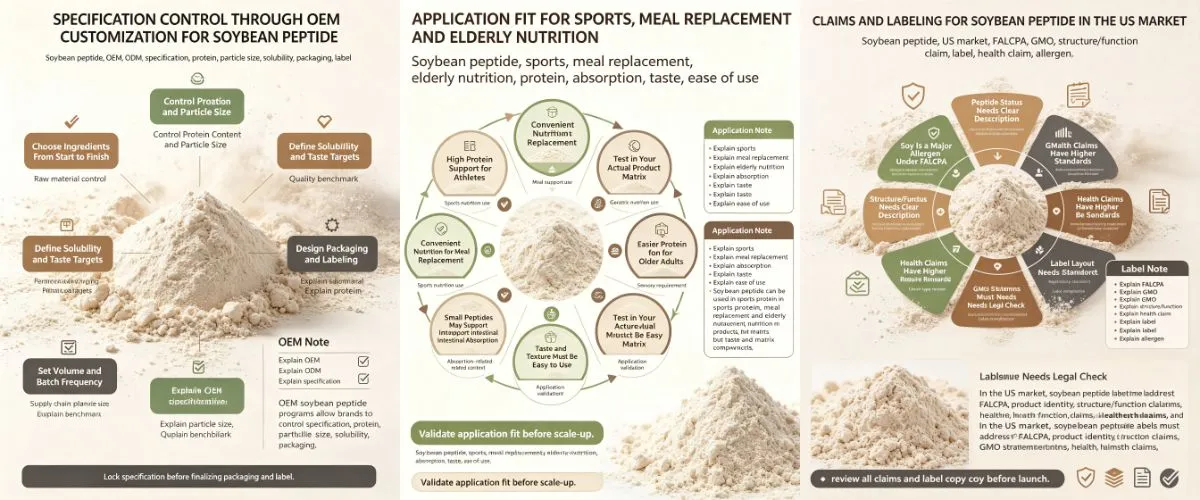
With an OEM program, a brand can pick the ingredients that go into the finished drink instead of having to change the drink to fit a stock powder. Sigma offers both ODM and OEM services, which include changing the recipe, making the specs fit your needs, designing the packaging, and adding labels. Goals for soybean peptide include the amount of protein, the size of the particles, how well they dissolve, how they taste, and the form of the bag. Then we check to see if it's possible for your volume. If you buy a normal powder and then find that it sticks in your mixer, you'll have to start the search all over again. This early alignment stops that from happening. It is also helpful for the quality and buying teams to have a written standard that they can compare against.
Application Fit for Sports, Meal Replacement, and Elderly Nutrition
Our soybean peptide works well in protein shakes for meal replacements, sports drinks, and vitamin powders for people who have just had surgery. This stuff is good for people who like to work out, athletes, people who need more protein after surgery, and older people whose digestion isn't as strong. Each group wants it to taste mild and be easy to mix. Small molecules can move through the gut wall with the help of the PepT1 transporter. This path is talked about in Daniel's review of intestinal peptide transport. Even though people are working on it, this should still be seen as nutrition science and not a promise that it will work. Test the product yourself to be sure it works well.
Claims and Labeling in the US Market
The Food Hazard Labeling and Consumer Protection Act of 2004 says that soy is one of the most dangerous foods in the US. Things that are already made need to have a clear soy statement, even if the protein has been broken down. There are tests that show that a soybean peptide is safe, so I wouldn't say that it is. Also, FDA rules say that health claims must be true. The type of protein in a peptide drink is important to know, but it shouldn't be used as the only way to lose weight or get better. Quickly have a lawyer look over the words on the front of the package, and ask us to send you the safety statement and GMO statement for your notes.
How OEM Soybean Peptide Improves Large-Scale Beverage Manufacturing
From Lab Sample to Pilot Batch
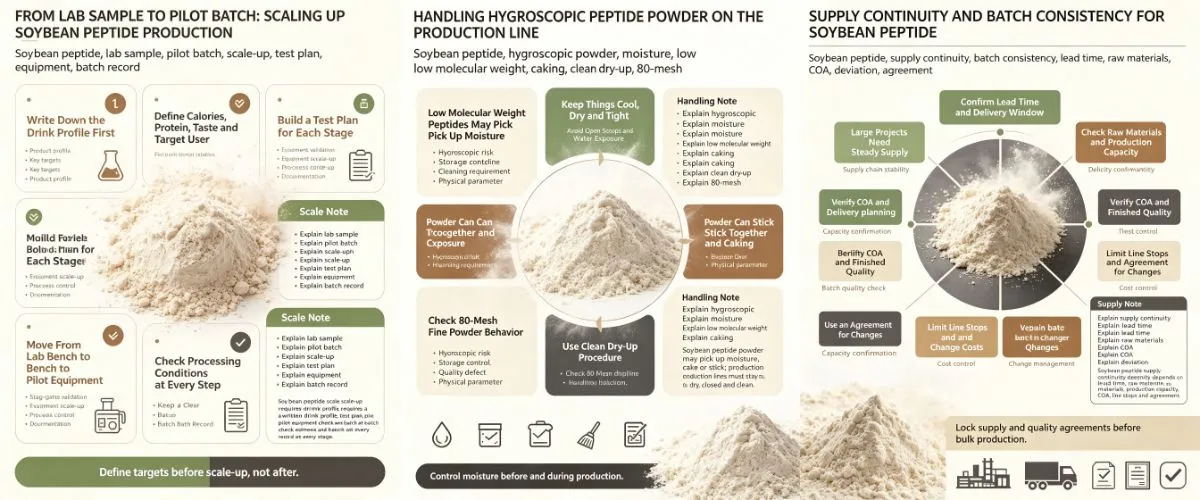
Less shocks happen when there is a planned scale-up. Write down what kind of drink it is, how many calories it has, how much protein it should have, what flavor it tastes like, and who it's for. To begin, test a piece on a bench. Now, move on to a test batch. On top of that, check that everything on the production equipment is right. At each step, keep an eye on the dispersion time, viscosity, sedimentation, pH, heat tolerance, filling behavior, and the need to clean. Make sure there are checks for shelf life at the temperatures your carriers use to store your goods. Your R&D team can try them out for free with Sigma before you buy a lot of them. Every result needs to be written down because it will be used as a guide for future orders.
Handling Hygroscopic Peptide Powder on the Line
Low molecular weight peptides take water from the air, so it's important to be careful with how you handle them. Keep our thing somewhere cool and dry, and make sure the lid is on tight. Close the bag quickly and use clean, dry scoops if you don't want the food to stick together. The powder should be added slowly while being stirred in so that it mixes in evenly. The 80-mesh fine powder dissolves completely in water, which makes it easier to measure out doses. Also, check to see if it works with the veggies, vitamins, and minerals in your premix. Teach the line staff these things before the first full production run.
Supply Continuity and Batch Consistency
For big projects to work, supply needs to stay steady. Sigma says they keep safety stock for important products and have soybean peptide in stock. They also offer delivery in 5–7 business days through a smooth ex-factory system. When you ship by boat, air, or express, you get all the paperwork you need and help with customs. Picking the raw materials is the first step in quality control. Checking the finished product is the last step. We promise quality for a year. Less line stops and changes from lot to lot are the perks that you can use. Also, ask for an agreement to handle changes. This way, any changes to the process or raw materials will be okay with the company before they get there.
A B2B Buyer's Checklist for Selecting an OEM Soybean Peptide Supplier
Documents to Request Before Placing an Order
An analysis certificate, an allergen statement, a GMO statement, microbiological results, contaminant testing, and information on how stable the product is are the first things you should look at. After that, look at the certificates. It is certified by ISO 9001, ISO 22000, and FSSC 22000. The soybean peptide we sell is also certified by ISO, HACCP, and Halal. It says on our business page that we are Kosher, so please check that this is true for your order. When you buy something from a seller, check that each certificate is valid for the right product and factory. Also, check the times that the certificate was given and when it expires. For cheap future issues with imports or stores, a quick look over this paper file doesn't take long and can save you a lot of money.
Questions About Capacity, Lead Time, and Export Support
Find out what the minimum order size is, how much can be ordered each month, how to support pilot batches, and how long it takes to place an order again. Find out who is in charge of the customs papers and show proof that you have sent goods to the country you want to visit. Sigma ships by sea, air, and express. They also help with paperwork, are available 24 hours a day, seven days a week, and let you track your order in real time. Also, find out how the seller deals with problems. Find out how long it takes for someone to answer and what kind of records they keep. They are more likely to do the same thing during production if they give clear answers during sampling.
Total Cost Versus Price per Kilogram
A low price per kilogram can hide costs that are higher. Things like re-formulation, output delays, low taste scores, mixed lots, returns, and missing papers quickly add up. A good OEM partner can cover these costs by giving clear specs, technical help, stable quality, and a steady supply. This method works well for sports nutrition, plant-based protein drinks, old people's formulas, and goods that are going to be sent abroad. Look at quotes that have been given, written down, and used. Over the course of a year, the supplier with better records and faster replies may charge less than the other one who offers the same price.
Conclusion
OEM soybean peptide is good for drink brands that need a steady supply of a peptide with a mild taste that is easy to breakdown. Soybean peptide is different from whole soy protein because hydrolysis shortens the chains and makes them more dispersed. It's still not clear how bitter things work, how acidic systems work, or how to take in water. OEM guidelines let brands choose ahead of time how much protein to use, the size of the particles, how to package and name the food. Keep an eye on things like dispersion, viscosity, sedimentation, and shelf life as you move from the sample to the pilot to the line validation. This is the best way for teams to scale up. There are still reports that foods in the US need to be marked as soy allergens and be very careful with them. There's more to a source than just price per kilogram that you should think about. You should also look at the total cost, certificates, batch records, stock, and how much it can ship.
FAQ
Is soybean peptide fully soluble in water?
It always says that our powder can be mixed with water. But the amount, pH, temperature, and minerals in your drink can change how it works, so test it first.
Does soybean peptide taste bitter?
Only a few peptides do. For a clean taste, we use patented debittering technology. I believe you should test your own base's taste buds.
Do US labels still need a soy declaration?
Yes. Soy is a major allergy according to US law, and hydrolysis does not get rid of the need to name it.
Which certificates come with the product?
The goods have ISO, HACCP, and Halal written on them. Please check that the item is Kosher or doesn't have GMOs before you buy it.
How should I store the powder?
To keep the soybean peptide powder dry, keep it closed and in a cool, dry place.
Contact Sigma for OEM Soybean Peptide Samples
This is the fine, off-white powder that Sigma sells. It has a molecular weight of ≤1000 Da and a protein content of ≥80%. They have ISO, HACCP, and Halal certifications, and they keep stock and offer OEM support. If you need a soybean peptide supplier for a beverage project, email Sarah at sarah@sxsigma.com with the type of product, the amount you want to buy each year, and your flavor goals.
References
1. Peptides, 2014. Singh, Vij and Hati, "Functional significance of bioactive peptides derived from soybean."
2. Annual Review of Physiology, 2004. Daniel, "Molecular and integrative physiology of intestinal peptide transport."
3. Cellular and Molecular Life Sciences, 2009. Maehashi and Huang, "Bitter peptides and bitter taste receptors."
4. Journal of the American Oil Chemists' Society, 1979. Kinsella, "Functional properties of soy proteins."
5. Food Allergen Labeling and Consumer Protection Act, U.S. Food and Drug Administration, 2004.
6. Enzymic Hydrolysis of Food Proteins, Elsevier Applied Science, 1986. Adler-Nissen.