Why Choose L-Carnosine Powder for Supplement Formulation Needs?
If you're building an anti-aging or brain health supplement line, ingredient selection makes or breaks your product. L-Carnosine powder — a white crystalline dipeptide with CAS number 305-84-0 — delivers a rare combination of antioxidant activity, anti-glycation protection, and neuroprotective support in a single raw material. With purity reaching ≥99% and verified compatibility across capsule, tablet, and cosmeceutical formats, it gives formulators a science-backed foundation that few single ingredients can match. This guide breaks down why procurement teams and R&D directors consistently return to high-grade carnosine as a formulation anchor.
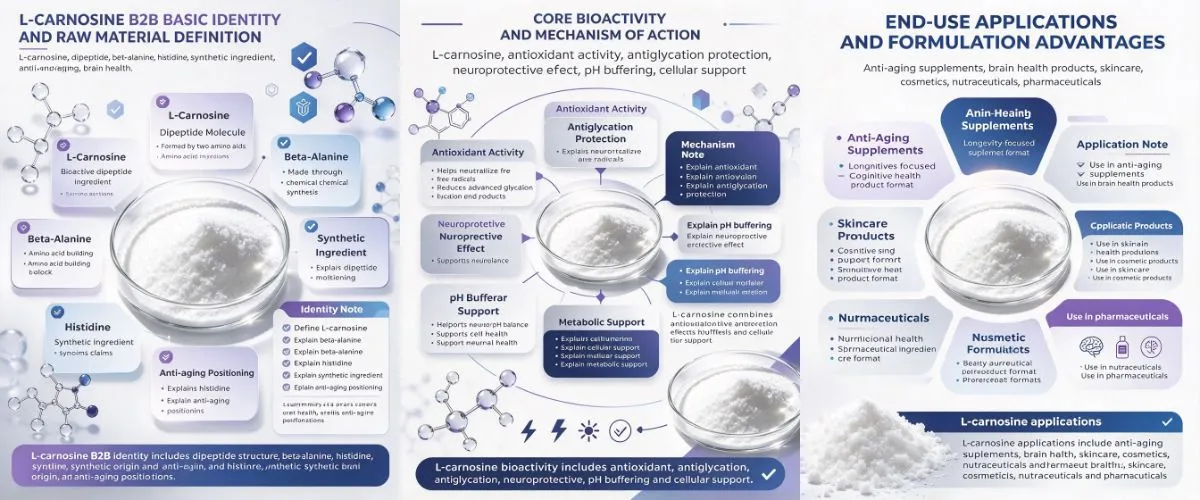
Understanding L-Carnosine Powder: An Overview
What Is L-Carnosine?
Beta-alanine and L-histidine are naturally occurring building blocks that make up L-carnosine. It mostly stays in brain cells, heart muscle, and skeletal muscle, where it works as an antioxidant, a biological buffer, and a glycation inhibitor. Manufacturers can now reach pharmaceutical-grade purity through synthetic production, which makes it possible for large-scale B2B supplement production. It is easy to process on standard production lines because it is a white crystalline powder with particles that are 100 mesh and lose only 0.5% of their weight when they dry.
The Anti-Glycation Mechanism
When reducing sugars combine with proteins, they create advanced glycation end-products (AGEs). These AGEs cause cross-linking, collagen stiffness, and cellular aging. L-Carnosine directly competes with body proteins for those reactive sugar molecules. This "sacrificial" reaction stops the formation of AGE at its source. The process is confirmed in both skin fibroblasts and neuronal tissue by data published in Nutrients (2020). This is why the ingredient is found in both high-end anti-aging serums and cognitive health pills.
Why Developers Prioritize It Now
In the last three years, people, especially in the U.S. and Japanese markets, have become much more aware of anti-glycation science. Japan has long used carnosine in eye drops and topical serums, which shows that the ingredient is well-known and accepted by regulators. Building on a well-known bioactive gives marketing teams the confidence to make health claims that are backed up by peer-reviewed research when they enter the nootropic or life product market.
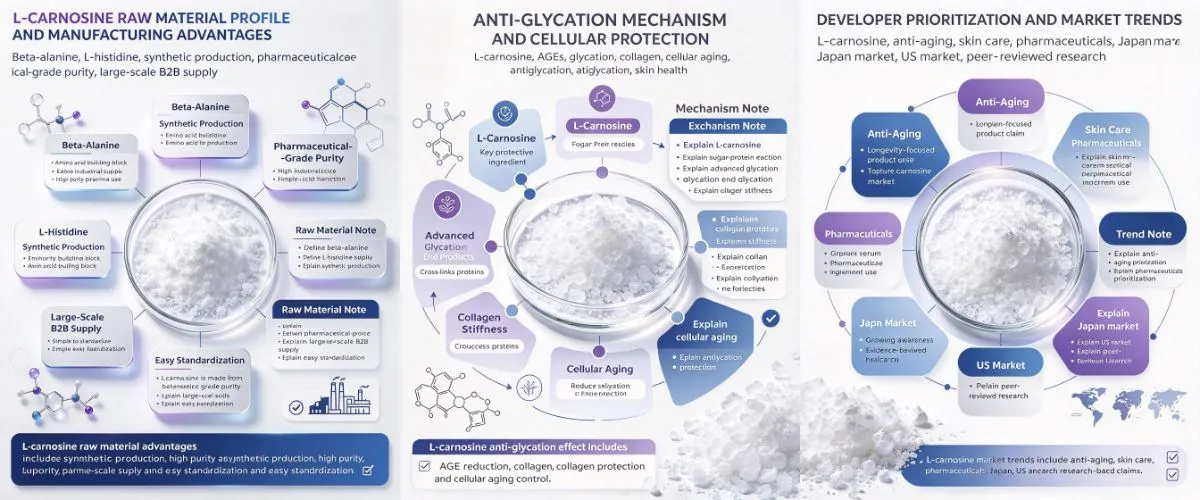
Comparing L-Carnosine Powder with Alternatives in Supplement Formulations
L-Carnosine vs. Beta-Alanine
It is possible for muscle tissue to make carnosine from beta-alanine, but taking beta-alanine by itself does not have the same direct anti-glycation and protective effects as whole carnosine. Beta-alanine mainly works to balance the pH inside muscles during anaerobic exercise and is linked to the well-known side effect of tingling (paresthesia). Because it does two things at once, L-Carnosine is better for anti-aging and memory formulations. It buffers pH and removes unstable carbonyls.
L-Carnosine vs. Collagen and Antioxidant Blends
In this case, collagen peptides help rebuild structural proteins, and vitamin C or resveratrol are common antioxidants that get rid of reactive oxygen species (ROS). Neither of them talks about reactive carbonyl species (RCS) like methylglyoxal, which cross-link collagen without oxidative stress. L-Carnosine powder directly neutralizes RCS, bringing back the skin's elasticity and brightness from a different biochemical point of view. Adding collagen to a recipe makes the two ingredients work better together instead of against each other.
Why Pure Powder Outperforms Mixed Blends
Formulators can precisely control dose by using pure L-Carnosine powder with 99% purity. Mixed mixes make it harder to say how strong something is and make sure that each batch is the same. Working from a single high-purity raw material makes both formulation math and quality paperwork easier for B2B clients who want to sell supplements in the U.S., where FDA labeling requires accurate quantitative statements.
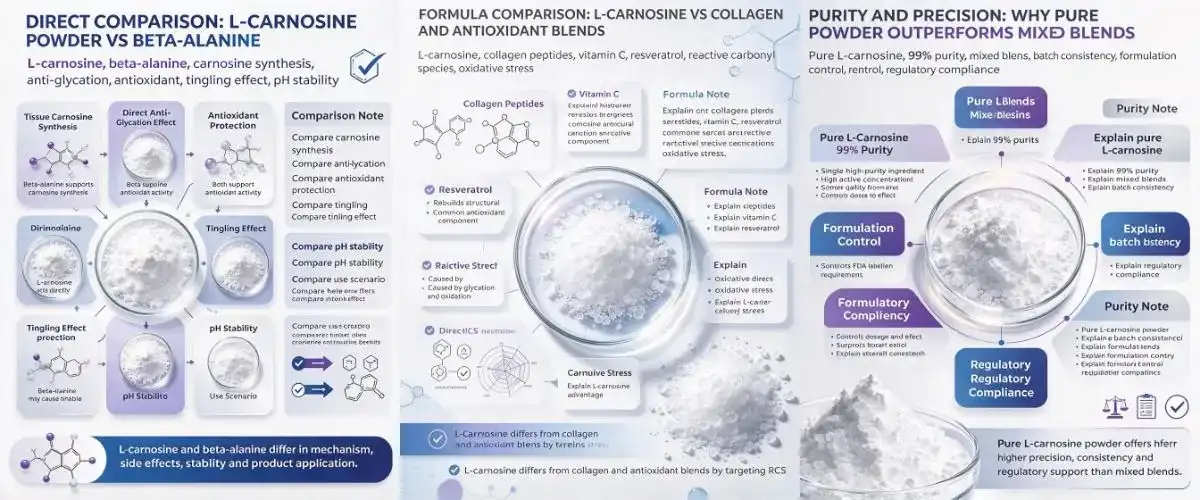
Procurement Insights: How to Source High-Quality L-Carnosine Powder
Key Certification Benchmarks
When looking at different suppliers, you should look for basic paperwork like ISO 9001 or ISO 22000 certification, HACCP certification, Kosher certification, and a full Certificate of Analysis (COA) that checks for heavy metals (≤10 ppm), residual solvents, microbial counts, and HPLC purity. Importantly, chiral-specific testing must make sure that D-carnosine enantiomers are not present, as they can be a source of contamination that lowers biological activity and makes it harder to follow the rules. Sigma's L-Carnosine is certified as ISO, HACCP, and Kosher, and full batch paperwork is provided upon request.
Evaluating Supplier Process Quality
L-Carnosine is made through a process called condensation chemistry, which can leave behind small amounts of organic solvents or catalytic leftovers. Reports on solvent residue from a reliable supplier are in line with ICH Q3C standards. Sigma uses a unique cleaning process that lowers the amount of endotoxin and heavy metals in their products well below the international standard. This is important for a wide range of uses, not just oral vitamins.
Balancing Cost and Quality at Scale
High quality costs more, but buying straight from a company that does all of its own production cuts down on markups. Sigma keeps 10–20 tons of safety stock on important items, and it takes 5–7 business days to get them to you after you confirm your order. For procurement teams that make purchases worth $80,000 to $400,000 a year, having a reliable inventory and clear prices directly leads to more trust in production planning and lower costs for emergency sources.
Formulation Considerations: Dosage, Safety, and Regulatory Compliance
Recommended Dosage Ranges by Application
Doses of L-Carnosine powder 500 mg to 2000 mg per day taken by mouth have been shown to help with anti-aging and brain health. Formulations for sports healing usually use 1,000 to 2,000 mg per day. Different concentrations of topical serums for cosmetic use are popular in the dermatologist literature.
These range from 0.5% to 2%. Because serum carnosinase breaks down carnosine after it is taken by mouth, encapsulation in delayed-release or enteric-coated formats can increase the time it stays in the plasma. This is a formulation strategy that you should talk to your ingredient supplier about.
Safety Profile and Side Effect Management
L-Carnosine has been shown to be safe in human tests. At therapeutic doses, studies in Anti-Aging Medicine and Biomolecules have not found any major side effects. It has a good tolerance rating because it is naturally found in human tissue. Getting supplement ingredients from a cGMP-compliant producer with full batch traceability lowers the risk of adverse events caused by contaminants, which is still the biggest safety worry when getting supplement ingredients.
Regulatory Pathways in the U.S. and Global Markets
If you're in the United States, you can buy L-Carnosine as a supplement ingredient under the name DSHEA. It doesn't have official FDA GRAS approval for use in food yet, so applications must clearly state that they are dietary supplements. In Japan, it can be found in eye drops and other approved semi-drugs. EU Novel Food regulations may apply if the product is in a certain format and there is proof that it has been used before. Brands that sell in more than one market should work with both their raw material provider and a regulatory expert.
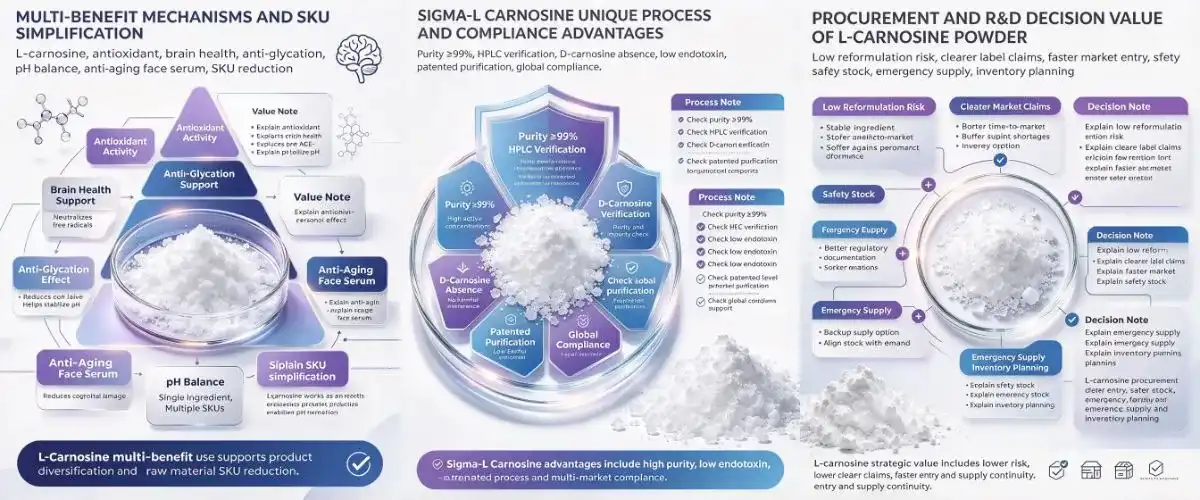
Why L-Carnosine Powder Is the Preferred Choice for Supplement Developers
Supplement makers keep coming back to L-Carnosine powder because it works on multiple biological processes at the same time, which is something that most raw materials can't do. Because it works as an antioxidant, stops glycation, and balances pH, one SKU can be used for many different product lines, from a brain health pill to an anti-aging face serum. This kind of recipe freedom makes it easier to differentiate products for different groups of customers while reducing the number of different SKUs for raw materials.
Here are some of the main benefits of Sigma's L-Carnosine:
- Purity ≥99% with HPLC verification and confirmed absence of D-carnosine enantiomers, ensuring full biological activity in every batch.
- Heavy metals ≤10 ppm and a patented purification process that keeps endotoxin levels well below international standards, supporting ophthalmic and high-sensitivity cosmetic applications.
- 100-mesh particle size and ≤0.5% loss on drying for smooth integration into capsule, tablet, and powder blend production lines.
- ISO, HACCP, and Kosher certified, with complete COA documentation for U.S., EU, and Japanese market compliance.
- 5–7 business-day delivery backed by maintained safety stock, eliminating the supply gaps that disrupt production schedules.
These requirements directly lead to lower risk of reformulation, clearer label claims, and faster entry into the market. These are all things that procurement and research and development teams regularly rank as very important for making decisions.
Conclusion
L-Carnosine powder has its own place in the market for supplement ingredients. It works against glycation, which is a molecular process that regular antioxidants can't reach. Because of its known effects on anti-aging, brain health, and sports healing, brands can use a single raw material to make more than one product line. For purchasing managers looking at ingredient sources, ≥99% purity, full licensing, open testing, and a guaranty of stock availability set the bar for a long-term supply relationship that is worth building.
FAQ
What purity level should I require for supplement-grade L-Carnosine?
For dietary supplement manufacturing in the U.S., ≥99% purity verified by HPLC is the accepted standard. Additionally, request chiral purity testing to confirm the absence of D-carnosine, which is biologically inactive and signals process quality issues.
How do I verify that a supplier's L-Carnosine contains no residual solvents?
Request solvent residue test reports aligned with ICH Q3C Class 2 and Class 3 limits. A reputable manufacturer provides batch-specific documentation, not generic certificates. Sigma provides full residue documentation with every COA.
What is the recommended storage condition for L-Carnosine powder?
Store in a sealed container in a cool, dry place, away from direct light and humidity. Proper storage preserves stability and maintains the ≤0.5% loss-on-drying specification through the shelf life period.
Can L-Carnosine be used in topical cosmetic formulations?
Yes. At concentrations of 0.5%–2%, it functions as an anti-glycation active in serums and creams, inhibiting the Maillard reaction in dermal proteins to preserve collagen elasticity and skin tone.
Does L-Carnosine require any special delivery format to maintain efficacy?
Because serum carnosinase degrades free carnosine after oral ingestion, enteric-coated or delayed-release capsule formats are recommended for systemic applications. Sigma can provide application guidance to support your formulation development.
Partner with Sigma for Premium L-Carnosine Powder Supply
Sigma has pharmaceutical-grade L-Carnosine powder that is ≥99% pure, certified by ISO, HACCP, and Kosher, and can be delivered in 5–7 days from a safety stock that is kept on hand. We offer full COA paperwork, affordable bulk prices, and flexible OEM/ODM services as a straight manufacturer of L-Carnosine powder. Our team is ready to help you with your formulation from the sample level all the way up to annual contract volumes of 25 kg. You can ask for a sample right now by emailing sarah@sxsigma.com or going to sxsigma.com.
References
1. Boldyrev, A. A., Aldini, G., & Derave, W. (2013). Physiology and pathophysiology of carnosine. Physiological Reviews, 93(4), 1803–1845.
2. Hipkiss, A. R. (2009). Carnosine and its possible roles in nutrition and health. Advances in Food and Nutrition Research, 57, 87–154.
3. Gualano, B., Everaert, I., Stegen, S., et al. (2012). Increased muscle carnosine levels and improved exercise capacity. Amino Acids, 42(6), 2311–2323.
4. Aloisi, A., Barca, A., Romano, A., et al. (2020). Anti-glycating and antioxidant properties of carnosine: A review. Nutrients, 12(9), 2823.
5. Seidler, N. W. (2013). Carnosine as a natural anti-aging peptide. Anti-Aging Medicine, 10(1), 2–15.
6. Baye, E., Ukropec, J., de Courten, M. P. J., et al. (2017). Effect of carnosine supplementation on cardiometabolic risk factors. British Journal of Nutrition, 118(12), 1003–1008.