Fucoxanthin Extract Powder vs Seaweed Extract: Which Is Best for You?
If you are sourcing ingredients for weight management or sports nutrition products, you have likely compared these two options. Fucoxanthin extract powder delivers a standardized, high-potency active compound isolated from brown seaweed, while general seaweed extract offers a broad nutritional profile. For brands targeting metabolic health and natural fat-burning claims, the choice between the two directly affects product efficacy, label credibility, and long-term supply reliability. This article breaks down what each ingredient offers so you can make a confident sourcing decision.
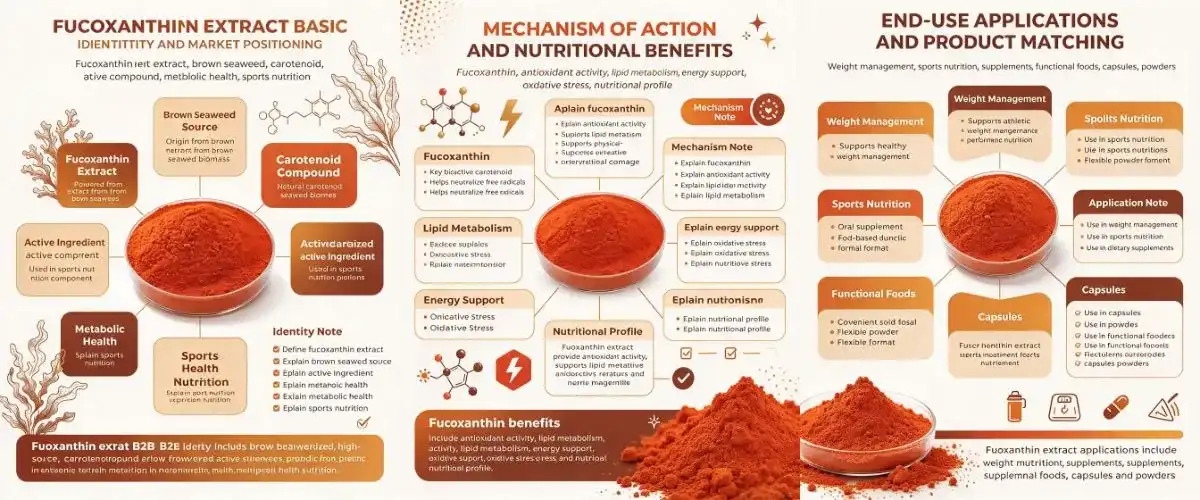
Understanding Fucoxanthin Extract Powder and Seaweed Extract
At the element level, it helps to know what each product is before putting them next to each other.
What Is Fucoxanthin Extract Powder?
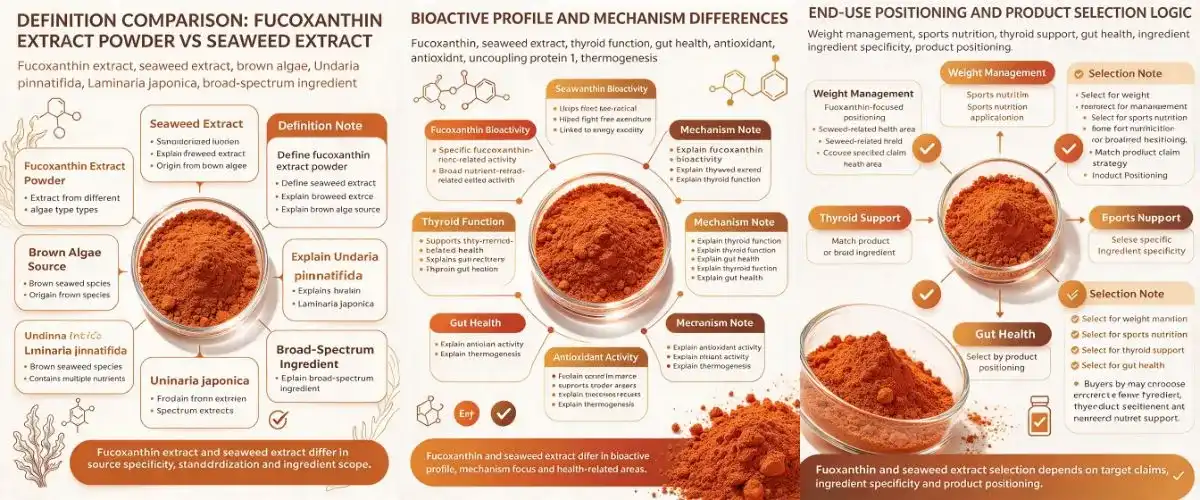
It is a xanthophyll carotenoid that can only be found in brown algae, like Undaria pinnatifida (wakame) and Laminaria japonica. When it is made as a standard powder, it is concentrated to a certain level of strength, which is usually ≥10% fucoxanthin by HPLC analysis. The molecule has a special allenic bond and a 5,6-monoepoxide group that give it unique metabolic activity. For example, it can turn on uncoupling protein 1 (UCP1) in white adipose tissue, which is linked to thermogenesis and losing visceral fat.
What Is Seaweed Extract?
Seaweed extract is a broad-spectrum ingredient that comes from different types of algae, such as brown, red, and green types. It keeps the vitamins, minerals, carbohydrates (like fucoidan and alginate), and trace iodine that are already there. This variety makes it good for general health formulas, but raw seaweed usually has less than 0.1% fucoxanthin by dry weight, which means it can't help with weight control without being concentrated.
How Do Their Bioactive Profiles Compare?
There is a big difference in how specific they are. A lot of different nutrients in seaweed extract help the thyroid work, keep the gut healthy, and protect against free radicals. With accuracy, fucoxanthin extract powder hits biochemical pathways. A study from 2010 in Diabetes, Obesity, and Metabolism (Abidov et al.) showed that obese women who took pure fucoxanthin had statistically significant drops in body weight and resting energy expenditure. This is something that generalized seaweed extract can't do at the same doses.
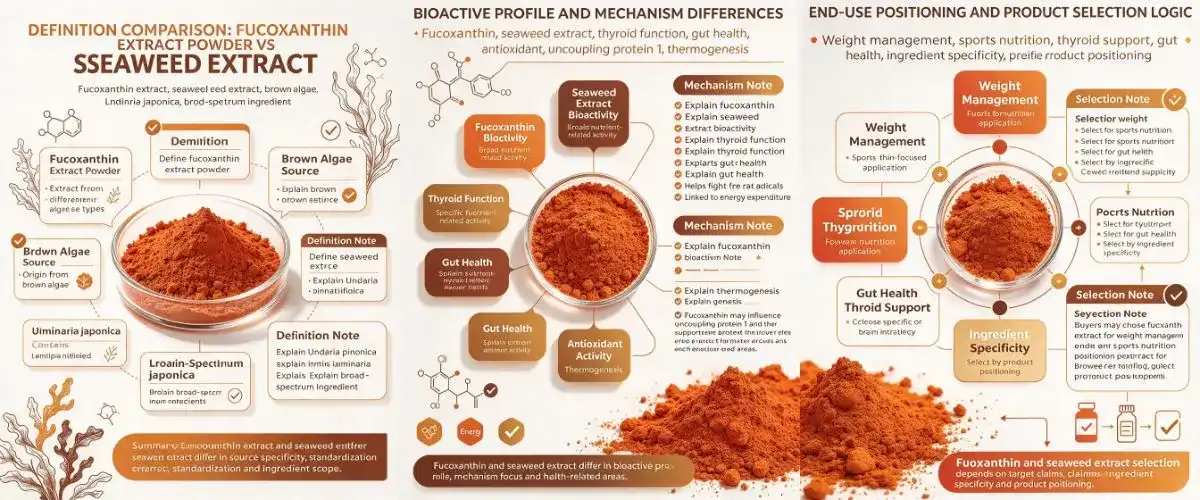
Comparing Fucoxanthin Extract Powder and Seaweed Extract: Efficacy and Applications
Understanding how each ingredient works helps procurement teams make decisions about where to get ingredients that are in line with what the product claims to do.
Metabolic Activity and Weight Management
Fucoxanthin turns on UCP1 in white adipose tissue, which speeds up mitochondrial thermogenesis without affecting the brain or spinal cord. This fat burner's non-stimulant mechanism makes it stand out in a market that is becoming more wary of fat burners that contain stimulants. According to clinical research, 2.4 mg to 8 mg of pure fucoxanthin should be taken every day. Using a ≥10% fucoxanthin extract powder, that means 24 mg to 80 mg of raw material per capsule dose, which is a useful and cost-effective range for softgel or hardshell capsules.
Seaweed Extract lacks this specific mechanism.
Seaweed extract doesn't have this particular process. Fucoidan in seaweed extract has been shown to reduce inflammation and change the immune system in preclinical studies, but there isn't any human clinical data that supports a weight loss claim similar to that of isolated fucoxanthin.
Safety Profile and Regulatory Considerations
Since both elements come from sea sources, there are good reasons to be concerned about the amount of heavy metals and iodine they contain. Professional processing gets rid of most of the minerals in regulated fucoxanthin extract powder made by supercritical CO₂ extraction. The fact that our product has a heavy metals standard of ≤10 ppm and a loss on drying specification of ≤3% shows that the production was managed and can be tracked.
According to the FDA's rules for dietary supplements, comments about how well they work must be backed up by data on the ingredients. Fucoxanthin's peer-reviewed clinical record is a stronger basis for compliance than generalized seaweed extract.
Formulation Compatibility
Fucoxanthin naturally attracts fat, so it works best in softgels that are filled with oil, powder blends that contain fat, or encapsulated tablets. Because it has water-soluble polysaccharides, seaweed extract is easier to mix into drink bases or gummy forms. For weight control SKUs that come in softgel or hardcap forms, uniform fucoxanthin extract powder is the better option from a business and medical point of view.
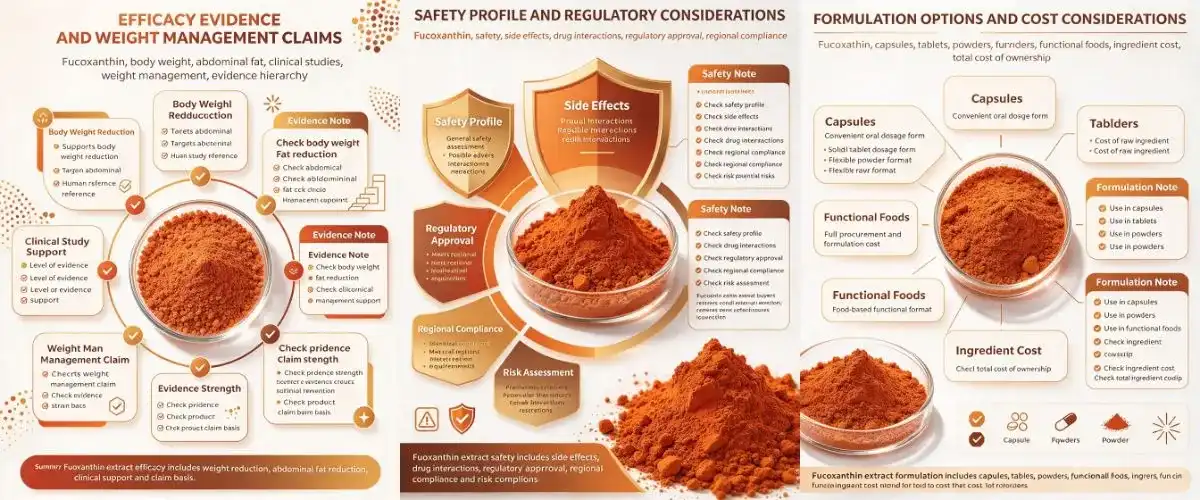
Procurement Considerations: Quality, Pricing, and Supplier Reliability
Getting the right ingredient also means getting it from the right place. These are the most important things.
Purity Standards and Certification
A reliable fucoxanthin extract powder supplier should test each batch's strength using HPLC instead of UV testing, which reads the total pigment and may give a false reading of the fucoxanthin content if it includes impurities. Look for a Certificate of Analysis (COA) that says how much of the active ingredient is in the product, how much moisture is in it, and how much heavy metal is in it (≤10 ppm). For entry into the North American and Australian markets, ISO 22000, HACCP, and Halal approvals are all acceptable. Our product is certified by ISO, HACCP, and Halal, and it comes with full batch paperwork.
Before you place a bulk order, here are the main quality checks you should make:
- Active ingredient content: Fucoxanthin ≥10%, as proven by HPLC, is the active ingredient
- Physical form: Brown fine powder, 80 mesh
- Moisture control: Loss of ≤3% when drying
- Contaminant limits: Heavy chemicals must be less than 10 parts per million (ppm); full microbe panel
- Extraction method: Supercritical CO₂—non-GMO, leaves no liquid residue
These requirements directly help dietary supplements follow FDA rules and the "natural marine" marketing strategy that works with weight management customers in North America.
Pricing Structure and MOQ Flexibility
High-purity fucoxanthin extract powder is a high-end ingredient, and mid-size brands with yearly raw material budgets of $100,000 to $500,000 are reallly worried about the cost-per-unit. Although the extraction process is difficult from a technical point of view, suppliers who have direct access to algae biomass and integrated production can offer better prices than trading middlemen. Asking for a tiered pricing plan and making sure the seller has enough stock for Q1 peak demand (the weight loss season of the new year) are useful steps that protect your supply chain.
Evaluating Supplier Credibility
Check more than just a supplier's certifications to see if they offer stability data for their particular product lot, allow private labeling, and provide helpful technical advice before the sale. When suppliers can talk about UCP1 activation mechanisms, dosage translation from clinical literature, and formulation compatibility, it means they have real expertise and aren't just trading commodities.
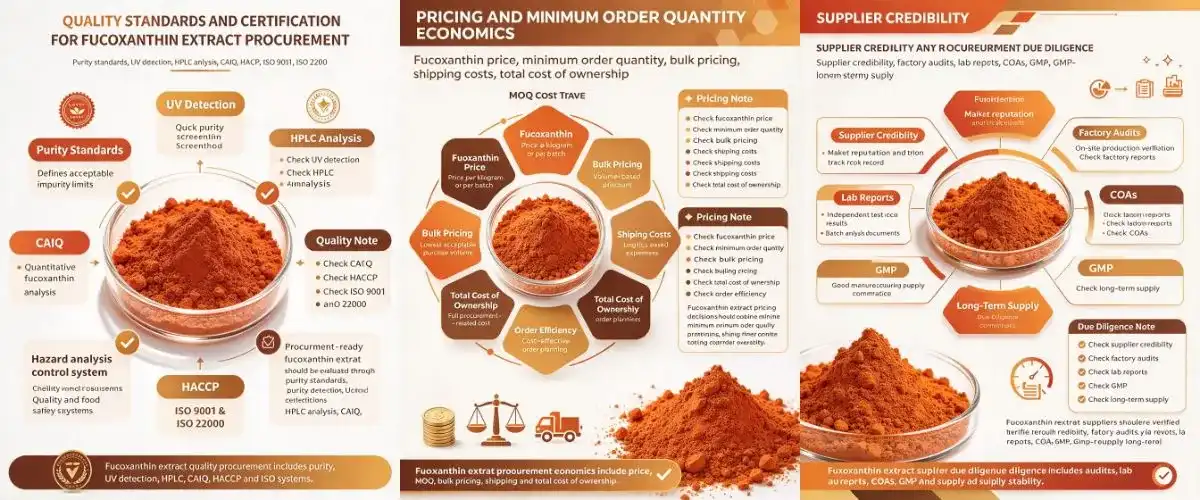
Making the Right Choice: Matching Product to Business Needs
What your product needs to do and how you plan to market its benefits will help you choose the right ingredient.
Dietary Supplements Targeting Weight Management
Standards-assured fucoxanthin extract powder is the better choice if your company is making a product to help people burn fat or support their metabolism. It meets the needs of North American customers and stores by having clinical support, a clean "marine-sourced" origin story, and a non-stimulant mechanism.
Broad Wellness and Functional Food Applications
If the product is meant to improve overall health, thyroid function, or gut health, a full-spectrum seaweed extract might be a better choice because it contains more nutrients and costs less per kilogram.
Supply Chain Sustainability and Market Trends
The global fucoxanthin extract powder market is expected to grow at a rate of more than 7% per year until 2030. This is because more people want natural ingredients that help them lose weight. Getting a long-term supplier deal with a manufacturer that keeps regular supplies on hand instead of buying in small amounts as needed lowers both the risk of price changes and running out of stock during busy times.
Conclusion
Which fucoxanthin extract powder or general seaweed extract to use depends on what you want your product to do and who you want to buy it. For managing weight and helping the metabolism, standardized fucoxanthin has more clinical proof, more concentrated effectiveness, and more marketing clarity than seaweed extract at the same amounts.
Seaweed extract is still useful for many health reasons when different vitamins and carbohydrates are wanted. Finding the right ingredient for your formulation strategy and a provider with good paperwork, licenses, and a reliable inventory is what makes the difference between a successful product launch and a costly redesign.
FAQ
What is the recommended daily dosage of fucoxanthin for weight management?
Clinical studies that have been published back taking between 2.4 mg and 8 mg of pure fucoxanthin every day. If the fucoxanthin extract powder is ≥10%, this means that each serving has 24 mg to 80 mg of raw material.
How should fucoxanthin extract be stored to maintain potency?
Keep below 20°C in sealed metal foil containers that block light. Fucoxanthin is easily damaged by light and heat. If you store it properly, it will stay active for 24 months.
Does fucoxanthin extract contain high iodine levels?
The vast majority of minerals are taken out of the algae biomass by supercritical CO₂ extraction. Suppliers can also offer de-iodized specifications (iodine <50 ppm) for products aimed at people with thyroid problems.
Is naturally extracted fucoxanthin different from synthetic versions?
Yes, natural fucoxanthin from brown algae has the exact trans-form stereochemistry that UCP1 needs to work. Synthetic versions of this biological action don't always work the same way, and in the U.S., dietary supplements have to list natural sources on the package in order to be legal.
Can I request a sample before committing to a bulk order?
Manufacturers with a good reputation will give you sample amounts so that you can check in the lab for purity, stability, and compatibility with other ingredients before you place a full order.
Partner with Sigma for Your Fucoxanthin Supply
Sigma gives brands all over North America and the world certified fucoxanthin extract powder. Our product is made by extracting supercritical CO₂ and is defined to have at least 10% active ingredient. It also comes with full HPLC batch testing and ISO, HACCP, and Halal approval. We keep a lot of stock on hand so that we can ship quickly (within 5–7 business days), and our OEM/ODM services are open. Visit sxsigma.com or email Sarah at sarah@sxsigma.com to get a free sample or bulk price from a reliable fucoxanthin extract powder supplier.
References
1. Abidov, M., Ramazanov, Z., Seifulla, R., & Grachev, S. (2010). Diabetes, Obesity and Metabolism, 12(1), 72–81.
2. Maeda, H., Hosokawa, M., Sashima, T., Funayama, K., & Miyashita, K. (2005). Biochemical and Biophysical Research Communications, 332(2), 392–397.
3. Miyashita, K. (2009). Journal of Oleo Science, 58(12), 617–625.
4. Peng, J., Yuan, J. P., Wu, C. F., & Wang, J. H. (2011). Marine Drugs, 9(10), 1806–1828.
5. Gammone, M. A., & D'Orazio, N. (2015). Marine Drugs, 13(7), 4677–4695.
6. Beppu, F., Niwano, Y., Tsukui, T., Hosokawa, M., & Miyashita, K. (2009). Journal of Nutritional Science and Vitaminology, 55(2), 186–191.