Why Choose a Pure Ashwagandha Extract OEM Supplier for Brands?
Brands sourcing adaptogenic ingredients today face a clear choice: work with a generic raw material broker or partner with a specialized OEM supplier who understands withanolide standardization, regulatory compliance, and formulation consistency. Pure ashwagandha extract—standardized to defined withanolide concentrations and verified by HPLC—is not a commodity. Its clinical value depends entirely on how it is produced, tested, and delivered. For procurement directors managing $300K–$1.5M in annual ashwagandha spend, choosing the right OEM partner directly affects product efficacy claims, batch consistency, and brand reputation.
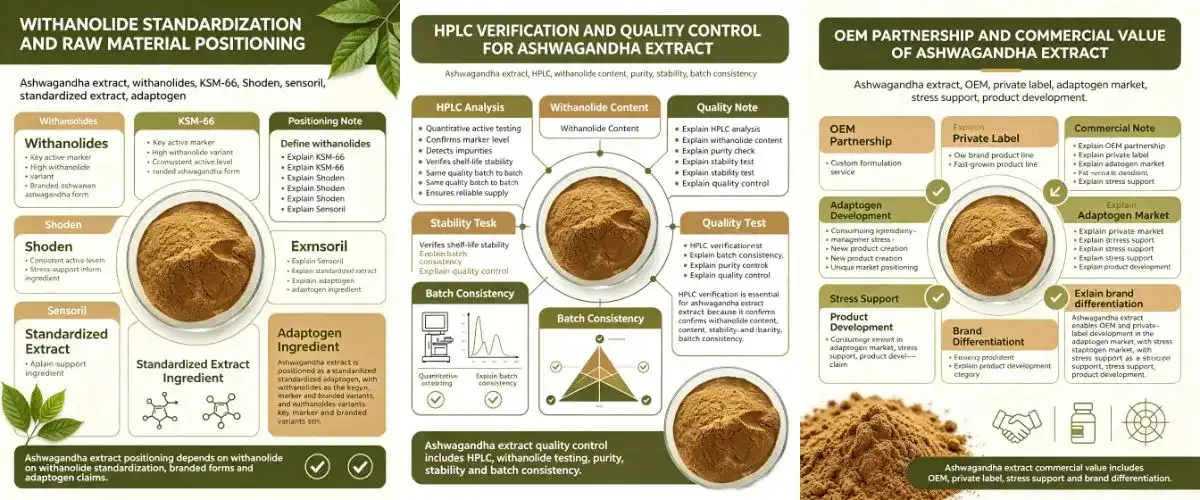
Understanding Pure Ashwagandha Extract and Its Market Demand
What Makes an Extract "Pure"?
Pure ashwagandha extract comes only from the roots of Withania somnifera. It is concentrated to separate bioactive withanolides from inactive cellulose and plant tissue. A real root-only extract is very different from mixed powders that contain leaf material, which has more Withaferin A, a chemical that is known to be cell-killing at high amounts. HPLC verification, not old gravimetric assays, is the standard way to make sure that withanolide is pure.
Extract vs. Powder vs. Branded Variants
Raw ashwagandha root powder usually has less than 1% withanolides and has a lot of microbes and varies a lot from batch to batch. Standardized extracts, like those made with 5% withanolides, deliver a dose that can be repeated and is useful for therapy in a much smaller volume. Branded chemicals, such as KSM-66 and Sensoril, come with their own extraction rights, which means they cost more. Standardized extracts that aren't branded but meet the same standards can be used by brands instead of existing patents, and they are legal and cost-effective.
Market Demand Driving Procurement Urgency
Ashwagandha is regularly ranked as one of the top three fastest-growing plant ingredients and the North American adaptogen supplement market grows at a rate of over 20% per year. The three main types of applications are stress relief, sleep support, and sports recovery. Brands that can guaranty a steady supply of high-quality raw materials during the busiest times in Q1 have a clear economic edge over those that have to buy on the spot.
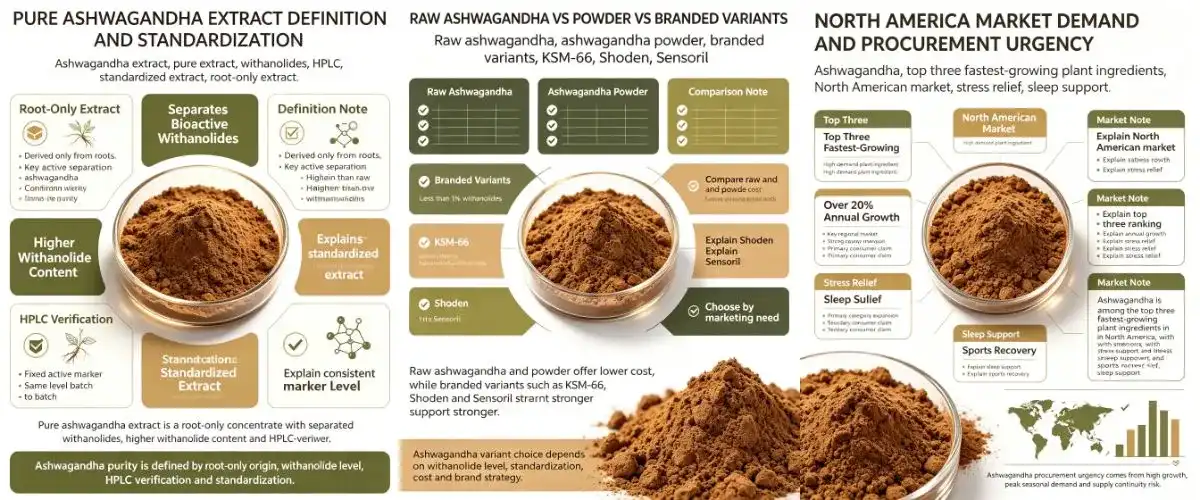
Challenges and Risks in Sourcing Pure Ashwagandha Extract
Adulteration and Mislabeling
The biggest quality risk in the pure ashwagandha extract supply chain is still fake or mixed with other products. Some suppliers cheat the withanolide test results by mixing leaf material or adding man-made withanolides to root powder. The only safe way to prove both species identity and active compound origin is to use DNA authentication along with third-party HPLC tests at accredited labs. Teams in charge of buying things should only accept certificates of analysis from independent labs and not just those given by suppliers.
Batch-to-Batch Inconsistency
If the amount of withanolide in a batch varies by more than 3%, it can cause problems with regulations and the way the product is made for brands that make functional claims on finished goods. A supplier that follows tested extraction protocols and keeps track of quality checks during the process can make sure that the potency stays the same across commercial-scale runs. When looking at different sources, you should ask for batch records from at least three different production lots.
Storage, Stability, and Regulatory Compliance
Ashwagandha extract absorbs water. To keep active compounds from breaking down, they need to be stored at low temperatures in sealed, moisture-barrier packages. For brands that want to sell in the U.S., which is regulated by the FDA, suppliers must follow cGMP guidelines and give stability data to back up claims about shelf life. Because the FDA is looking more closely at structure-function claims for adaptogens, brands need more than just specification sheets. They need safety dossiers for each ingredient.
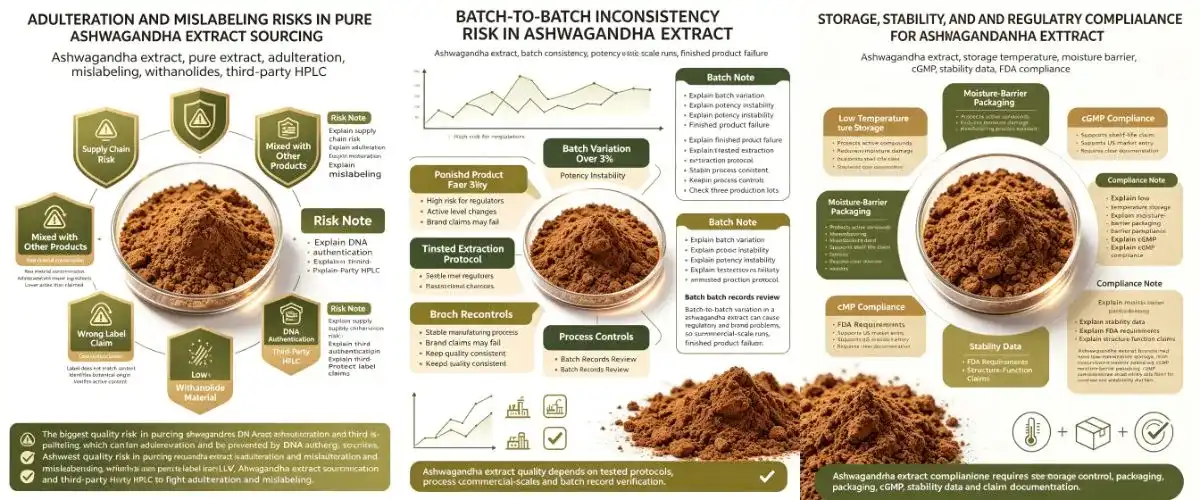
Why Partner with a Trusted OEM Supplier for Pure Ashwagandha Extract
Formulation Flexibility and Private Labeling
A good OEM partner does a lot more than just give raw materials. Brands can choose the extraction ratios, particle size (like 80 mesh for even mixing), moisture content (LOD ≤2%), and type of packaging (bulk drums, sachets, or pre-weighed lots for direct capsule filling). Support for private labeling lets procurement teams bring unique products to market without having to spend money on their own manufacturing infrastructure.
Here are the main skills that an ideal OEM partner for ashwagandha should have:
- Standardized active content: Withanolides ≥5% confirmed by HPLC-UV, with batch deviation ≤3%, supporting consistent label claims across production runs.
- Supercritical and ethanol extraction technology: Advanced extraction methods preserve thermolabile bioactives and minimize solvent residues, producing a cleaner, more bioavailable ingredient profile.
- Full certification coverage: ISO 22000, HACCP, Halal, and Kosher certifications address the documentation requirements of North American, European, and Middle Eastern distribution channels simultaneously.
When starting or expanding adaptogen product lines with pure ashwagandha extract, these features directly make it easier for buying and research and development teams to stick to rules and make new products.
Supply Chain Reliability at Commercial Scale
The operating standard that sets capable sellers apart from brokers is keeping 10–20 metric tons of ready-to-ship botanicals on hand, with a 5–7 business day delivery window. Seasonal ads by brands, especially for stress and sleep goods in the first quarter, can't make up for supply gaps caused by raw agricultural shortages. A vertically integrated manufacturer with roots in Shaanxi's botanical production regions manages sourcing, extraction, and quality control all along a single operational chain. This makes it less likely that third-party sourcing failures will happen.
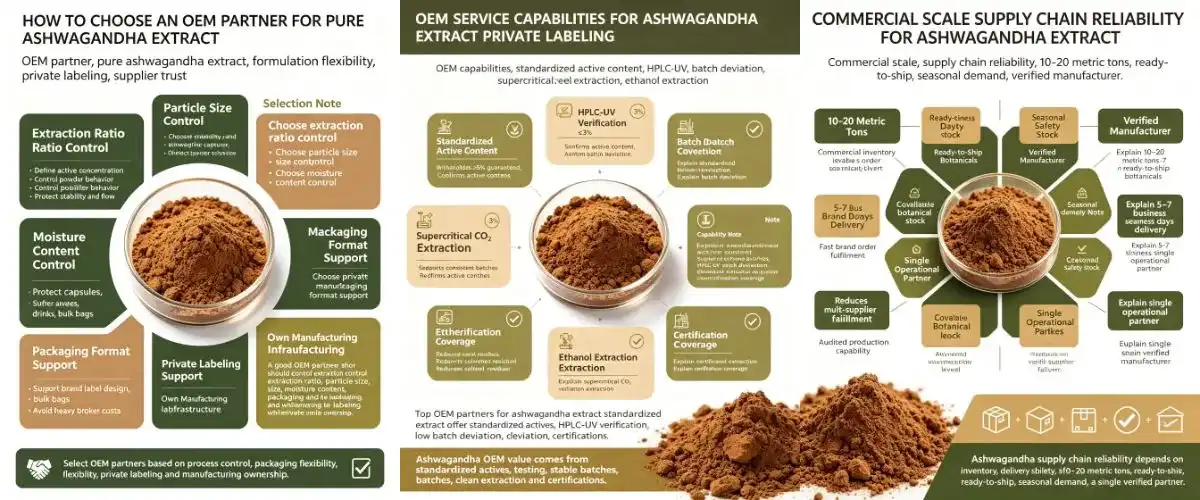
How to Evaluate and Choose the Right Pure Ashwagandha Extract OEM Supplier
Define Non-Negotiable Quality Criteria First
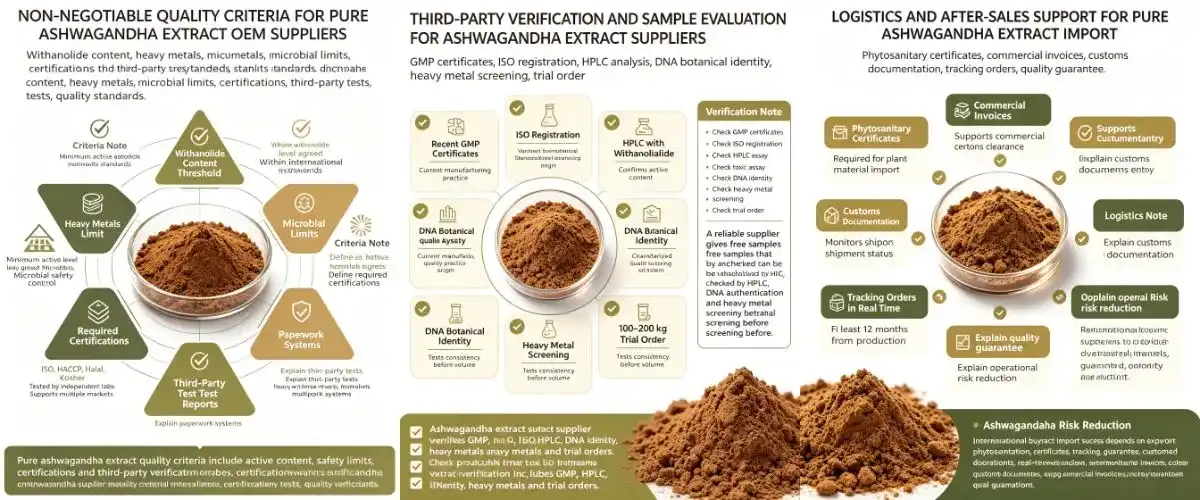
Before getting in touch with suppliers, the R&D and procurement teams should agree on the bare minimum of what is acceptable. This includes the withanolide content threshold, the acceptable heavy metal limits (that meet international standards like USP <2232>), the microbial limits, and the certifications that are needed. If a supplier can't give you third-party test results for every parameter within 48 hours of being asked, it's likely that they don't have the paperwork systems needed for controlled markets.
Verify Credentials and Request Samples
When judging a supplier, you should look at their most recent GMP certificates, ISO registration papers, and analytical results from a third party. A reliable supplier gives free samples that can be checked by a third-party lab for HPLC withanolide assay, DNA botanical identity, and heavy metal screening. Before signing an annual volume contract, the 100–200 kg trial order stage gives the best sign of how consistently the product is made.
Assess Logistics and After-Sales Support
For international business-to-business purchases of pure ashwagandha extract, suppliers must be able to provide established freight documentation, such as phytosanitary certificates, commercial invoices, country-of-origin documentation, and customs classification experience for dietary ingredient imports. Respondent contact after the sale, such as tracking orders in real time and a clear quality guaranty period (at least 12 months from the date of production), lowers operational risk in long-distance supply relationships.
Maximizing the Value of Pure Ashwagandha Extract in Your Product Line
Match Extract Specifications to Formulation Requirements
A 5% withanolides extract at 80 mesh works well in capsules, tablets, and powder sachets without sticking or not flowing well. To keep RTD drinks and liquid supplements from settling at acidic pH levels, they need water-soluble grade extracts with the right dispersibility profiles. If the particle size and solubility qualities are matched to the dose form during the sourcing stage, it will not be necessary to do expensive reformulation later on.
Use Clinical Data to Support Marketing Claims
According to the FTC and FDA, claims about stress, sleep, and recovery that are made to consumers need to be backed up at the ingredient level. When suppliers give brand marketing teams written clinical references, like peer-reviewed studies on Withania somnifera root extract, they have the proof they need to use structure-function language that is legal. This expert help sets us apart and isn't something we offer all the time.
Position Against Branded Extracts Strategically
Brands that used to use KSM-66 or Sensoril as ingredient anchors can switch to non-proprietary standardized root extracts that are just as effective as withanolide while lowering the cost of the ingredients by 30–50%. As part of the shift, HPLC testing and stability testing of the finished product must be done side by side. A trained OEM provider can help with these steps by providing technical paperwork and formulation advice.
Conclusion
To get standard pure ashwagandha extract on a large scale, you need to do more than just find a seller with good prices. It needs a supplier with tested extraction methods, a source for the raw materials that can be tracked, potency levels that are consistent with withanolide, and the legal paperwork to back up claims in both North American and global markets. Brands that put in the time to carefully qualify suppliers through things like sampling, third-party testing, trial orders, and contract terms build relationships with ingredient suppliers that protect product quality and help the business grow over the long term.
FAQ
How do I verify withanolide content independently?
Request a bulk sample and submit it to an accredited third-party laboratory for HPLC-UV analysis. Reliable suppliers provide their own COA and welcome external verification. Require the withanolide quantification method to be HPLC, not gravimetric, as the latter significantly overstates actual active content.
What is the recommended withanolide percentage for clinical applications?
Most peer-reviewed human trials use standardized root extracts at 2.5%–5% withanolides, dosed at 300–600 mg daily. For products targeting stress and sleep categories with structure-function claims, a 5% standardized extract provides the most defensible dose-to-claim alignment.
Does supercritical CO2 extraction affect withanolide stability?
Supercritical CO2 extraction operates at low temperatures, which protects heat-sensitive bioactives. This method also eliminates residual solvent concerns associated with conventional ethanol processing, producing a cleaner extract profile that meets Class 3 solvent residue limits under USP standards.
How should I store ashwagandha extract to maintain potency?
Store in sealed, moisture-barrier containers at low temperature (below 25°C), away from direct light. Proper storage conditions maintain active compound levels throughout the stated shelf life, typically 24 months from production date.
Partner with Sigma for Certified Pure Ashwagandha Extract Supply
Sigma has a yellow-brown fine powder ashwagandha extract with withanolides that has been standardized by HPLC. It is ISO/HACCP/Halal approved and always in stock. This ashwagandha extract is perfect for brands that can't afford quality changes or supply delays. We are a reliable company that makes pure ashwagandha extract and can do OEM work. We can support custom extraction ratios, mesh sizes, and private label packing. The best way to get a free sample and technical dossier is to email our team at sarah@sxsigma.com or go to sxsigma.com.
References
1. Nutrition Business Journal. Herb & Botanical Supplement Report. New Hope Network, 2023.
2. Chandrasekhar, K., Kapoor, J., & Anishetty, S. "A Prospective, Randomized Double-Blind, Placebo-Controlled Study of Safety and Efficacy of a High-Concentration Full-Spectrum Extract of Ashwagandha Root in Reducing Stress and Anxiety in Adults." Indian Journal of Psychological Medicine, 2012.
3. Wankhede, S., Langade, D., Joshi, K., Sinha, S. R., & Bhattacharyya, S. "Examining the Effect of Withania somnifera Supplementation on Muscle Strength and Recovery." Journal of the International Society of Sports Nutrition, 2015.
4. United States Pharmacopeia. USP General Chapter <2232>: Elemental Contaminants in Dietary Supplements. USP, 2021.
5. NutraIngredients-USA. "Ashwagandha Market Growth and Adulteration Risks in North American Supply Chains." NutraIngredients-USA, 2022.
6. Natural Products Insider. "Adaptogens in Dietary Supplements: Regulatory Considerations and Label Claim Substantiation." Informa Markets, 2023.