Where Can I Buy Bulk Senna Leaf Extract Powder Wholesale?
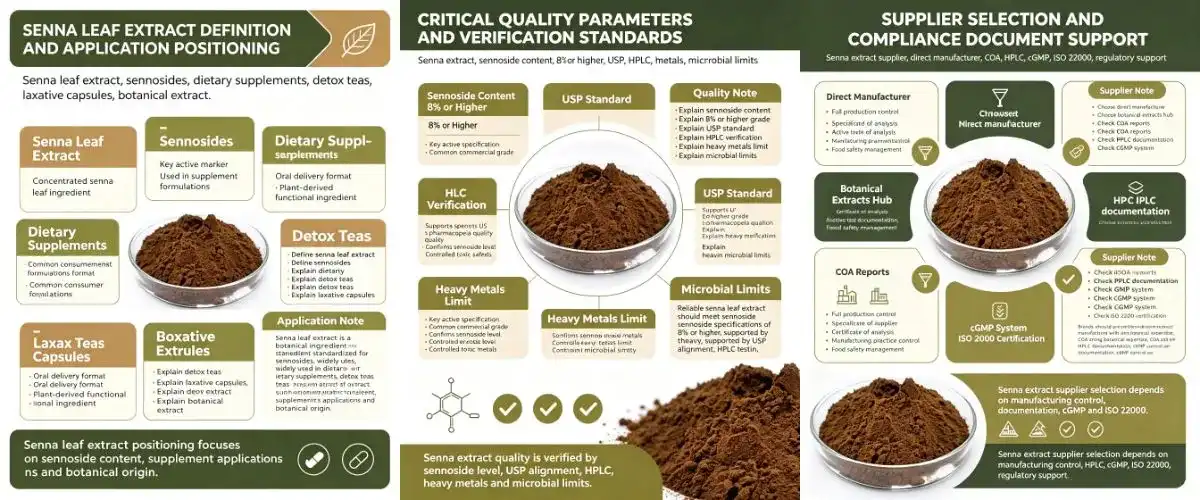
If you're sourcing bulk senna leaf extract powder for dietary supplements, detox teas, or laxative capsules, the most reliable options are direct manufacturers in botanical extract hubs like Shaanxi, China, verified suppliers on B2B platforms such as Alibaba, and established ingredient distributors serving the North American nutraceutical market. The key is finding a supplier who offers standardized sennosides content (≥8% or higher per USP), holds cGMP or ISO 22000 certification, and can provide full documentation including COA reports and pesticide residue testing. This guide walks you through exactly how to do that.
Understanding Senna Leaf Extract and Its Market Demand
Senna leaf extract powder comes from the dried leaflets of either Cassia angustifolia, which is also known as Indian Senna, or Cassia acutifolia, which is also known as Alexandrian Senna. By removing water and concentrating them under a vacuum, the process finds the active hydroxyanthracene glycosides, mostly Sennosides A and B, that make the colon move.
Why Standardized Extract Outperforms Raw Herb
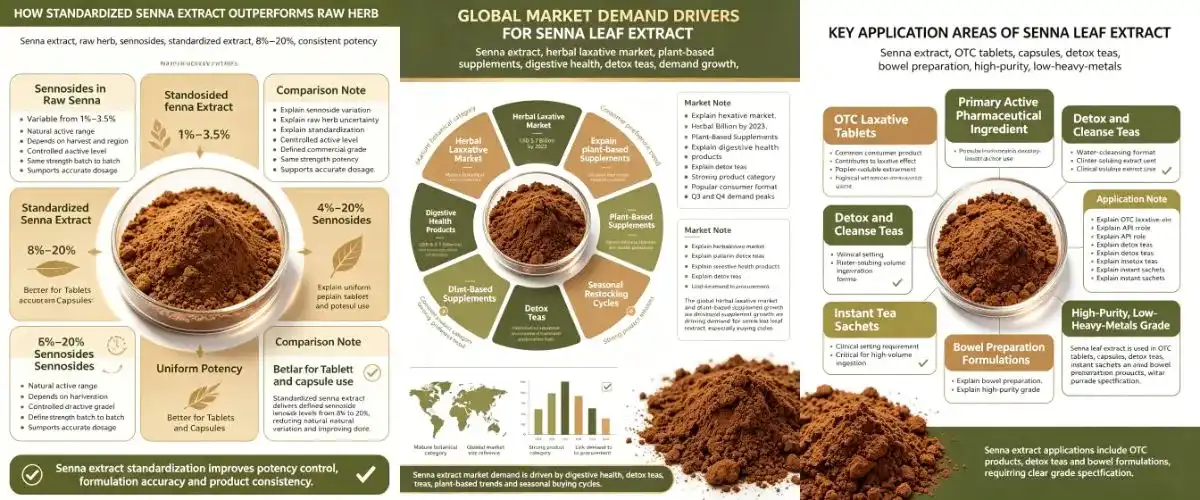
The amount of sennoside in raw ground senna leaf is hard to predict. It can be anywhere from 1.5% to 3.5%, depending on the harvest season and where it is grown. Standardized senna extract powder, on the other hand, keeps its strength at a set level, usually 8%, 20%, or higher. This lets formulators know exactly how much to use and how to make sure that the content is uniform for tablets and capsules.
Current Market Demand Drivers
The market for herbal laxatives is steadily growing around the world. Grand View Research estimated that the global laxatives market was worth more than USD 5.7 billion in 2023. Plant-based stimulant options were consistently becoming more popular. Demand for digestive health products, detox tea, and bowel prep products before surgery keeps driving up buying volumes, especially during the pre-season restocking cycles in Q3 and Q4.
Key Application Areas
Senna leaf extract is used in many production formats across many industries. These are the most common B2B use cases:
- OTC laxative tablets and capsules: The extract acts as the primary active pharmaceutical ingredient (API), where its flowability supports direct compression tableting with precise dose control.
- Detox and cleanse teas: Water-soluble grades of the extract blend well in instant tea sachets, delivering consistent peristaltic action without the variability of steeping whole leaves.
- Bowel preparation formulations: Used in clinical settings where high-purity, low-heavy-metal profiles are critical due to high-volume ingestion requirements.
In these application areas, buying things happens a lot, so supplier dependability is just as important as ingredient quality.
Key Factors to Consider When Buying Bulk Senna Leaf Extract Wholesale
Buying plant products such as senna leaf extract powder comes with real risks if the evaluation method isn't thorough. Before choosing a supplier, buyers should carefully look at these factors.
Active Ingredient Specification and COA
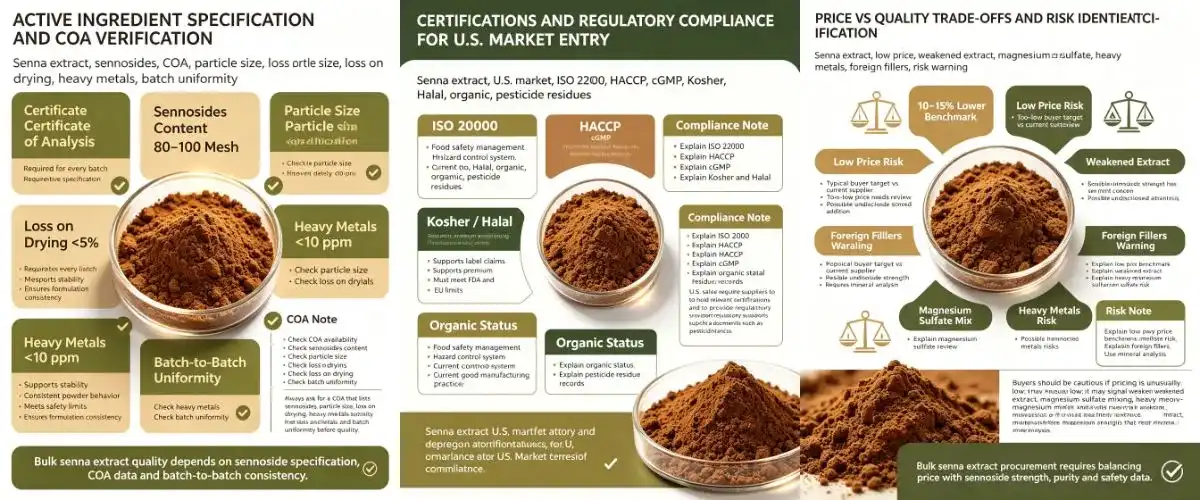
Always ask for a Certificate of Analysis (COA) that lists the amount of sennosides in each batch. A professional-grade extract should have a mesh size of 80 to 100 mesh, loss on drying of less than 5%, heavy metals less than 10ppm, and Sennosides greater than 20% (or the target titer your formulation needs). When your finished product has a label claim about its strength, batch-to-batch uniformity is a must.
Certifications That Matter for U.S. Market Entry
If your brand sells in the U.S., supplier certifications have a direct effect on how compliant you are. When it's possible, look for ISO 22000, HACCP, cGMP, and Kosher/Halal. Organic approval is important for high-end SKUs that are aimed at people who like clean labels. Every shipment should include regulatory support papers, such as pesticide residue records that are in line with FDA and EU limits.
Price vs. Quality Trade-offs
Most buyers in North America want the landed cost to be 10–15% less than their current supplier's benchmark. But prices that are too low usually mean that the extract has been weakened, that it has been mixed with inorganic salts like magnesium sulfate without being disclosed, or that heavy metal controls have been broken. Ask for an ash content test and a mineral analysis to make sure that the laxative effect comes from the standardized sennosides and not from any foreign fillers that were added.
Where to Find Reliable Bulk Sennosides Suppliers
There are many ways to source goods, and each one has pros and cons when it comes to price, quality, and speed of response.
B2B Online Platforms
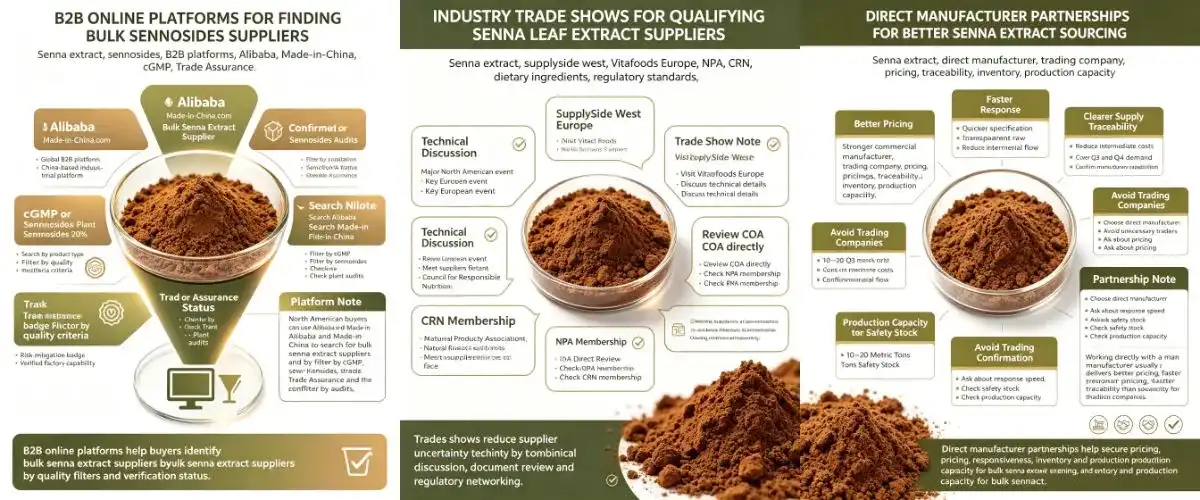
For North American buying teams, Alibaba International and Made-in-China.com are the best places to start. A search for "bulk senna extract supplier cGMP" or "sennosides 20% wholesale" will bring up a lot of results. You can sort the results by Trade Assurance status, answer rate, and confirmed plant audits. To directly ask for documents, you should always take the talk off-platform.
Industry Trade Shows
Verified ingredient makers of senna leaf extract powder show their goods at SupplySide West (Las Vegas) and Vitafoods Europe. Meeting the technical and export sales team of a supplier in person speeds up the qualification process and lets you review the COA directly. The NPA and CRN member directories also have a list of approved ingredient suppliers who are familiar with U.S. regulatory standards.
Direct Manufacturer Partnerships
Working directly with a manufacturer instead of a trading company usually leads to better pricing, faster response times to changes in specifications, and clearer supply chain traceability. You can avoid the supply problems that trading companies can't promise in Q3 and Q4 if you keep a safety stock of at least 10–20 metric tons of key ingredients and confirm your production capacity.
Comparing Bulk Senna Extract Options for B2B Buyers
There are different kinds of senna extract on the market that all do different things. Buyers should make sure that the product specs fit the needs of their production.
Pure Standardized Extract vs. Blended Powder
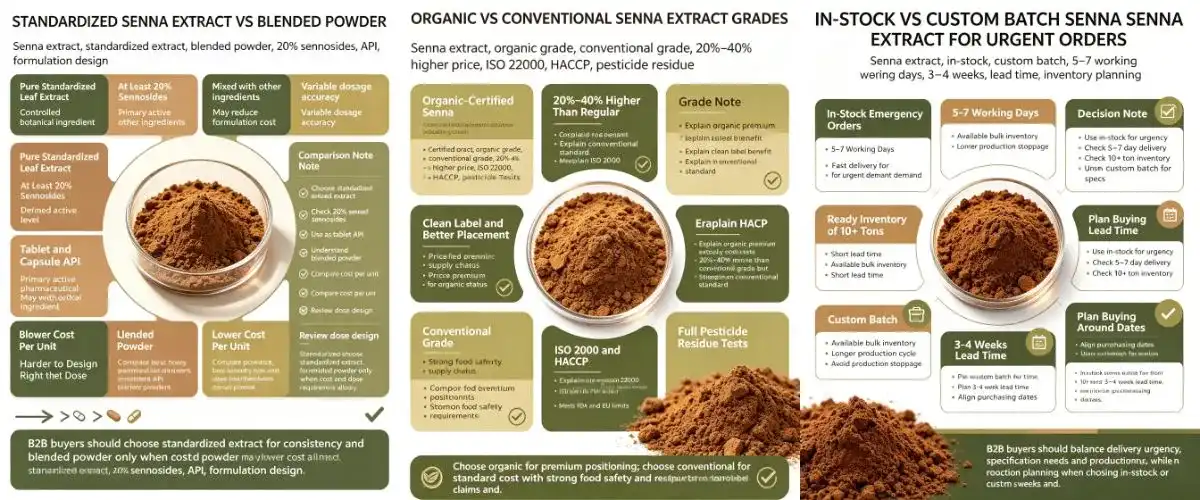
Pure senna leaf extract that is standardized to at least 20% sennosides gives tablet and capsule lines consistent API performance. Blended formulas that mix the extract with other ingredients might lower the cost per unit, but they make it harder to design the right dose. Always ask for a clean, unmixed product when it comes to pharmaceutical-grade uses.
Organic vs. Conventional Grade
Prices for organic-certified senna extract are about 20–40% higher than regular grades, but they can be used for clean labels and better placement in stores. For most supplement and tea uses, conventional extract that is made under ISO 22000 and HACCP standards and full pesticide residue tests meets the quality standard. It also doesn't cost more.
In-Stock vs. Custom Batch
Urgent orders can be filled within 5–7 working days by suppliers who have ready inventory (≥10 tons in stock). Custom extraction batches let you change things like particle size, wetness level, or certain sennoside ratios, but they usually need 3–4 weeks of lead time. Plan your buying around these dates to keep production from stopping.
Ensuring Safety and Compliance When Purchasing Senna Extract
Under its monograph for stimulant laxatives, the FDA lists sennosides from senna leaf extract powder as an over-the-counter (OTC) drug ingredient. Labels must have notes like "Do not use for more than one week." Suppliers that work with the U.S. market should know about these rules and give you proof to back up your label compliance review.
Pesticide Residue and Heavy Metal Testing
Since senna is a plant that is grown in fields, residues from farming tools pose a real quality risk. Need full reports on pesticide residues that meet EU MRL norms or USP <561>. Heavy metal tests should show that the levels of lead, arsenic, cadmium, and mercury are all well below 10ppm, or as low as your company's standards say they should be.
Storage and Handling Requirements
Senna leaf extract powder can hold water. Sennoside loses its effectiveness over time if it is stored incorrectly. For safe storage, double-layered PE bags sealed inside fiber drums must be kept in a cool, dry, dark place. Make sure that your provider sends with moisture-barrier packaging and desiccant packs.
Regulatory Support Documentation
Your compliance team will also need safety data sheets, country-of-origin certificates, and phytosanitary documentation to get the goods through customs. These will be ready ahead of time by a provider who knows how to follow U.S. FDA import processes.
Conclusion
To find bulk senna leaf extract powder, you need to do more than just compare prices. Buyers who put standard sennosides content, verified certifications, clear testing documents, and proven supply capacity at the top of their list of priorities will build stronger business relationships that last longer. When it comes to long-term suppliers, the difference between a good one and a bad one usually emerges not in the first shipment but in the fifth. Pay close attention to the qualification process, ask for samples before committing to a large order, and pick a supplier whose production infrastructure can grow with your brand.
FAQ
What sennosides content should I specify for capsule production?
For OTC laxative capsules, most formulators specify Sennosides ≥20% to allow precise dose titration at standard capsule fill weights. Some applications use 8% or 10% grades when working with higher fill volumes.
How do I verify that the extract hasn't been adulterated with inorganic salts?
Request an ash content test and specific mineral assay. Magnesium sulfate is the most common adulterant used to simulate laxative activity. A properly standardized extract derives all activity from hydroxyanthracene glycosides.
What is the typical MOQ for wholesale orders?
Most manufacturers set MOQ at 25–50 kg for initial trial orders. Volume pricing tiers typically begin at 100 kg and scale upward for annual framework agreements.
Can I get free samples before placing a bulk order?
Established manufacturers generally offer free samples (50–100g) with delivery within 7–10 business days for laboratory verification of sennosides content, solubility, and mesh size.
How should I store the extract after receiving it?
Keep it in its original double-PE-lined fiber drum in a cool, dry warehouse away from direct light. Avoid temperature fluctuations above 25°C to prevent moisture absorption and sennoside degradation.
Request a Sample from Sigma — Your Trusted Senna Leaf Extract Powder Supplier
Sigma (Shaanxi Sigma Biotechnology Co., Ltd.) makes senna leaf extract powder that is standardized to contain at least 20% sennosides and is certified to meet ISO 22000, HACCP, and Kosher standards. They keep 10–20 tons of this powder in stock and can ship it within 5–7 business days. Every order comes with full COA reports, testing for pesticide residue, and regulatory support documents. To start the qualification process right away, email Sarah at sarah@sxsigma.com with your needs or go to sxsigma.com to request a free trial.
References
1. Grand View Research. Laxatives Market Size, Share & Trends Analysis Report. 2023.
2. United States Pharmacopeia (USP). USP-NF Monograph: Senna. 2022.
3. European Medicines Agency (EMA). Herbal Monograph on Cassia senna L. and Cassia angustifolia Vahl. 2018.
4. U.S. Food and Drug Administration (FDA). OTC Monograph M011: Stimulant Laxative Drug Products. 2021.
5. Blumenthal, M., et al. The Complete German Commission E Monographs: Therapeutic Guide to Herbal Medicines. American Botanical Council, 1998.
6. Natural Products Association (NPA). Good Manufacturing Practices for Dietary Supplements: Compliance Guidelines. 2020.