What is Fucoxanthin Powder and Why Choose a Manufacturer?
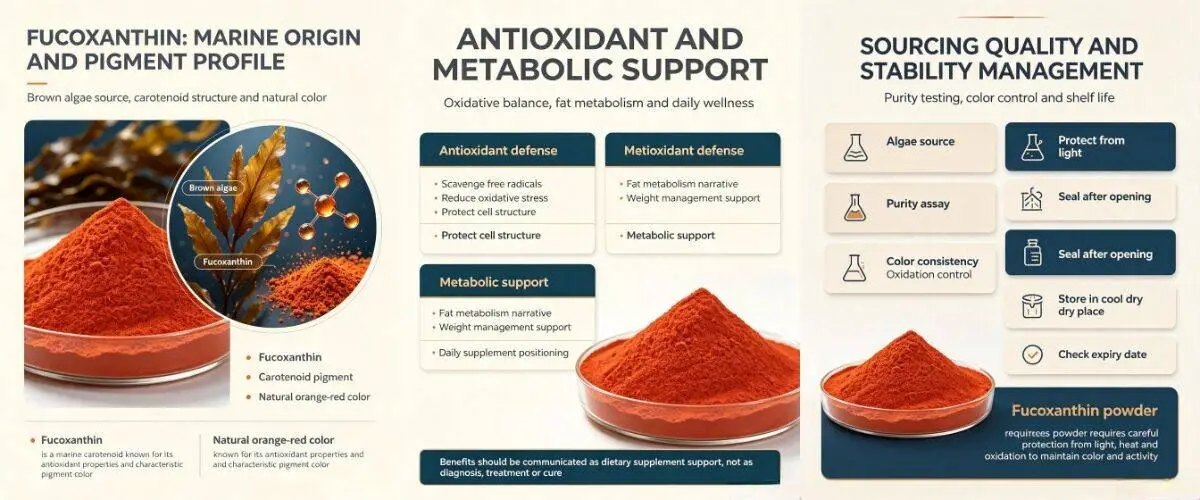
Fucoxanthin Extract Powder is a natural carotenoid that comes mostly from microalgae and brown seaweeds like Undaria pinnatifida. This fine brown powder is made up of concentrated beneficial substances that work as an antioxidant, reduce inflammation, and speed up the metabolism. Marine-sourced Fucoxanthin Extract Powder is better for you than synthetic versions because it is bioavailable and safe. This makes it a great ingredient for weight management products, functional drinks, and nutraceutical uses. Choosing the right manufacturer is important for B2B buyers in the food, dietary supplement, and pharmaceutical industries because it ensures consistent purity, batch-to-batch reliability, and compliance with international standards.
Understanding Fucoxanthin Powder: Composition and Benefits
What Makes Fucoxanthin Unique
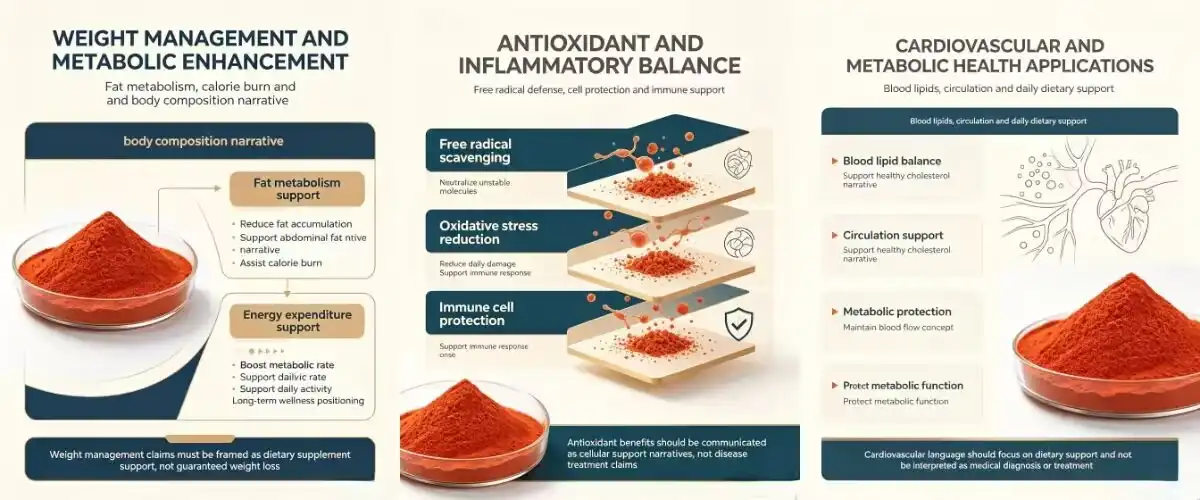
Fucoxanthin Extract Powder is a carotenoid from the xanthophyll family. It is different because it has an allenic bond and a 5,6-monoepoxide structure. Its molecular structure makes it easy for it to cross cellular barriers and reach white adipose tissue, where it increases the production of uncoupling protein 1 (UCP1). According to peer-reviewed clinical research, taking 2.4 to 8 mg of Fucoxanthin Extract Powder every day can help with thermogenesis and fat oxidation without making the central nervous system work harder.
Metabolic and Health Applications
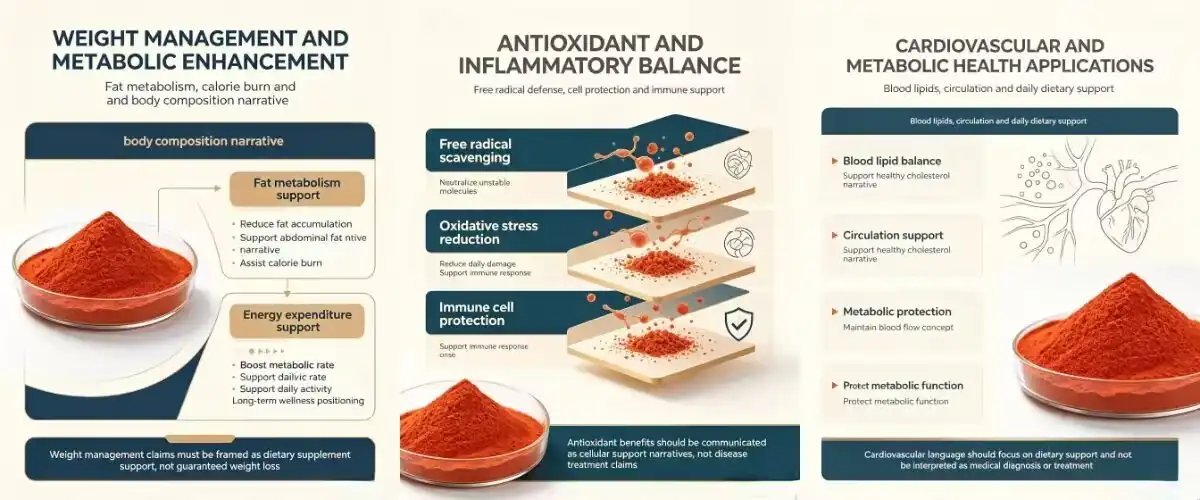
The compound works by increasing the activity of mitochondria in adipocytes. Over 16 weeks of intervention, studies with human subjects show statistically significant drops in body weight and waist circumference. Fucoxanthin Extract Powder helps with weight loss and also protects against oxidative stress, which is important for formulators who are making products for the metabolic syndrome, cardiovascular health, and anti-aging markets. It's not very harmful, as shown by LD50 values above 2000 mg/kg in rat models. This makes it a good alternative to manufactured fat-burning drugs that pose heart risks.
Quality Indicators for Procurement
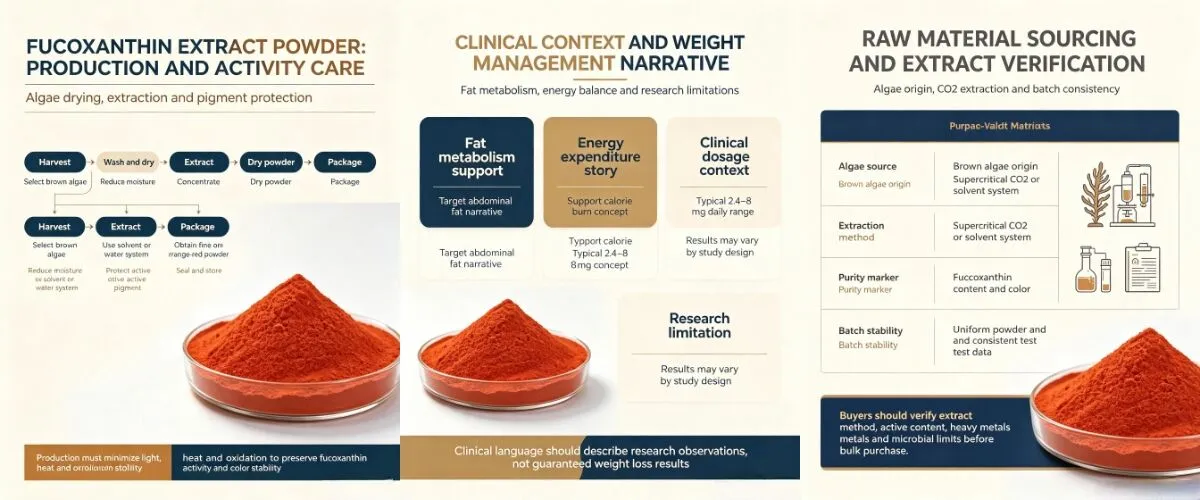
When looking at Fucoxanthin Extract Powder for industrial uses, procurement teams should focus on the concentration of the active ingredient, which is usually set at at least 10% Fucoxanthin Extract Powder. The supercritical CO2 extraction method keeps thermolabile chemicals while getting rid of solvent leftovers, which is an important thing to think about for clean-label positioning. Loss on drying requirements (≤3%) and heavy metal limits (≤10ppm) have a direct effect on the stability of the product and its ability to get regulatory approval in markets that have strict limits on contaminants.
Comparing Fucoxanthin Powder with Related Extracts and Forms
Fucoxanthin Versus Astaxanthin
Fucoxanthin Extract Powder and astaxanthin are both sea carotenoids, but they work in different ways in formulation methods. Astaxanthin mostly deals with oxidative stress in heart and eye tissues, while Fucoxanthin Extract Powder only deals with metabolism in fat tissues. The choice between these ingredients is based on the health benefits and the people who the product is meant for. Combination products that use both substances are popular with people who want complete metabolic and antioxidant support. However, these multi-carotenoid mixes need to be tested for stability to make sure they don't break down.
Powder vs. Encapsulated Delivery Systems
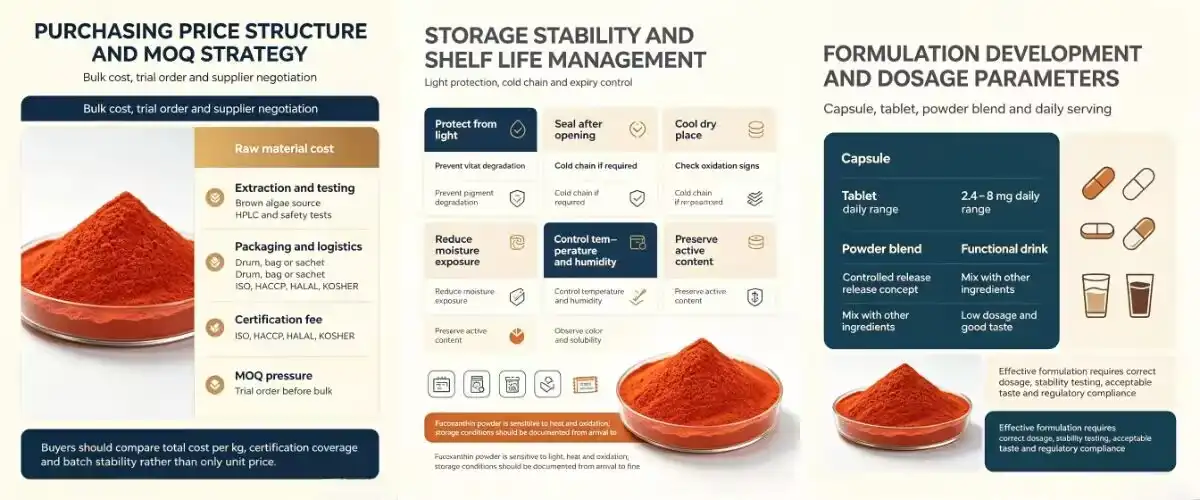
For B2B companies making custom dosage forms, raw Fucoxanthin Extract Powder gives them the most options. The 80-mesh particle size makes it easier for pills, capsules, and ready-to-drink drinks to spread out evenly. However, because the substance is sensitive to light and easily oxidized, it needs to be stored and processed in a way that keeps it safe.
Fucoxanthin Extract Powder itself must be handled under controlled lighting and inert atmospheres during manufacturing to prevent degradation before encapsulation. Using matrices like maltodextrin or modified starches in microencapsulation technologies makes things more stable in wet environments, but they raise the cost of production. When formulators choose delivery formats, they have to weigh the need for a long shelf life against the need to stay within budget.
Organic Certification and Market Positioning
The difference between standard Fucoxanthin Extract Powder and approved organic Fucoxanthin Extract Powder affects how a brand is positioned in high-end markets. For organic approval, the seaweed must come from marine areas that aren't polluted and must be processed according to rules that don't allow synthetic additives. Organic varieties cost 20–30% more, but they meet consumer needs for clear and environmentally friendly supply chains. To meet retailer requirements and make their products stand out on crowded shelves, B2B buyers aiming for European and North American markets are asking for dual certification—organic plus non-GMO verification.
Why Selecting the Right Fucoxanthin Powder Manufacturer Matters
Purity Verification and Testing Protocols
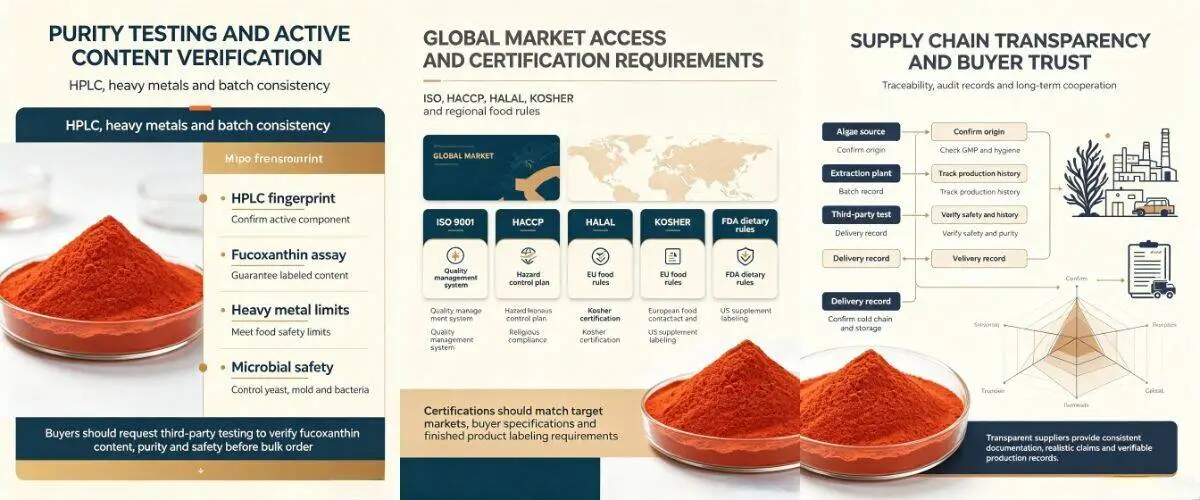
HPLC (High-Performance Liquid Chromatography) study by a third party proves the amount of Fucoxanthin Extract Powder present and finds impurities like cheaper carotenoid substitutes. Manufacturers with a good reputation give Certificates of Analysis (COA) for every batch of their products. These show the percentages of active ingredients, the physical parameters, and the results of any contaminant screenings. This openness lets R&D teams do useful stability studies and helps with regulatory submissions that need detailed ingredient documentation.
Advanced quality systems require manufacturers to test their products in more than one step, including checking the raw materials, keeping an eye on the process, and checking the finished product. With this multi-layered approach, deviations are caught before they hurt whole production runs. Purchasing managers should ask for past batch data to see how consistent things are across harvest seasons, since marine raw materials naturally vary and need skilled processing to make them the same.
Certifications and Compliance Infrastructure
The ISO 22000 and HACCP standards show that food safety is managed in a planned way. This is especially important for Fucoxanthin Extract Powder that is meant to be used in functional foods and dietary supplements. Certifications like Halal and Kosher make it easier for certain types of customers and areas to buy your products. In addition to basic licenses, companies that make medicines for other companies often have to follow GMP (Good Manufacturing Practice) rules. This means having stricter controls on the factory, training employees, and keeping records. A supplier's certification portfolio shows how well they can support global distribution strategies and deal with different regulatory environments.
Manufacturing Capabilities and Supply Reliability
Strategic partners are different from commodity suppliers because they can deliver custom specifications like changed extraction ratios, particle sizes, or blended formulations. Keeping a safety stock of 10 to 20 tonnes of core products, including Fucoxanthin Extract Powder, helps keep the supply chain running smoothly. This is especially helpful during busy times or when the environment makes it hard to harvest raw materials. Lead times of 5 to 7 working days from order confirmation to "ex-factory ready" make it possible for brands that are growing quickly or starting time-sensitive product campaigns to be flexible with their production schedules.
Buying Fucoxanthin Powder: Market Overview and Procurement Tips
Navigating Supplier Landscapes
There are three types of companies in the global Fucoxanthin Extract Powder market: vertically integrated manufacturers that control everything from growing the seaweed to extracting it, trading companies that buy from smaller producers and put together the output, and contract manufacturers that make unique mixtures. Vertically linked providers make it easier to track orders, but they may require bigger orders to start. Trading companies let you choose from a range of prices and grades, but the quality isn't always the same. Contract manufacturers are very good at making unique blends and dealing with complicated regulatory requirements for new uses.
Credential Verification Best Practices
The first step in doing your research before buying something is to make sure that the company's business licenses, production center registrations, and quality system certifications are real. Referrals from satisfied customers of well-known names that use similar products can help you understand how well the product works in real life, how reliable the delivery is, and how good the expert support is. Physical or virtual site audits show conditions in the factory, upkeep standards for equipment, and levels of staff knowledge that written records can't. Asking for inspection reports from outside groups like SGS or Intertek adds another layer of independent checking to the evaluation process.
Sample Evaluation and Pilot Scaling
Professional suppliers can provide samples weighing between 100 and 500 grams for early research and development testing. These samples are usually given for a small fee or for free to qualified prospects. An evaluation of the sample should include an organoleptic assessment (looking at color consistency and particle uniformity), solubility testing in target matrices, and accelerated stability studies that mimic the conditions of the finished product. When a sample works well, orders for 5 to 25 kilograms are placed as a pilot scale. This lets production trials happen that make sure the product can be processed and is profitable before committing to large buying contracts.
Future Outlook and Trends in Fucoxanthin Powder for B2B Buyers
Clean Label and Sustainability Demands
Demand for traceable, sustainably harvested marine botanicals, including Fucoxanthin Extract Powder, is driven by consumers who are more aware of where their food comes from. More and more, brands are asking suppliers to show proof that the ways they collect seaweed don't harm marine environments or make it hard for seaside communities to make a living.
Blockchain-based tracking systems are becoming a way to set products apart by letting customers check the origin of products by reading QR codes. Manufacturers have to spend money on digital infrastructure and third-party reporting as part of these openness efforts. Forward-thinking suppliers are willing to pay these costs in order to get premium market niches.
Bioavailability Enhancement Technologies
Nanotechnology and liposomal transport methods are the next big thing in Fucoxanthin Extract Powder formulation. They will help solve the problem of how poorly the chemical dissolves in water. Manufacturers of ingredients and academic institutions are working together on research that is leading to new delivery formats that are 2-3 times better at absorption rates than standard powder forms. These high-tech devices are currently very expensive, but as output grows and patents run out, more people will be able to afford them. This will change the competitive landscape in the functional ingredient sector.
Geographic Market Expansion
Asia-Pacific markets, especially Japan, South Korea, and China, are seeing a rise in the demand for health ingredients that come from marine sources. This is because traditional Asian diets stress eating seaweed. At the same time, Fucoxanthin Extract Powder is becoming more popular in both North America and Europe as more clinical evidence builds and regulatory pathways become clear. Manufacturers who set up dual-market capabilities—meeting both Asian notification requirements and Western novel food regulations—will be in a better position as international brand expansion and cross-border e-commerce continue to grow quickly.
Conclusion
Fucoxanthin Extract Powder is an ingredient that comes from marine life and has been scientifically proven to help the metabolism. It meets the growing demand from customers for natural metabolic support products. Because of its unique way of targeting adipose tissue and good safety ratings, the chemical is well-suited for use in dietary supplements, functional foods, and cosmetics. Getting Fucoxanthin Extract Powder-based products on the market depends on choosing the right manufacturers.
It's important to choose suppliers that provide consistent purity, keep strong quality systems, and offer flexible partnership models that can support custom formulation needs. Buying things after carefully checking credentials, testing samples, and looking at the supply chain lowers risks and encourages new ideas that take advantage of growing market opportunities in this group of ingredients.
FAQ
What is the recommended dosage of fucoxanthin for weight management products?
Clinical studies show that daily doses of 2.4 to 8 mg of pure Fucoxanthin Extract Powder work. These doses are usually split up and taken with meals that contain fat to help the body absorb them better. When B2B formulators figure out how much raw material they need, they should take into account the concentration percentage. For example, products with a 10% standardized extract need 24–80 mg of powder per serving to reach therapeutic levels. Regulating factors differ from place to place. Some places describe Fucoxanthin Extract Powder as a food supplement, which allows structure-function claims, while others need more safety information for higher-dose formulations.
How does fucoxanthin compare to green tea extract for metabolic applications?
Fucoxanthin Extract Powder and green tea catechins work in ways that support each other. Fucoxanthin Extract Powder increases thermogenesis in white adipose tissue, and EGCG from green tea decreases the activity of the catechol-O-methyltransferase enzyme, which changes the breakdown of norepinephrine. Combination formulas that use both ingredients show synergistic effects in clinical trials, producing greater body composition changes than either compound alone. When deciding whether to use a single ingredient or a mix of ingredients, product makers should think about the tastes and tolerances of the people they want to sell their products to.
Can I request samples before committing to bulk orders?
Professional manufacturers are happy to send samples to qualified B2B buyers who are developing products legally. Between 100 and 500 grams of samples are enough for tests to check for solubility, stability, and small-scale production. Reliable suppliers offer samples with COAs and technical data sheets, and they may do so for little or no cost to prospects who can clearly see when they can start selling the product. Sample policies aren't all the same, so making sure you understand the terms during the first questions sets realistic goals and shows professionalism in procurement.
Ready to Source Premium Fucoxanthin Extract Powder?
Shaanxi Sigma Biotechnology provides Fucoxanthin Extract Powder that is pharmaceutical-grade and standardized to ≥10% active content. This is done through supercritical CO2 extraction, which leaves no solvent waste and maximizes absorption. Our ISO 22000, HACCP, and Halal certifications make sure that we meet global food safety standards. We also keep 10–20 tonnes of safety stock on hand so that we can deliver within 5–7 working days.
Each batch goes through a thorough heavy metal screening and strict HPLC pure verification. Our expert team can help you optimize your formulas and give you full paperwork packages, whether you need large amounts for mass production or formulas that are specifically made for your needs. Get in touch with our purchasing agents at sarah@sxsigma.com to ask for samples, talk about your project needs, and find out why top supplement companies choose Sigma as their long-term Fucoxanthin Extract Powder supplier.
References
1. Maeda H, Hosokawa M, Sashima T, Miyashita K. "Dietary combination of fucoxanthin and fish oil attenuates the weight gain of white adipose tissue and decreases blood glucose in obese/diabetic KK-Ay mice." Journal of Agricultural and Food Chemistry, 2007; 55(19): 7701-7706.
2. Abidov M, Ramazanov Z, Seifulla R, Grachev S. "The effects of Xanthigen in the weight management of obese premenopausal women with non-alcoholic fatty liver disease and normal liver fat." Diabetes, Obesity and Metabolism, 2010; 12(1): 72-81.
3. Peng J, Yuan JP, Wu CF, Wang JH. "Fucoxanthin, a marine carotenoid present in brown seaweeds and diatoms: metabolism and bioactivities relevant to human health." Marine Drugs, 2011; 9(10): 1806-1828.
4. Miyashita K, Nishikawa S, Beppu F, Tsukui T, Abe M, Hosokawa M. "The allenic carotenoid fucoxanthin, a novel marine nutraceutical from brown seaweeds." Journal of the Science of Food and Agriculture, 2011; 91(7): 1166-1174.
5. Beppu F, Niwano Y, Tsukui T, Hosokawa M, Miyashita K. "Single and repeated oral dose toxicity study of fucoxanthin, a marine carotenoid, in mice." Journal of Toxicological Sciences, 2009; 34(5): 501-510.
6. Zhang H, Tang Y, Zhang Y, Zhang S, Qu J, Wang X, Kong R, Han C, Liu Z. "Fucoxanthin: A promising medicinal and nutritional ingredient." Evidence-Based Complementary and Alternative Medicine, 2015; Article ID 723515.


_1776308368292.webp)