What is Butterfly Pea Flower Extract?
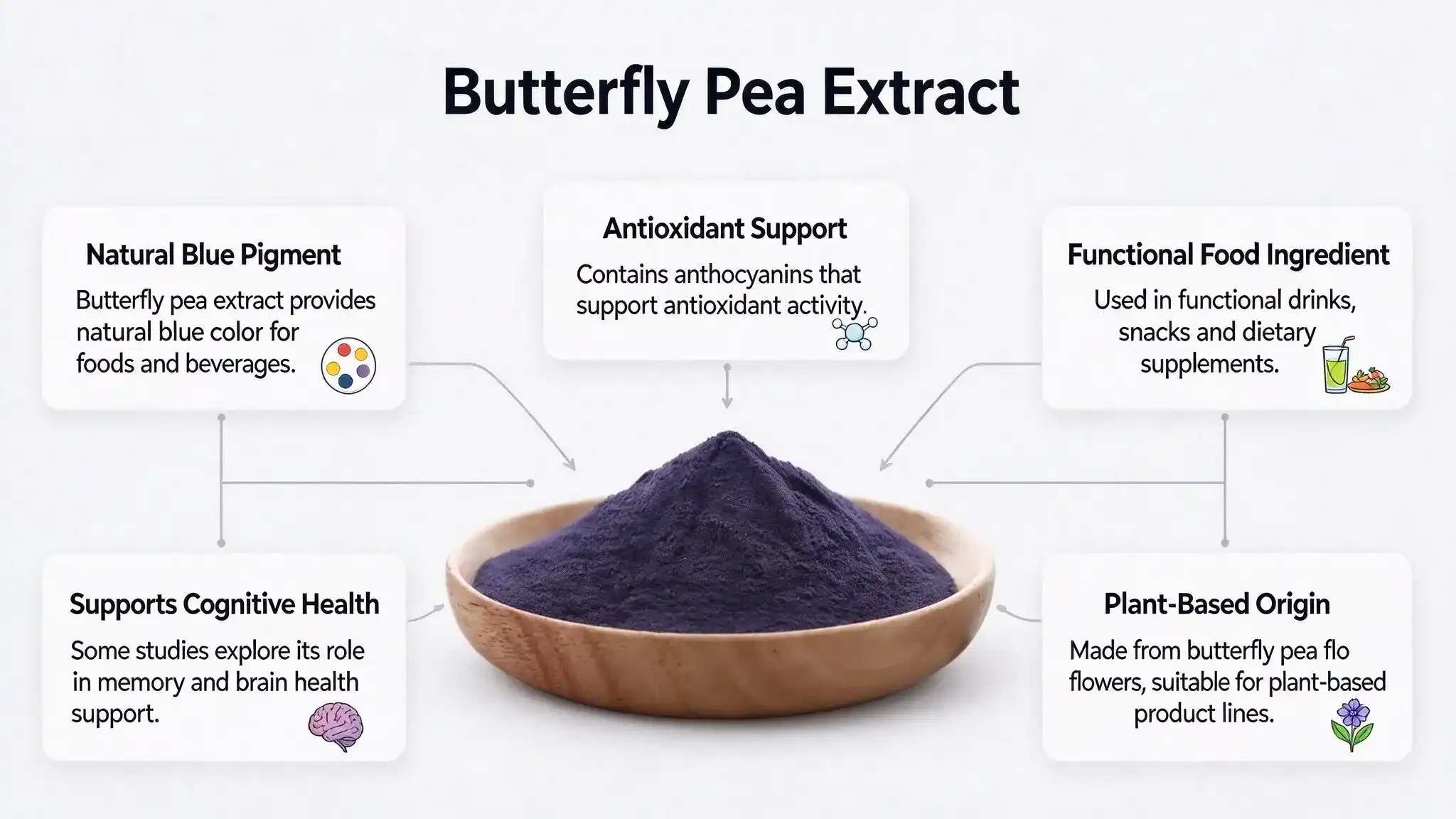
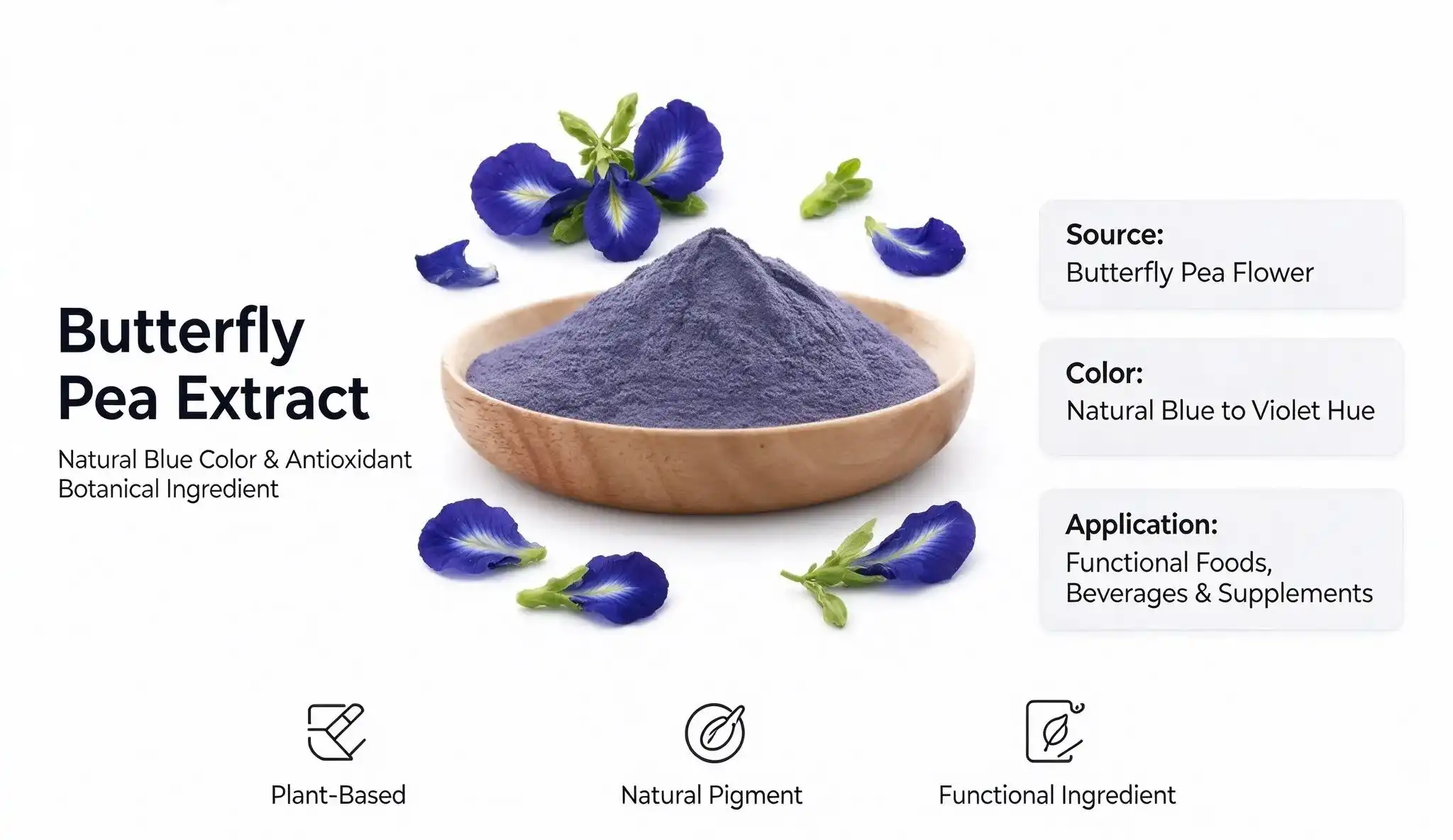
Butterfly Pea Flower Extract is a concentrated botanical ingredient derived from the vibrant petals of Clitoria ternatea, a tropical plant native to Southeast Asia. Unlike raw flower powder, this extract undergoes sophisticated water-ethanol extraction processes that isolate and concentrate anthocyanins—potent acylated ternatins responsible for its striking blue pigmentation and antioxidant properties. The result is a fine blue powder standardized to contain at least 25% anthocyanins, offering natural colorant capabilities with functional bioactive benefits. This ingredient addresses a critical industry pain point: the growing demand for clean-label alternatives to synthetic dyes while delivering consistent quality for large-scale manufacturing. Its unique pH-sensitive color-changing mechanism—transitioning from deep blue in neutral conditions to purple and pink in acidic environments—makes it particularly valuable for product developers seeking both aesthetic appeal and functional innovation.
Natural ingredients are reshaping B2B procurement strategies across multiple sectors, including cosmetics, nutraceuticals, food and beverage, and pharmaceuticals. As procurement managers and R&D teams search for alternatives to synthetic additives, understanding the technical specifications, quality parameters, and application versatility of botanical extracts becomes essential. This comprehensive guide provides decision-makers with the technical insights needed to evaluate suppliers, assess product quality, and integrate this botanical ingredient into formulations that meet regulatory standards and consumer expectations.
Understanding Butterfly Pea Flower Extract
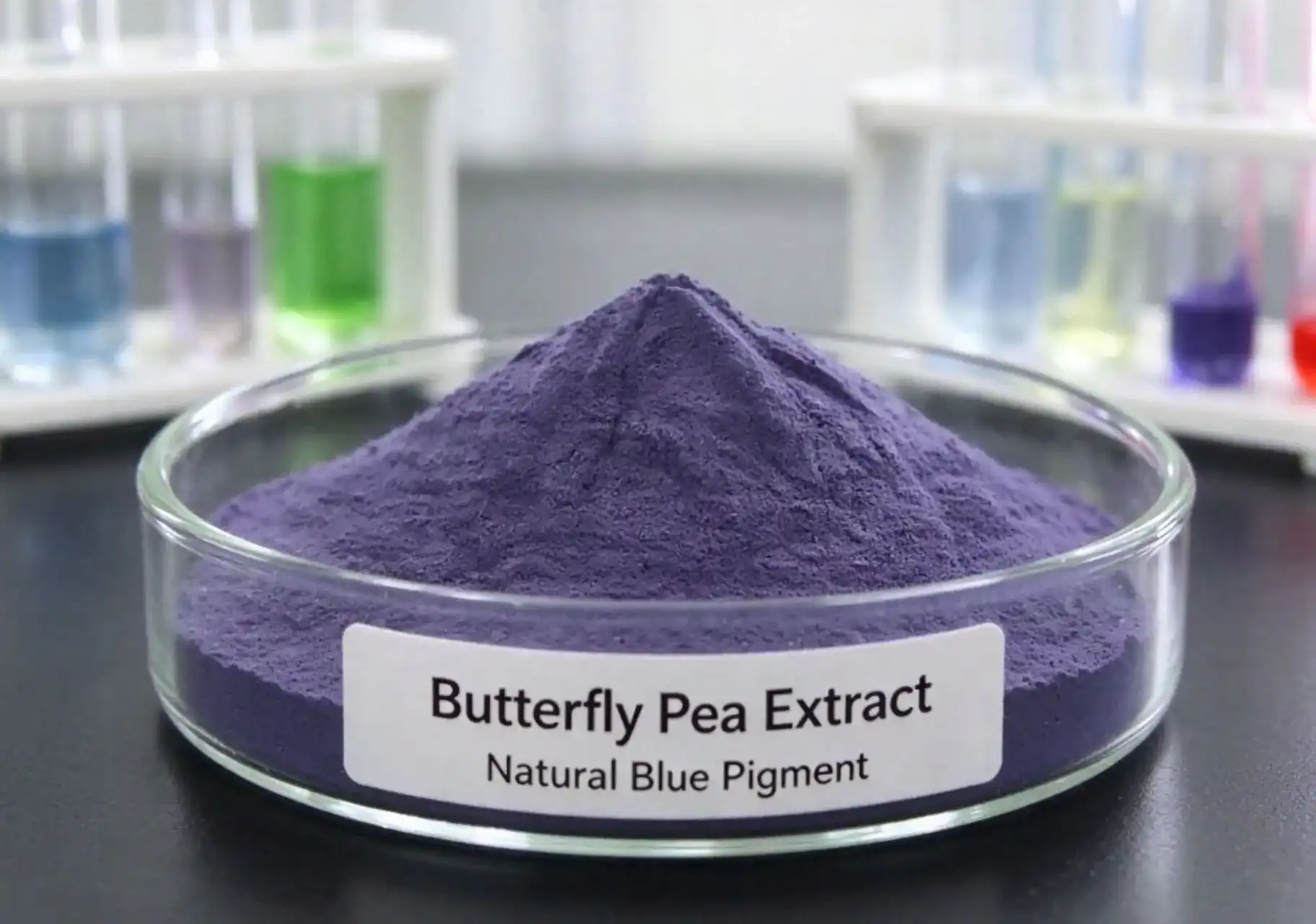
Butterfly Pea Flower Extract comes from the plant Clitoria ternatea, which is also known as Asian pigeonwings or blue pea vine. Usually, water-ethanol methods are used for the extraction process. These methods protect the delicate anthocyanin compounds while getting the best absorption and stability. The end result is a fine blue powder with a mesh size of 100. This makes sure that the particles are spread out evenly, which is important for consistent formulation performance.
Chemical Composition and Active Compounds
Anthocyanins are the main beneficial ingredient. It is the delphinidin-based ternatins that make this extract different from other forms of anthocyanins, like grape skin or berries. The normal concentration of at least 25% anthocyanins makes the colour intensity and antioxidant activity reliable. The extract keeps its pH level between 3.0 and 5.0, and its loss on drying is kept at ≤5%. This makes sure that it stays stable on the shelf and is consistent from batch to batch, which are important for manufacturers who need their supply chains to work reliably.
The antioxidant profile is more than just giving colour. Researchers have found that ternatins can get rid of free radicals and may help brain function by protecting neurones. Because it has these bioactive properties, the extract can be used for more than one thing instead of just colouring, which makes products for health-conscious people more valuable.
Extraction Technology and Quality Advantages
Modern production uses ultra-fine grinding and low-temperature drying to keep the safety of the anthocyanins and get fast water solubility without leaving behind any residue or off-flavors. This technological improvement solves a problem that formulators often have: keeping colours bright without changing the taste profiles in beverage apps. Through strict testing methods, the extraction process gets rid of worries about solvent leftovers, making sure that it meets FDA and EU food safety standards.
Key Benefits and Applications in Various Industries
This botanical extract is useful in many different industries, and each one uses different properties to deal with formulation problems and meet market needs. When buying teams understand these uses, they can find smart chances to improve and differentiate products using Butterfly Pea Flower Extract.
Food and Beverage Applications
Companies that make drinks have started using this natural colourant to make goods that look great and change colour depending on the pH level. Teas, lemonades, cocktails, and sports drinks that change colour use the extract's unique ability to turn blue to purple when acidic ingredients like lemon juice are added. This interactive feature gives customers unique experiences while still following clean label guidelines.
Some non-dairy uses for the extract are in liquid coffee creamers and plant-based drinks, where it adds a natural blue colour without any added chemicals. The powder mixes easily into frozen desserts, puddings, yoghurts, and baked goods, giving them a uniform colour. The extract is stable during processing, so it can be used in both cold and hot situations. However, it is important to keep the pH level under control to keep the colour.
Cosmetic and Personal Care Formulations
Skincare companies use this extract because it is an antioxidant that helps keep collagen and elastin strong, which may slow down the signs of ageing. Face masks, lotions, and serums can benefit from both the bioactive compounds that do something useful and the natural blue colour that lets customers know the product is made from plants. Because it reduces inflammation, it can be used in formulations for sensitive skin that help with redness and irritation.
Hair care products use the extract's antioxidant properties to fight against environmental stressors, which is good for the skin and helps hair grow. The natural pigment can also be used to add temporary colour to special formulas. Bath goods take advantage of the way blue bathwater looks to make spa-like experiences that are in line with health trends.
Nutraceutical and Dietary Supplement Integration
Manufacturers of health supplements know that the extract can help protect cells from oxidative stress by acting as an antioxidant. Formulations that help with brain function, weight management, and general health use this ingredient because it works well and tastes good. The standard amount of anthocyanin makes it possible to do accurate dosing calculations, which is important for supplement fact panels.
Research groups and contract research organisations (CROs) that are looking into using natural compounds in medicine study how ternatins connect with biological processes. The anti-glycation qualities look promising for metabolic health study, and the neuroprotective effects mean that more research needs to be done on how they can be used to help with cognitive functions.
Quality and Safety Considerations for B2B Procurement
When analysing providers, people who work in procurement have to deal with a lot of complicated quality criteria. The technical specs of a trustworthy Butterfly Pea Flower Extract set the stage for consistent recipe performance and regulatory compliance.
Critical Quality Control Parameters
For professional procurement, strict, multi-stage inspection protocols are needed. High-Performance Liquid Chromatography (HPLC) measures the amount of anthocyanin to make sure that claims of potency are true, making sure that the ≥25% standard is always met. HPTLC fingerprinting verifies the botanical identity and finds possible adulteration with cheaper anthocyanin sources, which protects the integrity of the brand and the safety of the consumer.
Microbiological screening checks for safety by looking at the Total Plate Count (ideally less than 1,000 CFU/g), the Yeast and Mould counts (less than 100 CFU/g), and the lack of pathogens like E. Salmonella, E. coli, and Staphylococcus aureus. These factors are especially important for ready-to-drink products and vitamins that are taken straight away.
ICP-MS (Inductively Coupled Plasma Mass Spectrometry) study of heavy metals checks that strict limits on Lead, Arsenic, Cadmium, and Mercury are met, making sure that international safety standards are met. Multi-residue pesticide analysis proves that the methods used for growing and harvesting meet USP/EP standards and, if necessary, organic certification requirements.
Certification and Regulatory Compliance
Quality assurance includes more than just testing. It also includes full certification portfolios. ISO 22000 and HACCP standards show that food safety is managed in a planned way throughout the production process. Halal and Kosher certifications help suppliers who sell to religiously strict customers get into more markets. Following the rules for FDA GRAS notice or EU Novel Food status makes sure that the food will be accepted by regulators in the places it is meant for.
The fact that the extract is Generally Recognised as Safe gives trust for uses in food and drinks. When used in cosmetics at the suggested concentrations, the ingredient's well-established safety profile also helps. Batch-to-batch consistency, which can be checked with COA (Certificate of Analysis) paperwork, makes sure that quality standards stay the same across procurement cycles, which is a must for large manufacturers.
Storage and Stability Requirements
Anthocyanin stays stable and doesn't break down as long as it is stored properly. Product integrity is maintained for the given shelf life as long as sealed packages are kept in cool, dry places away from light. The low moisture content (≤5% loss on drying) stops microbes from growing and prevents caking. This keeps the powder free-flowing and easy to work with during production.
Testing for stability under accelerated conditions gives information on how quickly substances oxidise and lose their colour when exposed to UV light. This information helps formulators figure out the right packing requirements for produced goods. By knowing these factors, buying teams can discuss the best order sizes that balance saving money on costs with keeping products fresh.
Butterfly Pea Flower Extract Market and Supplier Evaluation
Strategic supplier selection greatly impacts supply chain dependability, product quality, and competitive placement. To evaluate possible partners for Butterfly Pea Flower Extract, you need to take a thorough look at their professional skills, quality systems, and service infrastructure.
Supplier Qualification Criteria
Leading sellers stand out because they have research and development (R&D) departments that help with formulating better and fixing problems. Having access to expert staff who understand problems unique to certain applications, like keeping the colour stable in clear drinks or getting the best dispersion in oil-based cosmetics, is very helpful in addition to just providing the ingredients.
Infrastructure for manufacturing is very important. Suppliers who run modern factories with constant countercurrent extraction lines show that they care about quality and efficiency. Low-temperature concentration and fine separation purification technologies show high level of technical skill, which leads to better product qualities. Vertical integration, which includes getting the raw materials and packing them all the way through, gives you more control over quality and supply consistency.
The ability to manage inventory has a direct effect on the flexibility of procurement. Suppliers who keep 10–20 tonnes of key products in reserve can fill orders within 5–7 business days, which helps just-in-time manufacturing strategies. This flexibility means that customers don't have to keep too much material on hand, and production plans stay on track.
Evaluating Quality Systems and Documentation
Full quality control tools allow tracking from the botanical source to the end product. Suppliers should give COA paperwork with test results for each batch, an MSDS sheet with information on how to handle the material safely, and stable data to back up claims about the shelf life. Even though clinical research documentation isn't always useful, it shows that you want to understand how the ingredient works.
When quality management systems get ISO 9001 approval, it means they meet international standards for consistency and ongoing growth. The ISO 22000 and FSSC 22000 standards focus on food safety management, which is very important for items that will be eaten. Having more than one appropriate license shows that quality is handled in a planned way, not just by following the rules.
Being clear about where the raw materials come from boosts trust in the ethics and longevity of the supply chain. Suppliers who can show proof of botanical origin, cultivation methods, and fair trade partnerships show business duty, which is becoming more important to both end customers and buying decision-makers.
Pricing Structures and Value Assessment
When looking at competitive pricing, quality standards must be taken into account. Cheaper choices might have less anthocyanin, a less stable particle size distribution, or testing methods that aren't as strict. Comparing prices based on cost-per-kilogram is not as useful as comparing prices based on cost-per-unit of active ingredient.
When you buy in bulk, you usually get better prices, but the minimum order quantities need to match your storage and consumption rates. Long-term supply deals can lock in good prices and make sure there is a steady supply of goods, but you have to trust that the seller will be stable and do a good job. Budgeting and financial forecasting are easier when payment terms are flexible and prices are clear and don't have any secret fees.
How to Use Butterfly Pea Flower Extract in Your Products?
To make a good formulation, you need to know about dosage parameters, stability issues, and how well the ingredients work with each other in a variety of application settings. Successful integration of Butterfly Pea Flower Extract requires careful balancing of these technical factors.
Formulation Guidelines by Application
For beverage uses, a quantity of 0.1-0.5% is common, but it depends on the pH level and colour strength that is wanted. The extract mixes easily with water, but in ready-to-drink formats, it may need to be filtered or clarified before it is as clear as it can be. Formulators should think about how the pH of a product can change the colour of it. This can be done on purpose (to make interactive color-changing goods) or with the help of balancing systems.
A quantity of 0.5 to 2% in water is common in cosmetic formulas. It's easy for the extract to mix into emulsions, gels, and serums, and testing it for compatibility with certain surfactant systems and preservatives makes sure it stays stable over time. To get a uniform spread for oil-soluble materials, you need to use special dispersion methods or microencapsulation.
The amount of anthocyanin in a supplement is more important than its colour effects. The small particles and low moisture content of the extract make it good for encapsulation because they help the formulations flow well. Supplements that look like drinks use the colour and the antioxidant properties at levels that give each serving 25 to 100 mg of anthocyanins.
Stability Optimization Strategies
Paying attention to pH, light exposure, and temperature will help keep the colour vibrant for as long as the product is on the shelf. Buffering systems keep the pH level of drinks stable so that colours don't change accidentally while they're being stored. UV degradation can be stopped by opaque or amber packaging, which keeps colours longer. Synergistic stability may be provided by antioxidant systems, but interactions don't have to hurt effectiveness by being tested for compatibility.
Different uses call for different heat handling concerns. The extract can handle mild temperatures when beverages are pasteurised, but anthocyanins break down after being exposed to high temperatures for a long time. Bioactivity and colour richness are kept at their highest levels during cold-fill or aseptic processes. For baking uses, testing is needed to find the best incorporation places that keep heat contact to a minimum.
Flavour matching is important, especially when it comes to food and drinks. When used at colourant concentrations, the extract doesn't add much flavour on its own, but at higher levels, it may give off faint earthy notes. Flavour masking agents or complementary flavour profiles make sure that the product is acceptable to consumers while still achieving the desired visual effects.
Conclusion
Butterfly Pea Flower Extract is a useful natural ingredient that looks beautiful and has useful bioactive qualities that can be used in food, drinks, cosmetics, and supplements. Knowing the technical details, like the amount of anthocyanin, how it was extracted, and quality standards, helps sourcing workers choose suppliers that will help with formulation success and regulatory compliance. The unique pH-sensitive color-changing qualities of the extract make it possible to differentiate products and meet customer demands for clean labels. Premium providers that can meet large-scale manufacturing needs are set apart by strict quality control, thorough certifications, and stable supply lines. Strategic partnerships with qualified suppliers give you access to technical know-how, a range of customisation options, and quick, helpful service that goes beyond just providing ingredients and includes working together to create new products.
FAQ
What is the typical shelf life of butterfly pea flower extract powder?
The powder stays at its best for 24 months after it was made as long as it is kept in sealed containers out of the light and away from moisture. The low moisture level (≤5%) stops the growth of microbes and caking. Because they contain more water, liquid extracts usually only last 12 to 18 months, but this can change depending on how they are made and how they are stored.
How do I verify the purity and potency of butterfly pea flower extract?
Ask for a copy of the COA that shows an HPLC analysis that proves the anthocyanin content is at least 25%. Using HPTLC fingerprints to check the name of a plant without changing it should be possible. Microbiological screening, heavy metal analysis, and chemical residue tests should all be part of a full test. Reliable providers give this paperwork for every batch of production, which lets you track them and check the quality.
Can this extract be used in both organic and conventional product lines?
The Butterfly Pea Flower Extract fits into both groups, based on where it came from and how it was certified. Organic forms are grown and processed in a way that meets USDA or EU organic guidelines. Standard farming methods may be used in conventional versions, but strict quality and safety standards must still be met. During supplier qualification, procurement teams should be clear about organic requirements to make sure that the right certifications are obtained.
Partner with Sigma for Premium Butterfly Pea Flower Extract Supply
Shaanxi Sigma Biotechnology Co., Ltd. is ready to help you come up with new products by providing pharmaceutical-grade plant extracts and providing excellent customer service. Our Butterfly Pea Flower Extract supplier can do more than just provide ingredients. They can also help with formulations, fix technical problems, and offer flexible OEM/ODM services that are tailored to your needs.
Our modern factories in Shaanxi province use cutting-edge extraction methods to make sure that the anthocyanin content stays the same, the products dissolve instantly in water, and there are no leftover ingredients. We deliver goods that meet the strictest international safety standards because they are certified to ISO 22000, FSSC 22000, ISO 9001, HACCP, Halal, and Kosher standards. Keeping safety stock on hand lets you get deliveries within 5–7 business days, which helps with your just-in-time manufacturing needs without lowering the quality.
You can email our technical team at sarah@sxsigma.com to talk about details, ask for samples, and find out how our Butterfly Pea Flower Extract for sale can help your formulations. Our production is flexible enough to meet a wide range of needs, whether you need custom extraction ratios, particle sizes, or special packing.
References
1. Chusak, C., et al. (2018). "Acute and Long-term Effects of Butterfly Pea Flower Beverage on Cognitive Performance." Journal of Functional Foods, 47, 256-267.
2. Neda, G. D., et al. (2020). "Anthocyanins from Clitoria ternatea: Extraction, Stability, and Applications in Food Systems." Food Chemistry, 312, 126050.
3. Srichaikul, B., & Buachum, P. (2021). "Color Stability and Bioactivity of Butterfly Pea Anthocyanins Under Various Processing Conditions." International Journal of Food Science & Technology, 56(4), 1892-1901.
4. Lakshan, S. A. T., et al. (2019). "A Comprehensive Review on Nutritional, Pharmacological, and Cosmetic Applications of Clitoria ternatea." Industrial Crops and Products, 137, 405-426.
5. Pasukamonset, P., et al. (2016). "Ternatins: Novel Natural Colorants with Potential Health Benefits." Critical Reviews in Food Science and Nutrition, 56(13), 2234-2249.
6. Marpaung, A. M., et al. (2022). "Quality Evaluation and Standardization of Butterfly Pea Flower Extract for Industrial Applications." Journal of Applied Pharmaceutical Science, 12(5), 089-097.