What Are the Benefits of White Peony Extract Ingredients?
White Peony Extract, derived from Paeonia lactiflora, delivers remarkable health and cosmetic advantages through its active compound paeoniflorin. This botanical ingredient supports inflammatory modulation, liver function, immune balance, and skin health. Rich in monoterpene glycosides and antioxidants, it addresses formulation challenges in dietary supplements, functional beverages, and personal care products by offering natural, clinically backed alternatives to synthetic additives. With standardized paeoniflorin content typically ranging from 10% to 98%, the extract provides batch-to-batch consistency crucial for large-scale manufacturing while meeting stringent regulatory compliance standards in international markets.
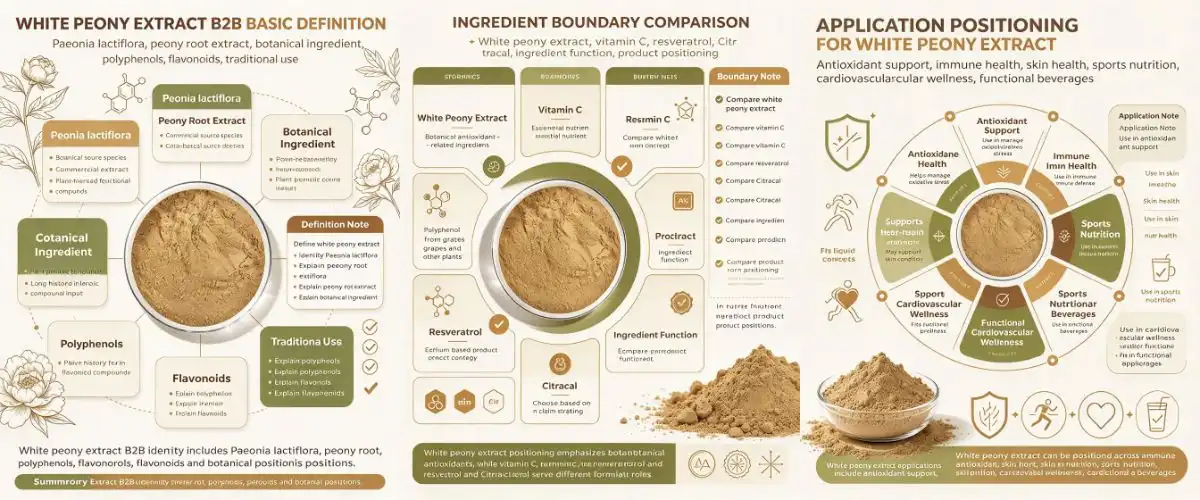
Understanding White Peony Extract: Composition and Mechanism
Botanical Origins and Active Compounds
There are many names for this plant, but the common one is "white peony." It has been grown for hundreds of years, especially in places known for having real medicinal plants. A unique method is used to peel and process the root, which makes it different from similar species like red peony. This careful preparation keeps the monoterpene glycosides whole, and paeoniflorin is used to show which parts are reactive. The powder is brown-yellow because the active ingredients were extracted using water and ethanol. The solvent leftovers had to be kept below 5000 parts per million, which is the limit for pharmaceutical-grade goods.
Extraction Technology and Purity Standards
Today, vacuum methods and low-temperature concentration are used for extraction so that sensitive chemicals don't break down at high temps. Picking the right raw materials, crushing them, removing the paeoniflorin, filtering them, cleaning them, and spray drying them are all steps that are used in industrial production to make sure that all regular recipes have at least 50% paeoniflorin. Businesses worry a lot about heavy metal contamination, and this methodical approach takes care of those worries. The finished goods meet EU standards for mercury (<0.1 ppm), arsenic (<2.0 ppm), lead (<3.0 ppm), and arsenic (<2.0 ppm). It is checked using High-Performance Liquid Chromatography (HPLC) to make sure that the label claim is right. The 100-mesh particle size is best for a wide range of uses because it dissolves quickly.
Biochemical Mechanisms in Human Physiology
There are several ways that paeoniflorin can help your body heal. It stops the NF-κB signaling system, which in turn stops cell models from making cytokines that cause inflammation. This method works really well for making mixtures that try to treat inflammatory conditions without the bad side effects of man-made anti-inflammatory drugs. Besides that, the chemical blocks tyrosinase, which stops the enzyme level production of melanin. This is why it works so well in makeup that make skin look better. The hypothalamic-pituitary-adrenal axis is changed, which helps manage the stress response. This makes the extract useful as an adaptogen in dietary supplements that aim to balance hormones and boost metabolic health.
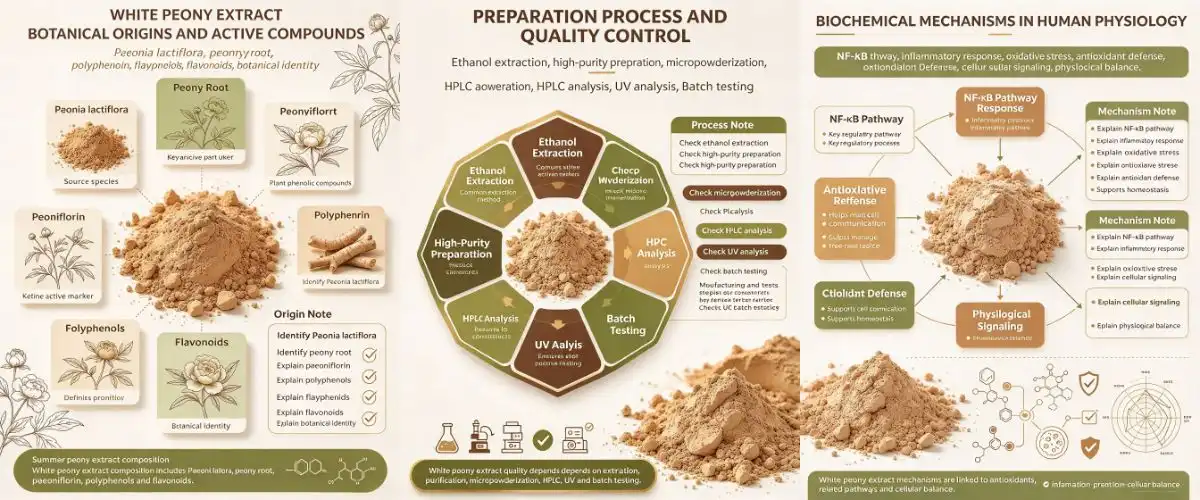
The Multifaceted Benefits of White Peony Extract Ingredients
By learning about the many benefits of paeoniflorin-rich materials like White Peony Extract, R&D teams can improve how they make a lot of different kinds of products. Clinical studies have shown that these benefits are real. This is the proof that is needed for regulatory applications and marketing statements in competitive markets.
Anti-Inflammatory and Immune Modulation
Chronic inflammation leads to a lot of health issues. This is why people look for natural ingredients that can change the immune system's work without harm. Paeoniflorin stopped cyclooxygenase-2 (COX-2) activity and dropped interleukin-6 levels in preclinical tests. This showed that it works just as well as other anti-inflammatory drugs. Food products that help the health of your heart, gut system, and joints can be made because of this trait. The immunomodulatory effects of the extract keep the immune system from overreacting without making it weaker. So, it's a good thing to put in items for people with inflammatory diseases or immune problems that come and go with the seasons.
Liver and Kidney Function Support
This thing can help protect the liver by increasing glutathione levels and making phase II detoxifying enzymes work better. Researchers have found that regular dosing saves hepatocytes from damage caused by chemicals and oxidative stress. This is very useful for people who are making functional drinks and liver health supplements. Animal tests also showed that the substance could help protect the kidneys, which means it could be used in medicines that help the kidneys filter blood and keep the urinary tract healthy. People are interested in detox and metabolic health goods more than ever, and these organ-protecting traits fill that need.
Skin Health and Cosmetic Applications
A lot of places are putting limits on synthetic skin-lightening chemicals like hydroquinone, so the makeup business is looking for natural options more and more. Paeoniflorin stops tyrosinase from working, which doesn't harm cells. This makes it a safe way to even out skin tone and lessen hyperpigmentation. Not only does the ingredient make the skin lighter, it also gets rid of reactive oxygen species that make you age faster. The ingredient is put into masks, serums, and creams to make the skin look brighter, less red, and better structured. There is a brown-yellow powder form that mixes well with both water and emulsions. This gives people who make products a lot of choices, and the powder stays stable in normal storage conditions.
Gastrointestinal and Metabolic Benefits
Scientists have found new evidence that an old use for digestive health is correct. The extract can relax smooth muscles in the digestive system, which helps with pain. This helps with gut pain, bloating, and not being able to go to the bathroom. For this reason, it works really well for people who are sensitive to heat or who have trouble going to the bathroom sometimes. One metabolic benefit that goes beyond reducing blood sugar is better insulin sensitivity. The other is better glucose metabolism. This means that paeoniflorin-containing products can be added to functional foods and drinks to help with metabolic syndrome and weight control.
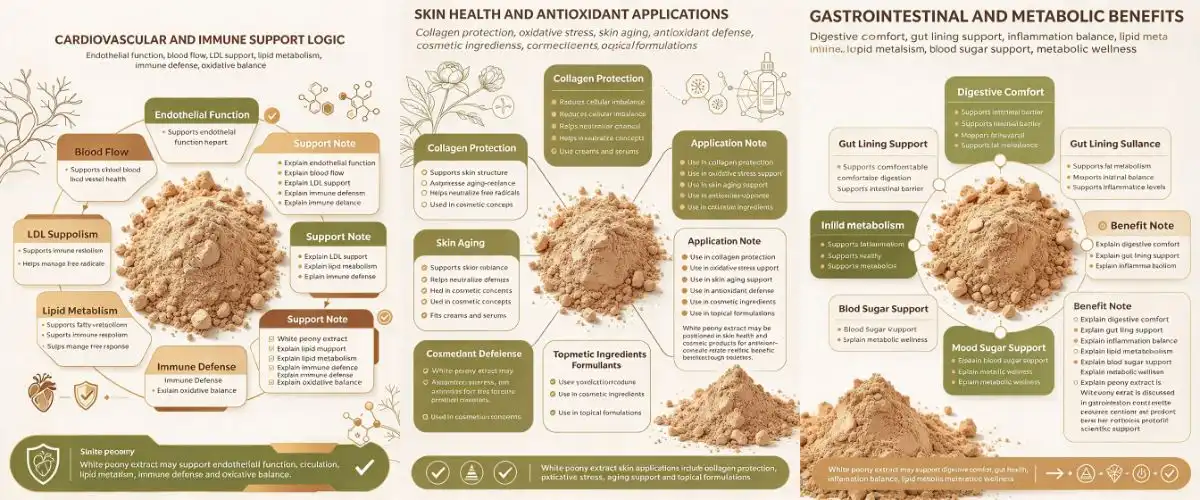
Comparing White Peony Extract to Other Herbal Extracts and Product Forms
People who work in procurement have to sort through a lot of different plant and physical forms in order to choose products. You can make smart choices that fit your recipe goals and market positioning if you know the differences between similar ingredients and delivery methods.
White Peony Versus Red Peony Extract
But even though both come from the same species of Paeonia, they work as medicines in very different ways and have different chemicals in them. The red peony (Paeonia veitchii or unpeeled P. lactiflora) has more paeonol, which makes blood move better. If you want to improve heart health or ease pain, this makes it a better choice. You get more paeoniflorin from the white variety when you peel it. This chemical helps the skin and immune system by reducing inflammation and nourishing cells. Using DNA barcoding to check the quality of food keeps species from mixing, which keeps brands from having identity issues that hurt customer trust and their standing with the government.
Powder Format Versus Encapsulated Products
You can package raw powder ingredients in the most different ways. You can change the amount very exactly and mix them into many different things, like drinks, pills, capsules, and creams for the skin. The 100-mesh particle size makes sure that White Peony Extract is spread out evenly and can be used by the body in all delivery systems. Manufacturers who can package their own goods can save money and make changes that work for them when they buy big powder. Pre-encapsulated forms are helpful for brands that don't have their own factories, but they tend to be more expensive and limit the kinds of ingredients that can be used. When buyers pick the right types of products, they need to think about these things, as well as how well they can make them and what their target market likes.
Organic Certification and Conventional Extraction
Organic approval is aimed at people who are willing to spend more on foods that don't have chemicals on them. We use GC-MS/LC-MS to look at more than 500 chemicals and make sure they follow the rules set by EC 396/2005. This is important for shipping to European markets. Conventional extracts that meet pharmaceutical-grade standards are just as pure and effective as organic ones, but they are cheaper. This makes them a good choice for uses that need to save money and where organic marking doesn't really make a difference. Both types have the same heavy metal tests and microbial control. The number of CFU/g of plates is kept below 1,000, and harmful organisms like E. E. coli are not there. Both Salmonella and E. coli. When suppliers are open about how they grow their plants and where their extraction solvents come from, buyers can make smart decisions that are in line with their brand image strategies.
Evaluating Supplier Credibility and Certifications
To build trust with providers, it's important to have quality processes that can be checked and to follow the rules. Businesses with ISO 22000, FSSC 22000, and HACCP certifications show they care about food safety. Kosher and Halal certifications help them reach certain customer groups. There must be a Certificate of Analysis (COA) for each batch that shows the microbe test results, the amounts of contaminants, and the HPLC test results. Fingerprinting with Thin Layer Chromatography (TLC) and DNA identification from sources are two more ways to stop economic fraud. This protects brands from quality issues that could get them in trouble with the law and hurt their image. To keep 10–20 tons of safety stock on hand, procurement managers should tell partners to do so right away. This will keep the supply fixed even if demand changes, and it will also make it possible to fill orders quickly, in 5–7 working days.
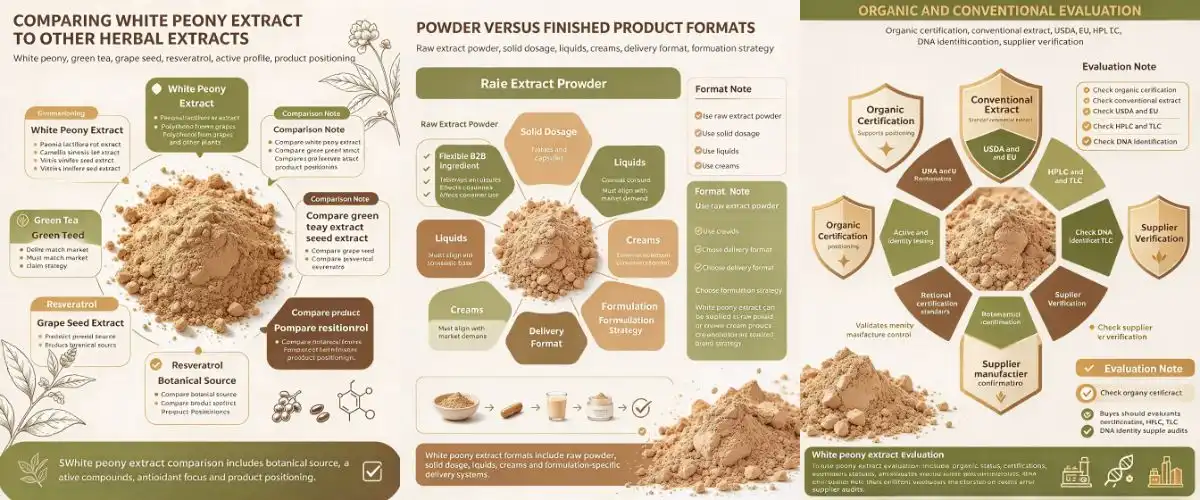
Best Practices for Using and Dosage of White Peony Extract in B2B Products
Formulation methods that work well strike a balance between making sure the therapy works and making sure everyone follows the rules. If people who make products know a lot about dosing factors and possible interactions, they can make formulations that people trust and that help them reach their health goals.
Recommended Dosage Guidelines by Application
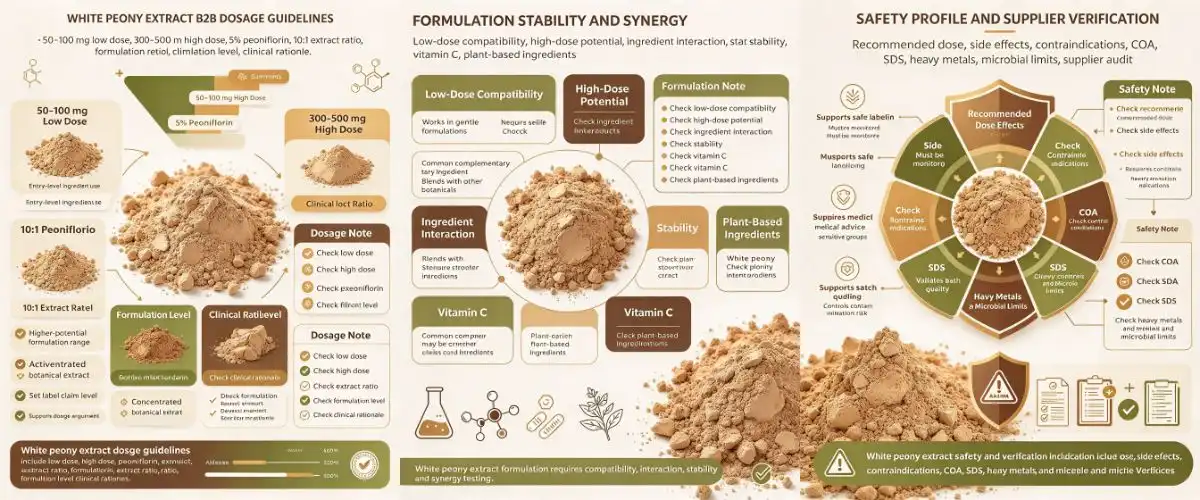
Every dose of dietary supplements has around 150 to 300 mg of active ingredient, which is equal to 300 to 600 mg of pure extract (≥50% paeoniflorin). In tests that looked at immune function and markers of inflammation, this range worked well with no side effects. Functional drinks use lower amounts, around 50 to 150 mg per dose, to find a good mix between bioactivity, taste, and customer acceptance. 1% to 5% extract is added to finished topical cosmetics to make the recipe stable and appealing to the senses while also giving the skin visible benefits. These rules are just places for R&D teams to start. They might need to be changed based on who the recipes are for, what products go well with what, and any health claims that are being made.
Formulation Stability and Synergistic Combinations
As long as the pH level is between 4 and 7, peloniflorin will not change. This means that it can be used in most products and food supplements. When you are storing things, it is best to keep them away from high temperatures and humidity. This is because food that loses 3% of its weight during drying shows that it is sensitive to moisture, which could make it go bad faster. When you mix plants that work well together, they work better and can be used for more medical purposes. Using licorice root extract changes how cortisol is used and increases its anti-inflammatory effects. This makes goods that help with stress that work well. Antioxidants work better when taken by mouth or put on the skin when they are mixed with vitamin C. There are a lot of ways that they fight aging when mixed with hyaluronic acid in cosmetics.
Safety Profile and Contraindications
There is clinical evidence that White Peony Extract works well at the recommended amounts. The only side effects that happen are mild stomach pain in people who are likely to be sensitive. More care needs to be taken with pregnant and nursing women because there isn't enough safety information for them. The product's label needs to be carefully read and pros should be contacted. People who have trouble with bleeding or who take drugs that stop blood clotting should be careful, because there may be links with coagulation pathways, even though there isn't a lot of clinical evidence for them. Labels for these side effects should make them clear. This is good management and lowers the risk of being sued. With the help of full technical documents such as Material Safety Data Sheets (MSDS) and clinical reference data, brands can answer questions from both patients and medical experts.
Procuring White Peony Extract: A Buying Guide for B2B Clients
Strategic sourcing decisions impact product quality, supply chain reliability, and ultimately market competitiveness. People who work in buying can get the best cost-performance ratios and build long-term relationships with providers if they know how to communicate and use useful evaluation criteria.
Identifying Reliable Wholesale Sources
If you have direct ties with makers, you can avoid the markups that come from brokers and get detailed information that can help you make formulations better. Vertically integrated suppliers offer better quality guaranty and tracking because they grow the raw materials, extract them, and check their quality. Where we live, like Shaanxi Province in China, where Paeonia lactiflora grows best, gives us an advantage when it comes to how much our raw materials cost and how well they work. Online business-to-business (B2B) platforms make it easier to find a provider. But before making big purchases, it's best to check out the facility or use a third-party inspection service to make sure the licenses and production capabilities being claimed are real.
Quality Verification and Testing Protocols
Testing methods that are very strict protect brands from both quality problems and legal problems. Ask for COAs from the most recent batches that show the outcomes of HPLC tests, heavy metal tests, pesticide residue screens, and microbe tests. International drug standards, like the USP and EP monographs, can be used to compare the given specs. Another layer of security is added by testing by a third party, like an approved lab. This is especially important when looking for new sellers or making sure that other sources are trustworthy. A DNA barcoding service checks that plants are the right ones and doesn't switch them out for species that don't work as well. When suppliers offer samples for full testing, it means they are sure of the quality of their goods and want to be open and honest.
Pricing Dynamics and Volume Negotiations
Prices for standardized plant extracts change on the market based on things like crop yields, exchange rates, and demand cycles. The spot market price for 50% paeoniflorin content is usually around $30 to $80 per kilogram. Higher purity grades bring higher prices. You can get discounts when you offer a lot of orders, especially for long-term deals that guarantee a certain minimum order amount. People who are buying something should think about both the price and the quality. If the price seems too low, it's likely that the specs have been dropped or the material has been tampered with. Payment terms that are common in the industry, like a 30% to 50% deposit and the rest due when you get the shipping papers, protect both parties and make the deal go smoothly. When you have a relationship with someone for a long time, you can get better deals, faster service when supplies are low, and personalized service support like help with formula development.
Building Strategic Supplier Relationships
When it comes to sustainable buying methods, partnerships are more important than transactional relationships. Suppliers that offer ODM/OEM services can help with things like customizing recipes, changing standards, and designing packages. It's kind of like having your own R&D team. Setting up regular times to talk, like business reviews every three months and advance supply forecasts, helps people work together, helps sellers guess what people will need, and makes it easier to keep track of goods. There is real value in technical support that goes beyond basic product knowledge. This includes application advice, help with stable testing, and regulatory paperwork. This could be why prices are higher. Watch how quickly they answer your questions, how open they are about production issues, and how adaptable they are when demand changes without notice. This could be a sign of a trustworthy relationship.
Conclusion
Ingredients high in paeoniflorin, such as White Peony Extract, can be used for many different kinds of treatments. This makes them good for B2B clients who are making new products in the beauty, functional food, and nutritional categories. The rules for quality control, the parts of plants, and how biochemical processes work are all things that procurement teams need to know in order to choose where to get products that are safe, effective, and affordable. Carefully choosing suppliers by testing how open they are and how reliable their certifications are lowers risks and makes the supply chain more resilient. As more people look for natural alternatives to synthetic additives, businesses can stand out by strategically investing in high-quality standardized extracts. This also creates long-term market opportunities.
FAQ
What are the primary health benefits of paeoniflorin extracts?
By stopping the NF-κB pathway, paeoniflorin's byproducts lower inflammation. They also help the liver clean itself out by raising glutathione levels and change the immune system without making it weaker. Stopping tyrosinase from working can help with cosmetic uses since it lowers discoloration. It can help with smooth muscle spasms and constipation in the digestive tract. This really does help with a number of different types of therapy, as shown by clinical studies.
How can buyers verify product authenticity and quality?
Please ask for full Certificates of Analysis that show the HPLC test results for the levels of paeoniflorin, heavy metals that meet EU standards, microbes, and pesticide residues. Need to know for sure what kind of plant it is? Ask for TLC fingerprinting or DNA barcoding. Before making big purchases, it's better to have them tested by a third party, like an approved lab.
What regulatory compliance considerations apply to international markets?
In the US, the FDA has rules for dietary supplements, and in the EU, there are rules for new foods. Products must meet the standards of the market they are going to. Look at the ISO 22000, HACCP, and GMP safety certificates that the supplier has. Make it easier for customs and regulatory officials to open packages by making sure they come with all the paperwork they need. This includes MSDSs, allergy statements, and comments about GMO status.
Partner with Sigma for Premium White Peony Extract Supply
Delta keeps a lot of plant-based ingredients that can be used safely in medicine on hand. Standardized paeoniflorin extracts with at least 50% active content are among these. This can be shown by HPLC analysis. Our ISO 22000 and HACCP-certified plants in Shaanxi Province use the natural resources of the area and the most up-to-date extraction technology to make sure that every batch is the best it can be. As a well-known business that makes White Peony Extract, we can help you meet your formulation development and production schedules by giving you full technical documentation, flexible specs, and fast delivery (within 5–7 working days). For heavy metals, chemical residues, and microbial pollution, our quality control procedures go above and beyond what is required by international law.
This makes sure that all markets around the world follow the rules without any issues. Send an email to sarah@sxsigma.com to ask for samples, talk about custom extraction needs, or find out more about how our full-service partnership approach can help you improve your supply chain and speed up product innovation. This approach includes formula development help and flexible OEM/ODM solutions. A lot of well-known names use Sigma's stable, high-quality plant-based ingredients.
References
1. Zhang, L., Wei, W., Xu, J., Min, F., Wang, L., Wang, X., Cao, S., Tan, D.H., Qi, Y. and Yang, X., 2009. Inhibitory effect of paeoniflorin on immunological hepatic fibrosis in rats. World Journal of Gastroenterology, 15(18), p.2186.
2. Parker, S., May, B., Zhang, C., Zhang, A.L., Lu, C. and Xue, C.C., 2016. A pharmacological review of bioactive constituents of Paeonia lactiflora Pallas and Paeonia veitchii Lynch. Phytotherapy Research, 30(9), pp.1445-1473.
3. Takagi, K. and Harada, M., 1969. Pharmacological studies on herb paeony root. Japanese Journal of Pharmacology, 19(2), pp.211-219.
4. Jin, X., Wang, J., Xia, Z.M., Shang, C.H., Chao, Q.L., Liu, Y.R., Fan, H.Y., Chen, D.Q., Qiu, F. and Zhao, F., 2016. Anti-inflammatory and anti-oxidative activities of paeonol and its metabolites through blocking MAPK/ERK/p38 signaling pathway. Inflammation, 39(1), pp.434-446.
5. Liu, D.H., Xiao, B., Han, J.N., Song, W., Liu, L.Y. and Zhong, Y.F., 2008. Total glucosides of paeony suppress adjuvant arthritis in rats and intervene cytokine-signaling between different types of synoviocytes. International Immunopharmacology, 8(10), pp.1375-1382.
6. He, D.Y. and Dai, S.M., 2011. Anti-inflammatory and immunomodulatory effects of Paeonia lactiflora Pall., a traditional Chinese herbal medicine. Frontiers in Pharmacology, 2, p.10.