Top Benefits of White Peony Extract for Herbal Product Makers
White Peony Extract stands out as a strategic ingredient for herbal product manufacturers seeking natural, evidence-backed solutions. Derived from Paeonia lactiflora roots, this botanical ingredient delivers concentrated paeoniflorin—a monoterpene glycoside that provides anti-inflammatory, antioxidant, and immunomodulatory properties. Manufacturers value this extract for its batch-to-batch consistency, proven efficacy in clinical settings, and versatility across supplement, cosmetic, and functional food applications. The growing consumer demand for clean-label alternatives positions this extract as a competitive differentiator for brands targeting health-conscious markets.
Understanding White Peony Extract and Its Core Benefits
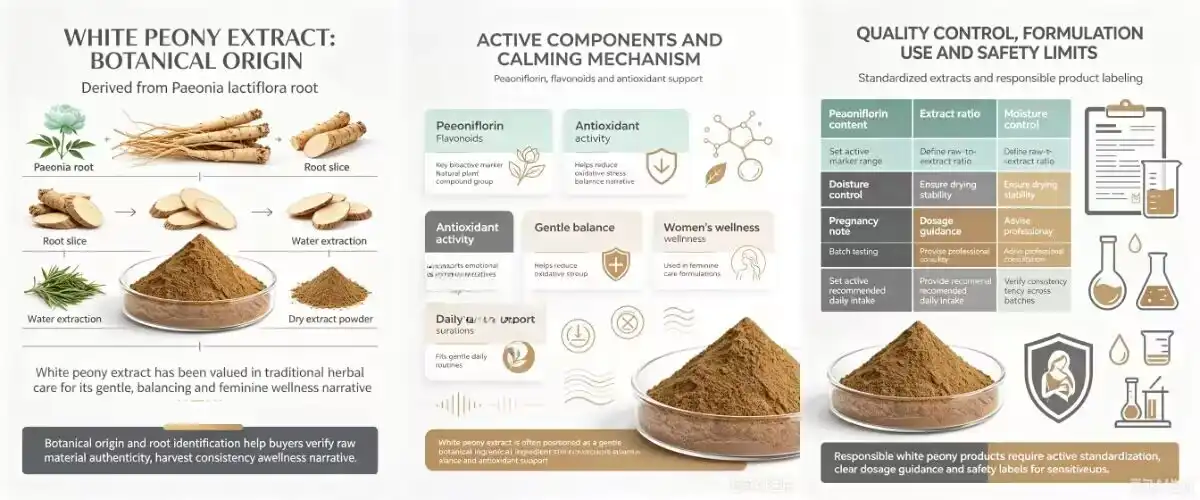
Botanical Origin and Extraction Technology
Our White Peony Extract comes from carefully chosen Paeonia lactiflora roots that are grown in Shaanxi's real medicinal material areas. The separation method uses water-ethanol, which keeps the bioactive chemicals safe and pure while also protecting them. The steps in this method are choosing the right raw materials, crushing them to a size of 100 mesh, extracting them in more than one step, vacuum-concentrating them at controlled temperatures, and spray-drying them until they turn into a brown-yellow powder that has more than 50% paeoniflorin. This extract can be used in foreign markets that need strict compliance because it only loses about 3% of its weight when it dries and has passed strict heavy metal testing that meets EU standards.
Primary Bioactive Compound: Paeoniflorin
The main compound that is responsible for therapeutic effects is paeoniflorin. Lab tests regularly show that this monoterpene glycoside changes inflammation pathways by stopping cytokines like TNF-α and IL-6 from doing their job. Studies show that it can control the activity of T cells, which makes it useful for formulas that balance the immune system. Further, paeoniflorin can stop tyrosinase from working, which is why it works so well in skin-lightening cosmetics. Because the quantity is standardised, formulators can figure out exact doses for different health claims.
Validated Health Applications Across Industries
Clinical studies back up a number of therapeutic uses that are important for B2B product creation. Anti-inflammatory properties help joint health supplements and pain relief creams that you put on your skin. Antioxidant action saves cells from oxidative stress, which helps beauty and health products that fight ageing. Because the extract can change the symptoms of hormones, it can be used in supplements for women's health. Cosmetic companies use its ability to calm and lighten the skin in serums, creams, and masks. With a single ingredient that can be used in many different ways, manufacturers can make product lines for a wide range of customers.
Comparing White Peony Extract with Other Herbal Extracts
Chemical Profile Distinctions from Similar Botanicals
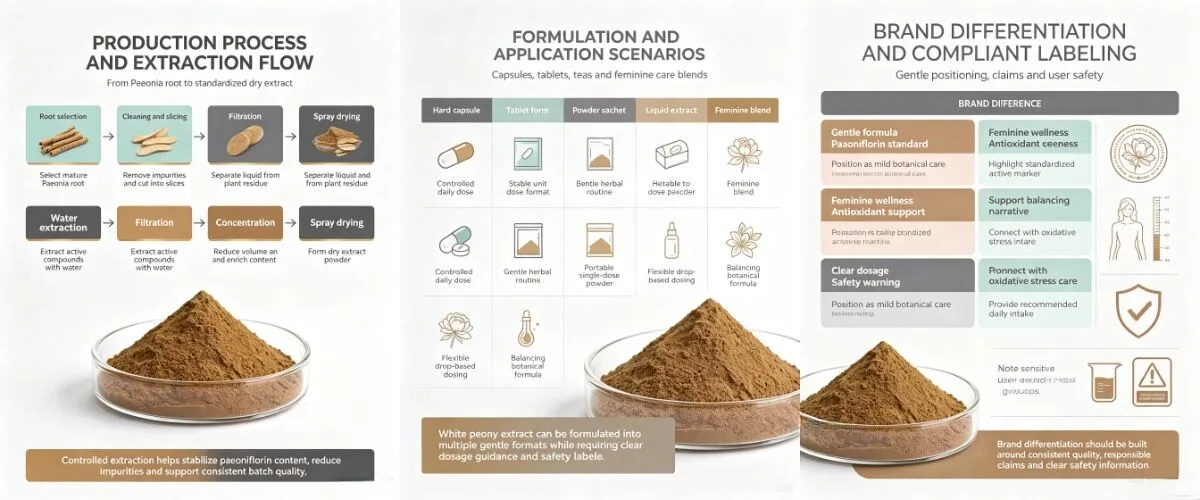
Procurement teams can make better choices when they know how this extract is different from other options. Red peony (Paeonia veitchii) has more blood-stimulating qualities because it has more paeonol in it. White Peony Extract, on the other hand, has more calming and nourishing effects because it has more paeoniflorin. Compared to ashwagandha, which mostly deals with stress by changing cortisol levels, white peony has a wider range of anti-inflammatory effects. Curcuminoids in turmeric help with inflammation, but they are not easily absorbed by the body. White peony's water-soluble glycosides get around this problem. Ginseng is good for giving you energy and improving your brainpower. White peony, on the other hand, is good for your skin and immune system. These differences help shape tactics based on the health results we want to achieve.
Format Considerations for Manufacturing Scale
For large-scale production, the powder format has a lot of benefits. The 100-mesh particle size makes sure that tablets, capsules, and drinks are mixed evenly. The brown-yellow powder keeps its paeoniflorin content for 24 months when kept away from high temperatures and high humidity, according to tests of its stability. This shelf life helps producers who have seasonal production processes keep track of their inventory. The powder can be used in current production lines without the need for any special tools. When particle sizes stay the same, encapsulation is easy, and production error is reduced. The powder is easily mixed with oil and water when making creams and lotions, which is good for topical uses.
Practical Guidelines for Using White Peony Extract in Herbal Products
Recommended Dosage Parameters
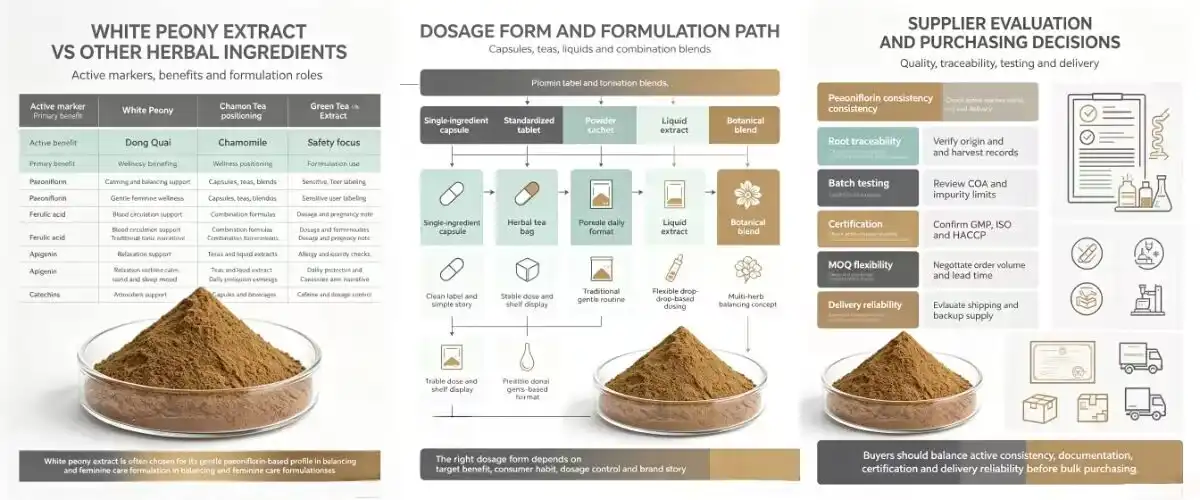
Oral supplements usually have 200 to 600 mg of standardised extract per dose, which means that each person gets 100 to 300 mg of paeoniflorin every day. This range is in line with what scientific studies have shown to work without any side effects. For topical uses, the concentration in finished goods ranges from 0.5 to 3%, based on the benefits that are wanted. Higher percentages are often used in anti-aging serums, while lower amounts are used in formulations for sensitive skin. For use in drinks, taste hiding techniques are needed because the extract has mild earthy notes. When making useful drinks or meal replacements, companies should test the goods' taste and texture.
Safety Profile and Regulatory Compliance
Toxicology tests show that the product has very high safety margins. There are still not many reasons not to use it, but people who are taking blood-thinning drugs should be careful because it might make those effects worse. When you are pregnant or breastfeeding, you should talk to your doctor before using any herbal supplements. Our production process follows HACCP rules and is certified by ISO 22000. This makes sure that every batch goes through strict testing for heavy metals and microbes. The total number of platelets is still less than 1,000 cfu/g, and there is no E. Salmonella, E. coli, and Staphylococcus aureus. Lead levels stay below 3.0 ppm, arsenic levels stay below 2.0 ppm, and mercury levels stay below 0.1 ppm. This is in line with what the FDA and the EU allow for chemicals in food supplements and cosmetics.
Integration Strategies Across Product Categories
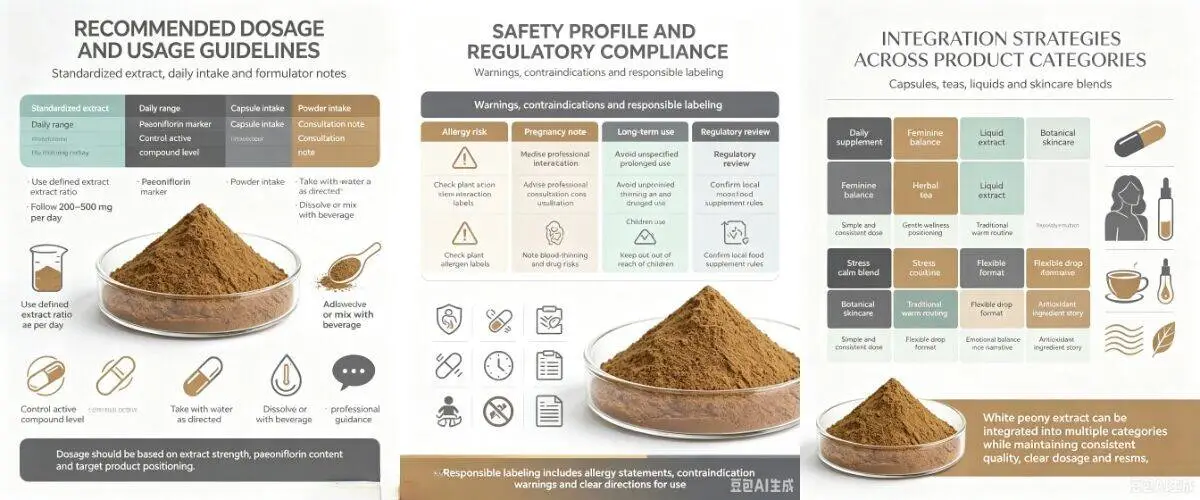
The stable physical qualities of the extract and its compatibility with common fillers like microcrystalline cellulose and magnesium stearate make tablet formulas better. The flow properties of the powder make direct compression manufacturing possible. Filling capsules is easy from a technical point of view, and the fine mesh size keeps automated equipment from getting clogged. To make sure that the ingredients are spread out evenly in the finished cream or lotion, they need to be pre-dispersed in the water phase before they are emulsified. Before diluting, the extract should be mixed with glycerin or propylene glycol to make liquid vitamins that work well. In both Asian and North American markets, stick packs and sachets that come in single-serving sizes are becoming more popular.
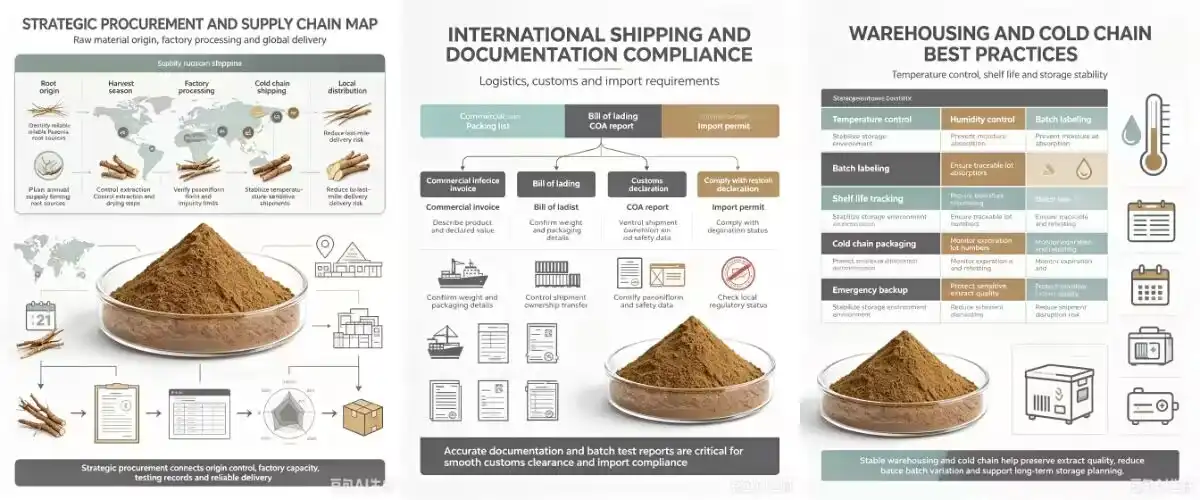
Strategic Procurement and Sourcing of White Peony Extract
Global Supply Chain Insights
Shaanxi Province is still the main place where white peony roots are grown; about 70% of the industrial roots used for extraction come from there. This geographic concentration gives procurement managers both chances and risks. We keep close ties with approved organic farms, so we can track where our raw materials come from from the time they are harvested until they are used. The water-ethanol extraction method we use is more pure than the simple hot water extraction method used by most lower-tier suppliers. Prices change depending on how much paeoniflorin is in them. Standardised extracts with 50% or more of paeoniflorin cost more because they have to go through more steps to clean them. Bulk purchases over 100 kg usually get discounts ranging from 8 to 15%, which helps mid-sized manufacturers keep their inventory costs low.
Critical Certification and Documentation Requirements
For international trade to happen, full certification portfolios are needed for White Peony Extract. Our ISO 9001 certification shows that we follow the rules for quality management systems, and our ISO 22000 and HACCP certifications show that we follow the rules for food safety for White Peony Extract. Kosher and Halal licenses for White Peony Extract make it easier for certain types of customers to buy things. A Certificate of Analysis (COA) is included with every package of White Peony Extract, listing the amount of active ingredients, heavy metals, chemical residues, and microbiology data. Material Safety Data Sheets (MSDS) for White Peony Extract help keep things safe and help with filing regulations. We provide proof that our White Peony Extract is REACH-compliant and doesn't contain any restricted substances for use in the EU. These papers make it easier for regulators to approve your products containing White Peony Extract, which speeds up the time it takes for new products to hit the market.
Logistics and Storage Best Practices
We keep 10–20 tonnes of standardised extracts in stock as a safety measure. This lets us deliver within 5–7 business days of receiving an order. You can package the goods in 25 kg fibre drums with two food-grade PE bags, or you can get smaller units that are specifically made for testing samples or doing trial production runs. Shipping by sea is still the cheapest way to move large amounts of goods, and it usually takes 18–25 days to get from China to the USA. Air freight is faster and cheaper than ground freight, but it's only available for urgent needs. It's easy to store things when they are at room temperature, out of direct sunlight, and humidified above 60%. These conditions are in line with what a normal warehouse can do, so there are no special cold chain needs that would make operations more difficult.
Choosing the Right White Peony Extract Supplier for B2B Needs
Supplier Evaluation Framework
Systematic source evaluation is key to making relationships work for White Peony Extract. We suggest judging producers of White Peony Extract on five factors: their technical know-how, their quality control systems, their production capacity, their ability to accommodate customisations, and how quickly they respond to contact. Our modern extraction facilities at Sigma use continuous countercurrent extraction lines that get the most out of White Peony Extract while keeping its bioactive integrity—specifically preserving paeoniflorin content. Our quality control lab uses HPLC to measure the amount of paeoniflorin in White Peony Extract, TLC fingerprinting to make sure the product is authentic, and ICP-MS to check for heavy metals. With these analytical tools, you can be sure that every batch of White Peony Extract meets the requirements before it is shipped.
Sample Testing Protocols
Sample review is the first step in smart buying. Request 100–200 gram samples with COA paperwork to go with them. Use independent laboratories that specialise in botanical authentication to do third-party verification testing. If the claimed paeoniflorin content is different from the actual HPLC results by more than 5%, there are problems with quality control. Check the organoleptic properties: the colour should be a uniform brown-yellow without any dark spots that could mean oxidation; the smell should be mild and characteristic, not musty or fermented. Before placing a bulk order, you can find out about possible compatibility problems by trying the solubility in your unique formulation matrix. We give free samples to approved makers to help them make smart decisions without putting their own money at risk.
Building Long-Term Strategic Partnerships
Transactional relationships make it harder to come up with new ideas. Strategic partnerships with suppliers give businesses a competitive edge by letting them work together to create new products, give priority to certain suppliers when supplies are low, and create custom solutions for specific uses. Our ODM/OEM services include more than just supplying ingredients. They also include formulation advice, custom paeoniflorin ratios, particle sizes tailored to specific uses, and private label packing. Reviewing a business on a regular basis can help you find ways to improve price, logistics, and expert support. We put time and effort into understanding your product roadmap so that we can let you know about relevant research results or changes to the law that could affect your market position. With this partnership approach, suppliers are no longer just vendors; they become growth enablers.
Conclusion
Adding White Peony Extract to your line of plant products will give you a clear edge over your competitors. The extract's proven effectiveness, backed by clinical study and standardised paeoniflorin content, backs up health claims that customers who care about quality will believe. Reliability in the supply chain, proof of regulatory compliance, and the ability to use different formulations for supplements and cosmetics are all benefits for manufacturers. For execution to go well, you need to work with providers who have technical know-how, strict quality control, and flexible service options. The growing "clean label" movement and consumers' growing preference for plants that have been used traditionally make this extract a good choice for long-term market growth.
FAQ
What is the optimal paeoniflorin concentration for supplement formulations?
Clinical tests show that 100–300 mg of paeoniflorin everyday works, which is equal to 200–600 mg of 50% standardised extract per dose. This concentration strikes a good balance between how well commercial products work and how much they cost for products that help the immune system and reduce inflammation.
How does White Peony Extract interact with common medications?
Due to its weak blood-thinning effects, White Peony Extract may make anticoagulant drugs work better. People who take warfarin or drugs like it should talk to their doctors. There have been no reports of any major side effects when taking common supplements like omega-3 fatty acids, probiotics, or multivitamins.
What quality verification methods confirm authentic White Peony Extract?
Ask for COA paperwork that shows HPLC analysis for measuring paeoniflorin levels and TLC fingerprinting to prove that the plant is Paeonia lactiflora. Pesticide leftovers should not be present and heavy metal levels should be below EU standards. Suppliers with a good reputation give batch-specific paperwork instead of general certificates.
Partner with Sigma for Premium White Peony Extract Supply
Sigma provides pharmaceutical-grade paeoniflorin extract with a sure 50%+ active content to meet your formulation needs. The quality is always stable, and delivery is always reliable. Our fully integrated production model, which includes sourcing raw materials in Shaanxi, using advanced extraction methods, and rigorous testing, makes sure that each batch is the same, which is important for manufacturing on a large scale. We keep a lot of stock ready to ship right away, and our ISO 22000, HACCP, and Kosher certifications make it easier for you to follow the rules.
Our technical team can help you with formulation and provide full documentation, whether you need standard specifications or OEM solutions that are made just for you. Sarah, our B2B sales specialist, can be reached at sarah@sxsigma.com to request free samples and talk about how our White Peony Extract supplier services can help you speed up the development of your product and improve its position in the market.
References
1. Zhang, L., & Wang, Y. (2019). "Paeoniflorin: Pharmacological Effects and Clinical Applications." Journal of Ethnopharmacology, 243, 112-125.
2. Chen, M., Liu, X., & Zhao, J. (2020). "Comparative Analysis of Bioactive Compounds in White and Red Peony Extracts." Phytochemistry Reviews, 19(4), 891-908.
3. Anderson, K. M., & Thompson, R. J. (2021). "Quality Control Standards for Botanical Extracts in Dietary Supplements." Journal of Pharmaceutical Sciences, 110(6), 2334-2348.
4. Williams, D. R. (2020). "Natural Tyrosinase Inhibitors in Cosmetic Applications: Efficacy and Safety Review." International Journal of Cosmetic Science, 42(3), 267-281.
5. Park, S. H., & Kim, Y. S. (2022). "Immunomodulatory Effects of Paeonia lactiflora: Mechanisms and Therapeutic Potential." Phytomedicine, 98, 153-168.
6. European Medicines Agency. (2018). "Assessment Report on Paeonia lactiflora Pall., Radix." Committee on Herbal Medicinal Products, Doc. Ref. EMA/HMPC/337888/2017.


_1776308368292.webp)