Polygonatum Extract Benefits vs. Other Botanical Ingredients
When sourcing botanical ingredients for functional food and wellness formulations, the choices can feel overwhelming. Huang Jing—known scientifically as polygonatum extract—is drawing serious attention from procurement teams across Japan, Korea, China, and Southeast Asia. But how does it actually stack up against other widely used botanicals? This article walks through the science, the supply chain realities, and the practical value this ingredient delivers, so you can make a confident sourcing decision.
Understanding Polygonatum Extract and Its Core Benefits
Polygonatum extract is a standard botanical powder made from the dried rhizomes of Polygonatum sibiricum, P. cyrtonema, or P. kingianum. It is made by extracting the plants with hot water. This makes a fine brown-yellow powder with an 80-mesh particle size, a polysaccharide content measured at ≥30%, and great solubility in hot water.
It can be used right away in oral drinks, functional teas, granules, and capsules because of these qualities. China's "medicine and food homology" structure classifies it as having two uses, which makes it one of the most useful raw materials on the market right now.
Polysaccharides as the Primary Bioactive Marker
The polysaccharides in Huang Jing rhizome extract are what make it work. A study in the Journal of Ethnopharmacology shows that these carbohydrates have measurable antioxidant activity by scavenging DPPH free radicals, lower the buildup of lactic acid in the blood during physical stress, and help keep blood sugar levels steady. These scientific supports are not extraneous for people who are making anti-fatigue or Qi-and-Yin tonifying formulas; they are essential.
Seasonal Harvesting and Quality Consistency
The harvest season has a direct effect on the quality of the rhizome. Polygonatum rhizomes that are picked in the fall, after the plant has finished growing, have a lot more polysaccharides than those that are picked in the spring. Suppliers who use controlled farming methods and standard post-harvest processing, like Sigma's plant in Shaanxi, which is located in one of China's best medicinal material-producing regions, can provide consistent batch-to-batch polysaccharides that raw herb traders usually can't match.
Safety Profile and Regulatory Standing
Polygonatum sibiricum has been used safely in Traditional Chinese Medicine for a long time, and standard dietary doses have not been linked to any serious side effects. The amount of ash is limited to ≤5%, the amount of moisture is strictly controlled, and the levels of heavy metals (Pb <3.0 mg/kg, As <2.0 mg/kg, Cd <1.0 mg/kg, and Hg <0.1 mg/kg) are set to meet Chinese pharmaceutical standards as well as Japanese and Korean import standards. This set of data is very important for procurement managers in Japan and Korea who have to deal with strict government regulations.
Comparing Polygonatum Extract with Other Popular Botanical Ingredients
There is no one plant ingredient like polygonatum extract that can do everything. When looking for products, it's important to compare them honestly in terms of how well they work, how safe they are, how complicated the supply chain is, and how well they work with the final product.
Polygonatum vs. Asparagus Extract
Asparagus root extract (Asparagus racemosus or A. officinalis) has some of the same functions as Polygonatum. For example, both can help the defense system and make the body more adaptable. However, the amount of polysaccharide that can be extracted from Polygonatum rhizomes using measured water is usually higher and more reliable than what is obtained from asparagus root. Polygonatum's bioactive profile provides a more targeted active ingredient at a similar price point for formulations that make direct claims of reducing fatigue or nourishing the Yin.
Polygonatum vs. Lily of the Valley
Lily of the valley (Convallaria majalis) has heart-harming chemicals in it that can be harmful even in small amounts. Because of this, it can't be used in food or as an over-the-counter product in most places around the world. Polygonatum, on the other hand, is on China's "medicine and food homology" list, and its safety data supports its use in functional foods that people eat every day. This difference in legal risk alone makes the comparison easy for B2B buyers who are making wellness goods for consumers.
Polygonatum vs. Solomon's Seal and Hosta
Polygonatum biflorum, or True Solomon's Seal, is native to North America and shares genus-level chemistry with Chinese Polygonatum species. However, it does not have the well-established research base or standardized commercial extract supply chain that P. sibiricum and P. cyrtonema do.
Hosta species, which are sometimes mixed up with Polygonatum when talking about decorative plants, have a high yield and are hard to grow, which makes it hard to get their extracts for sale. Chinese Polygonatum species are still the best choice for procurement teams that need a reliable, large-volume supply with proof of species authenticity.
Procurement Considerations for Polygonatum Extract in a B2B Context
It's not enough to just write down the right ingredient such as polygonatum extract. It's just as important how reliably your supplier can deliver it, batch after batch, with paperwork that can stand up to scrutiny by regulators.
Before committing to a supplier, you should think about these main procurement factors:
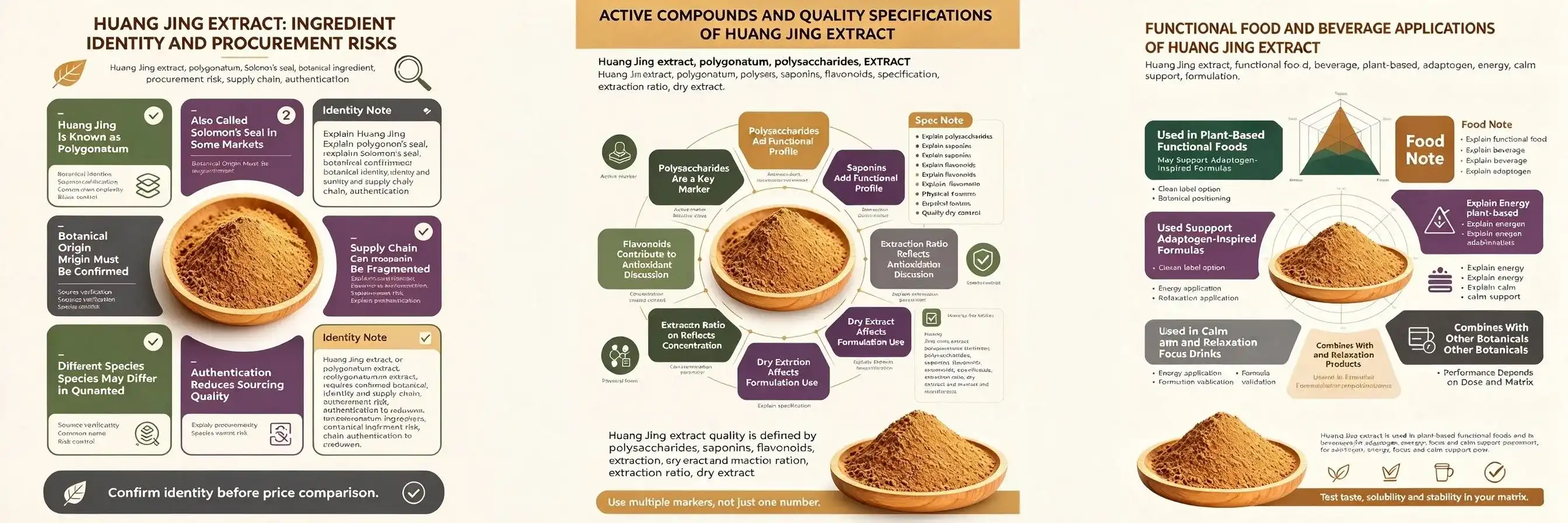
- Species authentication: Demand documented identification confirming P. sibiricum, P. cyrtonema, or P. kingianum—this directly affects polysaccharide content and efficacy claims. Credible suppliers provide a Certificate of Analysis (COA) plus third-party species verification.
- Sulfur dioxide and residue testing: Traditional Chinese herb processing sometimes uses sulfur fumigation for preservation. A compliant supplier provides an SO₂ residue report alongside standard pesticide residue and heavy metal panels—especially important for Japanese and Korean import clearance.
- Certification alignment: ISO 22000, HACCP, GMP, Kosher, and Halal certifications are not interchangeable. Match the supplier's certifications against the regulatory requirements of your target market before placing a trial order.
- MOQ flexibility and sampling: A supplier willing to ship 25–50 kg trial quantities with a free sample for lab verification demonstrates real confidence in their product consistency. This step is non-negotiable before scaling to annual framework contracts.
Use Cases and Applications of Polygonatum Extract in Industry
The 80-mesh brown-yellow powder form of this ingredient is not a compromise; it was chosen on purpose to work with other processes. It dissolves easily in hot water, which makes it safe to use in liquid drug forms. The controlled particle size makes it easy to blend evenly in granule and pill lines.
Functional Beverages and Tonic Formulations
Water-soluble polysaccharide-rich extracts work best in ready-to-drink functional teas, oral liquid tonics, and quick powder drinks because they breakdown easily and don't leave behind any sediment or cloudiness. Huang Jing polysaccharide extract naturally meets this need, and its mild to slightly sweet taste doesn't need any flavorings to hide it in most recipes.
Dietary Supplements and Capsules
When mixed with plants that work well together, like Astragalus (Huangqi) or Wolfberry (Gouqi), polygonatum extract naturally fits into pills that help the immune system and fight age. The standardized ≥30% polysaccharide assay lets product developers figure out how much of an active ingredient to use in each batch of production with confidence.
Cosmeceutical and Skincare Integration
Cosmeceutical formulators who are making skin barrier repair products are interested in Polygonatum polysaccharides because they are antioxidants. Even though the main uses are in food and supplements and not on the face, the antioxidant power makes it a scientifically sound ingredient for high-end anti-aging lines.
Why Choose Polygonatum Extract? Value Proposition and Future Outlook
The market for botanical ingredients around the world is growing at a steady rate. Grand View Research says the market will grow at a compound annual growth rate (CAGR) of more than 5% through 2030. In 2022, it was worth about USD 36 billion. Polygonatum is one of those ingredients that has both historical credibility and current clinical evidence that gives it a structural edge in that market.
It's worth more than just what it says on the box. It comes from a standard active marker, recorded safety data, dual regulatory status for food and medicine, and a production method that gets rid of the raw material's natural processing problems, such as calcium oxalate crystals and problems with hygroscopicity. These useful benefits directly mean lower formulation risk for teams working on new products.
Conclusion
Polygonatum extract is one of a kind when it comes to plant raw materials. It has a long history of traditional use and can now be standardized in a way that the nutraceutical and functional food businesses really need. It is safer, has better supply chain support, and gives more stable bioactive assay results than asparagus extract, Solomon's Seal, lily of the valley, and other botanicals in the same functional group. If procurement managers are looking at where to get ingredients in the Asia-Pacific and global markets, this is one that should go from "consideration" to "trial order."
FAQ
What is the standard polysaccharide content in Sigma's Polygonatum extract?
Sigma's Polygonatum extract is guarantyd to contain at least 30% polysaccharides, as shown by UV-VIS spectrophotometry for each batch. You can also get specs that are made just for you based on the needs of your recipe.
How do I verify the species of Polygonatum used in the extract?
A reliable supplier gives proof of species identification that says for sure whether the source material is P. sibiricum, P. cyrtonema, or P. kingianum. If you ask, Sigma will give you a full COA with species proof.
Does the extract contain sulfur dioxide residues?
Sigma's Polygonatum extract is made without using sulfur fumigation, and SO₂ residue test reports are included as normal paperwork, which is important for following Japanese and Korean import rules.
What is the minimum order quantity for a trial purchase?
Trial orders from 25 kg to 50 kg can be placed, and free samples can be sent to a lab for testing before the trial order is made.
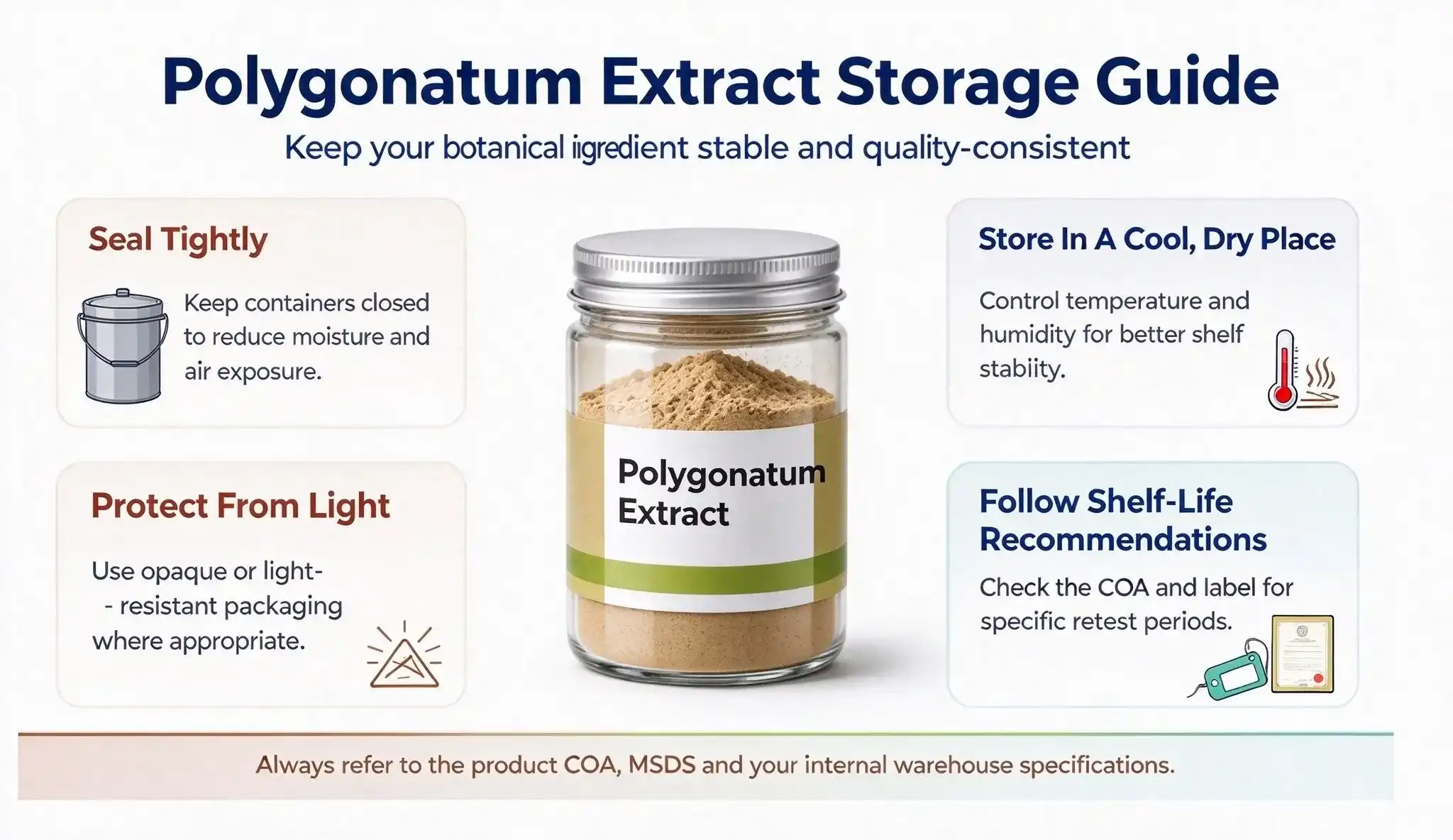
How should Polygonatum extract be stored?
Keep it away from direct light in a cool, dry place with a lid. If you store it properly, it should last for 24 months from the date it was made.
Request a Free Sample of Sigma's Polygonatum Extract
Sigma is a reliable company that makes and sells polygonatum extract. It is based in Shaanxi, China, which has some of the oldest medical herb-growing areas in China. Our extract is in stock now and meets ISO, HACCP, and Kosher standards. It is standardized at 30% polysaccharides and 80 mesh. We offer free samples, low MOQ trial sales, and custom specs for a range of product shapes. You can email our team at sarah@sxsigma.com or go to sxsigma.com to ask for your sample and COA paperwork right away.
References
1. Huang, L., et al. "Bioactive polysaccharides from Polygonatum sibiricum: Extraction, purification, and immunomodulatory activity." Journal of Ethnopharmacology, 2019.
2. Chen, H., & Zhang, M. "Anti-fatigue effects of Polygonatum polysaccharides in mice subjected to forced swimming." Food & Function, 2020.
3. Grand View Research. "Botanical Ingredients Market Size, Share & Trends Analysis Report." 2023.
4. Chinese Pharmacopoeia Commission. Pharmacopoeia of the People's Republic of China, Volume I. 2020.
5. Li, X., et al. "Comparative study of polysaccharide content in three Polygonatum species under different harvest seasons." Industrial Crops and Products, 2021.
6. Korea Ministry of Food and Drug Safety. Standards and Specifications for Health Functional Foods. 2022.