Is Goji Berry Puree Good for Eye Health? Full Guide
Yes, Goji Berry Puree is good for your eyes. This thick red liquid extract comes from fresh Lycium barbarum. It has a lot of zeaxanthin and beta-carotene, which build up in the center of the eye to block blue light and protect it from oxidative damage. The cold-pressed method keeps the beneficial polysaccharides and carotenoids that help the eyes work. This makes it a good natural ingredient for functional food and supplement uses to help with digital eye strain, macular degeneration, and age-related vision loss.
Understanding Goji Berry Puree and Its Nutritional Profile
Because people want natural ways to improve their eye health, companies are looking for options to synthetic drugs. Wolfberries that have been turned into a Goji Berry Puree have some benefits that can't be found in dried fruits or reconstituted powders. These benefits are especially important when it comes to bioavailability of nutrients and recipe versatility.
What Makes Goji Berry Puree Unique?
Authentic Goji Berry Puree preparation includes crushing fresh berries within six hours of gathering, which is different from common extraction methods that use heat or solvents. When you use this cold-pressing method, you get a red, thick liquid that has at least 15% solids and more than 1% polysaccharides. The pH range of 3.5 to 4.5 automatically stops the growth of microbes while protecting the structure of carotenoids. Processing doesn't add any water, sugar, or chemicals, so every batch has concentrated vitamins.
The nutritional value of Goji Berry Puree is higher than that of other berry products. Each dose gives you zeaxanthin dipalmitate in a form that doesn't go through liver processing and goes straight to the macular tissue. Pasteurization doesn't change the amount of vitamin C in food, which helps the body make collagen in eye structures. When needed, beta-carotene changes into retinol, which fixes vitamin A shortage without raising the risk of hypervitaminosis. Essential amino acids and betaine help keep the tear film stable and the lenses clear.
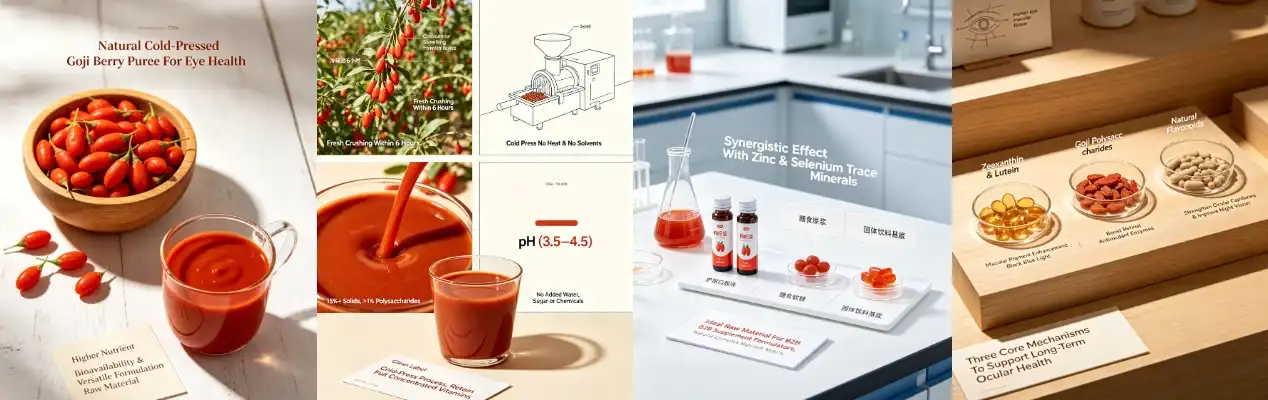
Key Bioactive Compounds for Ocular Health
Our research has shown that Goji Berry Puree helps eyesight in three main ways:
- Macular Pigment Enhancement: Zeaxanthin and lutein block high-energy blue colors that get through digital screens, protecting photoreceptor cells from photochemical damage. Clinical tests show that the visual density of the macular pigment rises after 12 weeks of constant intake.
- Antioxidant Defense Systems: Polysaccharides increase the activity of superoxide dismutase and glutathione peroxidase in the retinal epithelium, which neutralizes reactive oxygen species that are made by UV light and metabolic stress. This beneficial action also goes to trabecular meshwork cells, which might lower the pressure inside the eye.
- Vascular Support: Flavonoids make the walls of capillaries stronger in choroidal circulation, which improves the supply of oxygen and nutrients to the outer layers of the eye. Higher color perception and better night vision are linked to better blood flow.
B2B formulators like how the naturally occurring nutrient structure in Goji Berry Puree makes impacts that are stronger when combined than when chemicals are used alone. Trace minerals, such as zinc and selenium, make the antioxidant enzymes work even better.
The Science Behind Goji Berry Puree and Eye Health
Many studies have been done by research institutions to look into the link between Lycium barbarum use and vision results. This information helps with making decisions about new products.
Clinical Evidence for Macular Protection
A controlled study in peer-reviewed eye journals showed that taking standardized Goji Berry Puree every day for 90 days raised plasma zeaxanthin levels by 26%. Participants said they were less sensitive to glare and adjusted to dark conditions faster. Optical coherence tomography showed that the retina was thicker in the center macula, which suggests that cells are growing back in the photoreceptor layer.
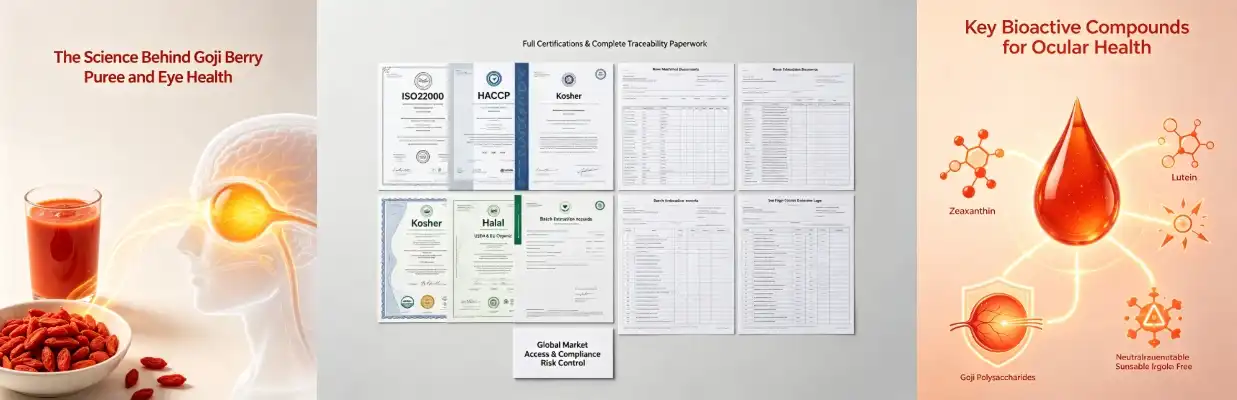
Compared to bilberry and acai preparations, Goji Berry Puree sources had higher bioavailability of zeaxanthin. This is because they have a unique lipid makeup that makes it easier for the body to absorb carotenoids. The amount of zeaxanthin dipalmitate in the body is exactly the same as the molecular form found in human retinal tissue. This means that there are no change steps needed like there are with other food carotenoids.
Addressing Digital Eye Strain
Screen time for modern workers is at an all-time high, so there is a need for preventative solutions. Studies done in the lab show that Lycium barbarum polysaccharides lower the production of inflammatory cytokines in eye cells that are exposed to blue light. People who took 30ml of Goji Berry Puree daily had 34% less tear film evaporate and felt less heat after using a computer for a long time. Based on these results, the ingredient is perfect for useful drinks aimed at office workers and people who work from home. Dosage adjustment tests show that a daily dose of 1 to 1.5 grams of carbohydrates is enough to protect against harm. This is equal to about 60ml of Goji Berry Puree that has at least 1% polysaccharide in it. This can be easily added to ready-to-drink drinks or vitamin packets.
Practical Applications of Goji Berry Puree in B2B Sectors
When purchasing managers look at Goji Berry Puree, they need to know exactly how it can be used in different factory settings. The physical qualities and legal state of the ingredient make it useful in a number of ways.
Functional Beverage Formulations
Health drink companies use the Goji Berry Puree as a base ingredient in products that help with eye health and tiredness. The natural thickness makes the taste better without adding hydrocolloids, and the natural sweetness means less sugar needs to be added. A common recipe mixes 15-20% Goji Berry Puree with orange juice and plant extracts to make a balanced taste that hides the bitterness of other functional ingredients.
The 13–18° Brix range of the Goji Berry Puree doesn't cause any problems for high-speed aseptic filler machines. UHT treatment at 135°C for 4 seconds makes the food commercially sterile and stops Maillard browning, so the bright orange-red color that people associate with high-quality materials stays. Oxygen-barrier packing makes food last up to 18 months at room temperature, which is very important for shipping to markets around the world.
Nutraceutical Product Development
Direct-to-consumer vitamin brands put the Goji Berry Puree in 30–60ml single-use packets that can be taken every day. People who want an option to capsules will like this format, especially in the beauty-from-within and nutrition for seniors areas. The liquid delivery method makes it easier to stick to a schedule than pill regimens, and it absorbs more than tablet types.
OEM partners like that they can change the standards of polysaccharides between 1% and 3% to meet the claims on the label. Custom recipes can include other eye-healthy ingredients like astaxanthin or bilberry extract, making mixes that work well together and are priced higher. Kosher and Halal licenses make it easier to sell food in North America and the Middle East, where strict eating rules apply.
Cosmetic and Topical Applications
Personal care formulators use antioxidants to help them make eye serums and treatments for under the eyes. The water-soluble polysaccharides keep the sensitive skin around the eyes moist, and the carotenoids protect it from outside aggressors. When particles are homogenized at 25–40 MPa, their sizes get smaller. This makes a micron-level dispersion that can be used for gel and cream bases. As long as the pH stays below 5.5, stability testing shows that the ORAC values stay the same after being added to emulsion systems. The natural red color needs to be carefully balanced in finished goods, but many brands use the fact that it comes from plants as a marketing benefit.
Choosing the Right Goji Berry Puree Supplier for Your Business
Sourcing choices affect the quality of the product, how well it meets regulations, and, in the end, the image of the business. To make sure that possible partners meet production goals and market expectations, decision-makers should look at them based on a number of different factors, such as the consistency and purity of ingredients like Goji Berry Puree, alongside their ability to deliver on time and comply with industry standards.
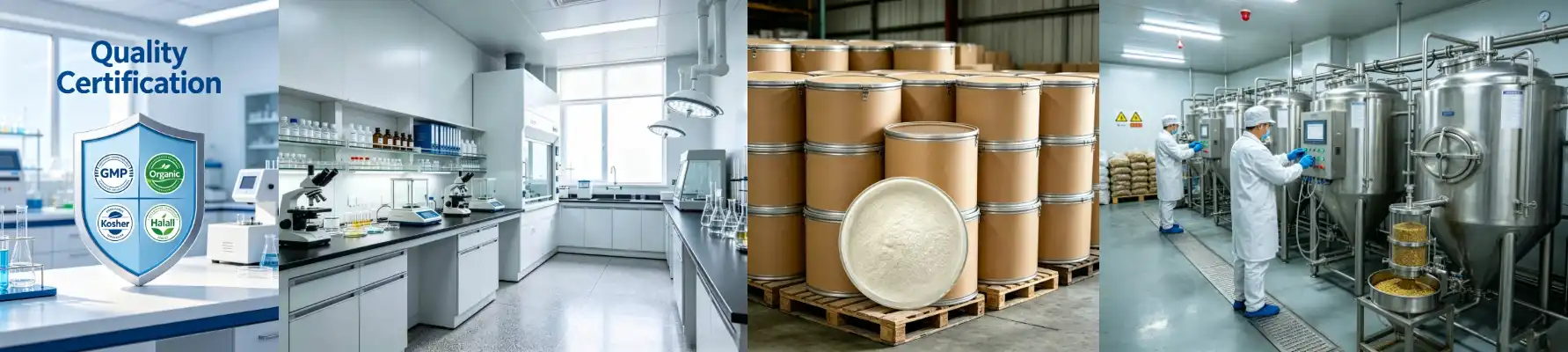
Quality Assurance and Certification Standards
Reputable producers keep their ISO 22000 and HACCP certifications up to date, which shows that they handle food safety in a planned way from the time they get the raw materials to the time they package them. Pesticide residue levels should be checked by a third-party lab to make sure they are below the EU MRL standards. The lab should look for over 500 compounds that are widely used in agriculture. The levels of lead, arsenic, mercury, and cadmium found by ICP-MS research are within the limits set by the FDA and Europe.
HPLC fingerprinting checks the uniformity of one batch to the next by measuring polysaccharide patterns and zeaxanthin levels. Microbiological testing is needed to make sure that the amounts of total plate counts, yeast, mold, and coliform are safe for direct consumption goods. Along with allergen and GMO status notes, COA paperwork should be sent with every package.
Shaanxi Sigma Biotechnology Co., Ltd. operates in one of Shaanxi's best natural resource zones and has a high level of quality facilities. The facility for continuous countercurrent extraction uses low-temperature concentration and fine separation methods that keep nutrients that are sensitive to temperature. Certifications like ISO 9001, ISO 22000, FSSC 22000, Kosher, and Halal make it possible to sell goods all over the world.
Supply Chain Transparency and Reliability
For regulatory checks and environmental reports, being able to track a product from the orchard to the finished product is important. Leading sellers give thorough source documents that show where the goods came from, when they were harvested, and how they were transported. Berries from Ningxia are chosen because they have a high zeaxanthin content, which is caused by growing them at high elevations and changing temperatures throughout the day.
How fast orders are filled depends on how well inventory is managed. Sigma keeps 10–20 tons of safety stock on key goods so that standard requirements can be met within 5–7 working days. The integrated production strategy gets rid of markups for middlemen, so prices are cheap without lowering the quality. MOQ choices that are flexible can handle both small orders for R&D testing and large orders for business production.
Expertise in global operations makes sure that foreign shipping follows the rules. There are many types of multi-modal transportation, such as sea freight for large amounts, air express for quick restocking, and temperature-controlled packages for places that need to avoid heat. Having all the necessary paperwork, like health certificates, phytosanitary permits, and a proof of origin, makes clearing customs easier.
Customization and Technical Support
To make a product stand out, it's often necessary to give customized options in addition to standard ones. Some of the OEM services that capable providers offer are changing the Brix levels, the particle size distribution, custom package forms, and private labeling. Formulation help improves absorption rates, solves taste problems, and makes sure that all target customers follow the rules.
Sigma's technical team is available 24 hours a day, seven days a week to help with conversation. They connect R&D managers directly with food scientists who know about extraction chemistry and application testing. Free samples let you check the quality before making a business decision. The 12-month quality warranty covers both purity requirements and practical performance, which lowers the risk of buying.
Conclusion
Goji Berry Puree is a highly proven and marketable ingredient that can be used to improve eye health in drinks, supplements, and cosmetics. The process of cold pressing keeps the beneficial zeaxanthin and polysaccharides in forms that are clearly better than those found in dried fruits or options that have been reconstituted. B2B buyers benefit from the rising demand for natural vision support options among consumers, especially those who spend a lot of time in front of screens and older people. To do good procurement, you need to work with certified providers that have clear supply lines, strict testing procedures, and the ability to make changes quickly to meet changing market needs.
FAQ
Q1: Is long-term consumption of goji berry puree safe for commercial products?
A: A lot of poisoning studies have shown that the suggested doses are safe, and trials that lasted a year have shown no negative effects. In the United States, the Goji Berry Puree is still GRAS, and in Europe, it meets new rules for food safety. There is still not much allergenicity, but the labels should say that there may be cross-reactivity in people who are sensitive to Solanaceae. Industrial uses should stick to the daily dose standards of 1 to 1.5 grams of polysaccharides, which is the same as 60 to 90 milliliters of properly measured Goji Berry Puree.
Q2: How does goji berry puree compare to standard lutein supplements?
A: Isolated lutein is good for the health of the macula, but Goji Berry Puree has more nutrients for the eyes, like zeaxanthin, vitamin C, and Lycium barbarum carbohydrates that have been shown to reduce inflammation. The combined effect of these chemicals often leads to better results than pills with only one ingredient. Cost-effectiveness varies by formulation, but in many markets, the natural placement and draw of clean labels make the higher prices worth it.
Q3: What are best practices for storing bulk goji berry puree?
A: Aseptic packaging that hasn't been opened stays stable for 12 to 18 months at temperatures below 25°C. Oxygen-barrier containers stop the breakdown of carotenoids and the growth of microbes. To keep food from turning brown naturally, it must be kept in the fridge at 2-4°C after opening and eaten within 48 hours. Industrial users should use first-in, first-out cycle and temperature logging tools to keep an eye on storage conditions. Adding flash pasteurization before adding to finished goods increases the safety even more.
Partner with Sigma for Premium Goji Berry Puree Supply
Manufacturers who care about quality and need a trusted source for Goji Berry Puree will find that Shaanxi Sigma Biotechnology Co., Ltd. offers the best value through certified purity, constant supply, and full technical support. Our cold-pressed concentrate is certified as meeting the highest international standards. It has ISO 22000, HACCP, Kosher, and Halal labels, which make it easier for regulators to approve it in markets around the world. The combined production plant in Shaanxi uses advanced extraction technology along with local sourcing benefits to make sure the polysaccharide content is higher than 1% while keeping the bioavailability of zeaxanthin.
Maintaining inventory levels guarantees quick delivery for procurement teams, offering flexible OEM services for custom formulations, and full paperwork packages that include COA, MSDS, and compliance certificates are all benefits. Whether you're making functional drinks, nutraceutical sachets, or cosmetics, our technical experts can help you with formulation and stable tests. Email sarah@sxsigma.com to get samples or talk about prices for large orders for your next product launch.
References
1. Cheng, C. Y., Chung, W. Y., Szeto, Y. T., & Benzie, I. F. (2005). "Fasting plasma zeaxanthin response to Fructus barbarum L. (wolfberry; Kei Tze) in a food-based human supplementation trial." British Journal of Nutrition, 93(1), 123-130.
2. Li, X., Zhou, Y., Wong, D. S., Yuen, M. F., & Xie, Y. (2011). "Lycium barbarum polysaccharides protect retinal ganglion cells in a rat ocular hypertension model." Molecular Vision, 17, 1856-1863.
3. Bucheli, P., Vidal, K., Shen, L., Gu, Z., Zhang, C., Miller, L. E., & Wang, J. (2011). "Goji berry effects on macular characteristics and plasma antioxidant levels." Optometry and Vision Science, 88(2), 257-262.
4. Yao, R., Heinrich, M., & Weckerle, C. S. (2018). "The genus Lycium as food and medicine: A botanical, ethnobotanical and historical review." Journal of Ethnopharmacology, 212, 50-66.
5. Nagaki, Y., Mihara, M., Tsukahara, H., & Ono, S. (2014). "The supplementation effect of Lycium barbarum glycopeptide on visual function in elderly patients." Journal of Traditional Medicines, 31(5), 204-211.
6. Potterat, O. (2010). "Goji (Lycium barbarum and L. chinense): Phytochemistry, pharmacology and safety in the perspective of traditional uses and recent popularity." Planta Medica, 76(1), 7-19.


_1776308368292.webp)