How to use polygonatum in supplements?
To use Polygonatum in supplements, you must first choose a standardized Polygonatum Extract that comes from Polygonatum sibiricum or a similar plant. This fine, brown-yellow powder is full of polysaccharides (usually 30–40%) and is used in tonic pastes, pills, and functional drinks. The water-soluble extract is more bioavailable than raw root powder, so it's possible to give the right amount to boost the immune system and help tired people recover. Manufacturers should check for cleanliness, germ control, and certificates such as ISO and HACCP to make sure that each batch is the same and that they are following the rules in all global markets.
Understanding Polygonatum Extract and Its Benefits
In traditional Chinese medicine, the Polygonatum plant is known as "Huang Jing." It has become popular among B2B supplement makers looking for natural, useful ingredients. This change is because more and more people want plant-based options to synthetic additives, especially in the health and immune areas.
What Makes Polygonatum Extract Valuable?
Polygonatum Extract is made by first extracting it with hot water, then filtering it and spray drying it, which concentrates the beneficial polysaccharides and saponins. The high moisture and sticky nature of raw rhizome powder make it hard to formulate. The standardized extract, on the other hand, has constant strength and is easy to incorporate into production processes. Polygonatum polysaccharides, which are the main active markers, have been looked at to see what part they play in supporting the immune system, making energy for cells, and acting as antioxidants. Studies in pharmacological journals show that these polysaccharides can change immune reactions without overstimulating them. This means that they can be used in daily health products.

Key Bioactive Compounds and Their Roles
The extract is made up of several types of compounds that work together to make it useful. Polysaccharides make up at least 30% of the best grades; they work on the immune system to make macrophages work better. Smaller amounts of steroidal saponins help keep the metabolism in balance. Flavonoids help protect cells from reactive stress by being antioxidants. This mix meets the needs of research and development teams working on goods to help with tiredness, seasonal immune support, and healthy aging. Formulators like that the extract can be used as both food and medicine in many places. This makes the regulatory process easier than with synthetic chemicals.
Dosage Considerations Across Product Types
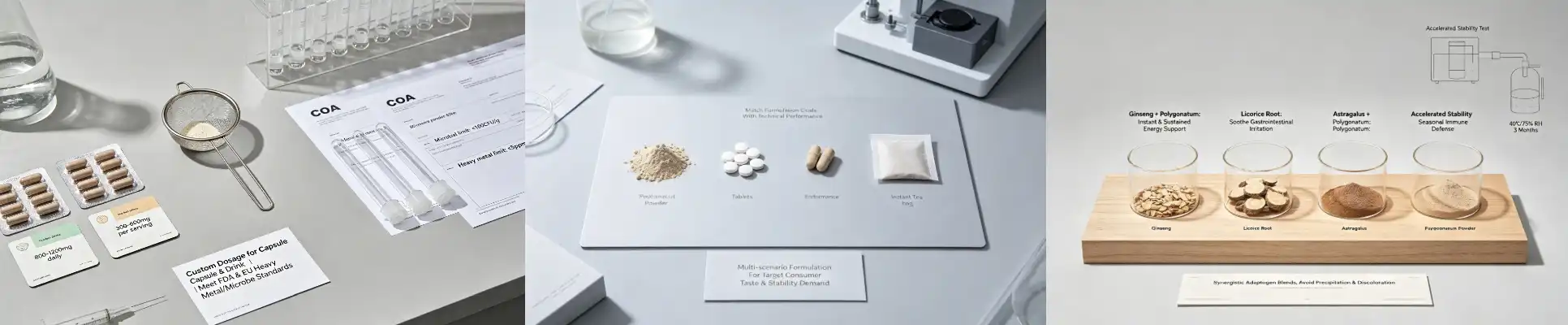
Doses usually run from 500 mg to 2,000 mg per dose, but this depends on how the product is marketed and who it is meant for. Most immunity products that come in capsule form use 800 to 1,200 mg per day, split into two doses. Functional drinks have 300 to 600 mg per dose to keep the taste without making it sour. When making plans, buying managers have to find a balance between active content and the limits of what can be made. The 80-mesh particle size standard makes sure that dry mixes are mixed evenly and keeps sealing equipment's nozzles from getting clogged. This is what quality assurance teams need to say about microbe controls (total plate count <1,000 CFU/g) and heavy metal limits (lead <2 ppm, arsenic <1 ppm) in order to meet US FDA and EU regulatory standards.
How to Incorporate Polygonatum Extract into Supplement Products?
To successfully add this plant ingredient, formulation goals must be matched with technical skills. During the creation phase, manufacturers have to think about the product shape, the stability needs, and the tastes of the target consumers.
Choosing the Right Formulation Format
Powder form is still the most flexible choice for business-to-business buyers. The fine brown-yellow powder melts easily in hot water, making it great for quick teas and other ready-to-drink drinks. It also presses down easily to make tablets. It doesn't mess up binder systems much when tablets are being made because it has a low ash level (≤5%). The Polygonatum Extract has great flow qualities that make it useful for capsule uses because they reduce bridging in hopper systems during encapsulation. When added to ingredients like maltodextrin or microcrystalline cellulose, the extract stays stable and doesn't clump over time. For making tinctures or syrups, the extract can be mixed back together with propylene glycol or glycerin bases. However, it should be tested for stability to make sure it works with the other plant extracts in the recipe.
Synergistic Ingredient Combinations
Combining Polygonatum with adaptogens that work well with it makes the product work better. Ginseng and Polygonatum work together to support energy in a healthy way. Ginseng gives you energy right away, and Polygonatum gives you energy over time. In traditional medicine, licorice root balances out mixtures and keeps stomachs from getting upset from stronger herbs. Astragalus and Polygonatum work together to make defense solutions that are good for seasonal health stronger. Formulators should do interaction studies to make sure that mixing extracts doesn't make active markers precipitate, change color, or break down. Before full-scale production, possible interactions are found by checking stability under accelerated conditions (40°C/75% RH for three months).
Quality Control Checkpoints
Each batch should come with a Certificate of Analysis (COA) that lists the amount of polysaccharides, heavy metals, chemical residues, and microbes that are present. High-Performance Liquid Chromatography (HPLC) testing done in-house shows that the amounts of polysaccharides meet the supplier's requirements. Testing the powder's moisture content makes sure that it stays below 5% so that microbes don't grow while it's being stored. Third-party testing by approved labs adds another level of confidence, especially for brands that want to sell their products in countries with strict rules on imports. Good Manufacturing Practices (GMP) are checked regularly at the sites of suppliers. This keeps the supply chain honest from harvesting to final packing.
Selecting Trusted Polygonatum Extract Suppliers for Bulk Procurement
Choosing a provider has an impact on the stability of the product, following the rules, and making money in the long run. To make sure there is a steady supply of high-quality goods, procurement managers must look at more than just unit price.
Essential Certifications and Documentation
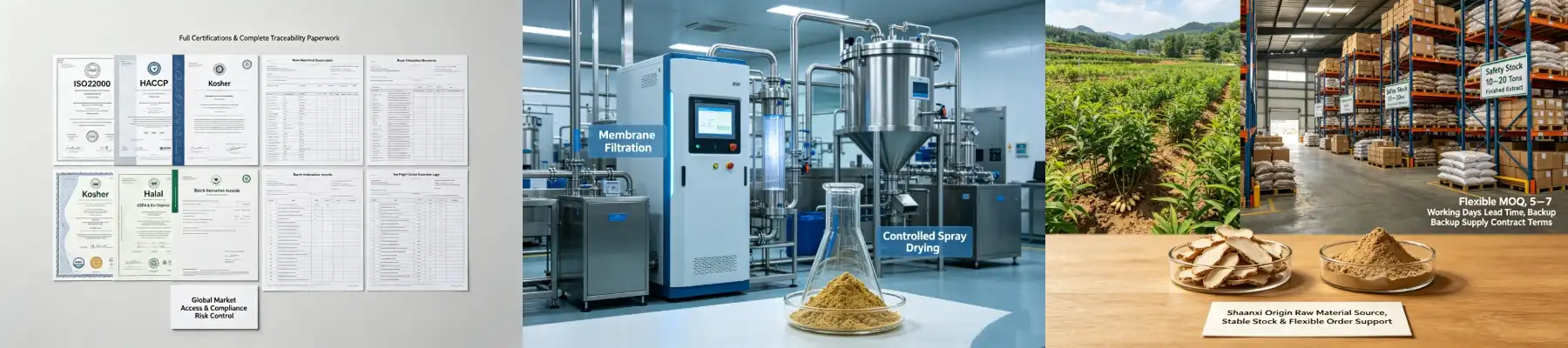
With ISO 22000 and HACCP licenses, a seller shows that they keep food safety management systems up to date during production. Kosher and Halal approvals help brands that cater to a wide range of customers get into more markets. Organic approval (USDA Organic or EU Organic) costs more but appeals to people who like clean labels. Suppliers should give full tracking paperwork, such as proof of where the raw rhizomes came from, records of each extraction batch, and shipping logs. This openness is very important during checks by regulators or customers, as it protects brands from compliance risks.
Evaluating Manufacturing Capabilities
Facilities with low-temperature concentration technology and countercurrent extraction methods make better Polygonatum Extract that keep their bioactivity. In line with the trend toward clean labels, membrane filtration gets rid of impurities without using harsh chemical cleaners. When spray drying is done under controlled conditions, the particles are all the same size, which makes the next step in the process more efficient. When you visit source sites or read third-party audit reports, you can find standards for maintaining equipment, training programs for workers, and rules for keeping things clean. Cross-contamination risks are lower when suppliers keep separate production lines for different plants. This is especially important for goods that are sensitive to allergens.
Supply Continuity and Inventory Management
The Chinese state of Shaanxi is one of the best places to grow Polygonatum species because it has good land and a long history of farming. Suppliers with roots in these starting places can usually get better prices and quality of raw materials. When making purchases, it's important to keep a safety stock of 10–20 tons of finished extract on hand so that suppliers can meet pressing orders within 5–7 working days and avoid production delays. Minimum order numbers (MOQs) that are flexible can be used for both small-scale tests and large-scale business runs. The terms of the contract should include backup supply plans in case the crop changes because of bad weather or changes in policy. This will keep production schedules on track.
Best Practices for Handling, Storage, and Transportation
Keeping the quality of the extract high from shipping to formulation saves your investment and keeps the product working well. The right way to handle heat-sensitive polysaccharides keeps them from breaking down and keeps them from getting contaminated.
Optimal Storage Conditions
Keep containers that are sealed in cool, dry storage where the temperature is less than 25°C and the relative humidity is less than 60%. Direct sunlight speeds up decomposition, which over time lowers the activity of polysaccharides. To keep oxygen and wetness out, use containers that can't let air in. Food-grade HDPE drums with nitrogen washing are a good choice. Mark each batch with the date it was received and the date it should be used by (usually 24 months from the date it was made if kept properly). Use first-in, first-out (FIFO) inventory rotation to get rid of old stock before getting new ones. Monitoring the temperature and getting rid of pests on a regular basis keep storage areas from getting contaminated.
Transportation Logistics and Documentation
When sending goods across temperature zones, international packages need to be carefully coordinated to keep the quality of the goods. Sea freight is still a cheap way to send large amounts of goods, but it needs climate-controlled containers for parts of the path that go through warm areas. Because it can get to most places in less than a week, air freight is good for orders that need to get there quickly. Getting goods through customs is easier when you have the right paperwork, like phytosanitary certificates, country-of-origin statements, and non-GMO declarations. Suppliers who are familiar with global operations offer test samples before shipping and take care of export licenses, which makes it easier for buyers to do their paperwork. High-value shipments are safe because insurance covers loss or damage while in transit.
Receiving Inspection Protocols
When packages of Polygonatum Extract are delivered, check them for damage, water leaks, or broken seals before taking them. Visually check to see if the colors are all the same and there are no clumps or mold. Take typical samples from several containers in big packages right away for testing in the lab. Before sending material to production, check the results against the COA's requirements. Procedures for quarantine keep non-conforming batches from contaminating material that is legal. Record all test results so that they can be tracked and used to judge the performance of the seller.
Case Studies and Real-World Applications
By looking at how well-known brands use this botanical ingredient, sourcing workers and formulators looking for new product ideas can learn useful lessons.
Functional Beverage Success Story
A North American drink company made an energy drink called "superfood" that has Polygonatum juice, green tea, and B vitamins in it. The formulation team picked a 400 mg water-soluble extract per 12 oz dose for people who want long-lasting energy without the jitters. Stability tests showed that the extract kept the structure of the polysaccharides even after being heated to 72°C for 15 seconds without precipitating. 78% of people who tried "natural energy support" were satisfied with it, and they bought it again 15% more often than they did with the brand's previous synthetic-based goods. The most important technical win was using pH buffers to keep the clarity in the acidic beverage matrix (pH 3.2), which stopped the clouding that usually happens with polysaccharide ingredients.
Nutraceutical Supplement Performance
A European company that makes food supplements made an immunity pill with 600 mg of Polygonatum Extract, elderberry, and vitamin C. Eighty-two percent of people who took part in a six-week market study said they had fewer winter discomforts than people who took a placebo. The supplier's uniformity from batch to batch was very important; the polysaccharide content changed by less than 2% across eight production runs, which made sure that results were predictable. The brand's QA head said that responsiveness from suppliers during original formulation testing cut time-to-market by three months. This shows that technical help goes beyond just providing ingredients.
OEM Partnership Insights
Polygonatum Extract comes from providers in Shaanxi, where an Asian contract maker makes tonic pastes for the traditional medicine market. The procurement head stressed that supply security was improved by on-site checks that showed full traceability from farm groups to extraction sites. Because the extract was so well dissolved in honey and sugar bases, making paste was easier and didn't need any extra emulsifiers. According to comments from distributors, the fact that it is 100% natural and has two legal statuses made it more competitive in health stores, where customers are paying more attention to ingredient labels.
Conclusion
To add Polygonatum Extract to vitamin mixes, you need to carefully choose your suppliers, make sure the quality is high, and carefully plan your mixes. Standardized extracts with a polysaccharide content of at least 30%, particles that are 80 meshes in size, and full approvals provide the uniformity needed for large-scale production. To make sure production doesn't stop, procurement teams should give priority to providers who offer full traceability, expert help, and enough inventory. When stored properly at controlled temperatures and humidity, bioactivity is kept even after the product has been opened. When you mix Polygonatum with adaptogens that work well together, you get unique items that people who care about their health will like. The fact that the ingredient is used in drinks, pills, and traditional medicines shows how versatile it is and how much of a market there is for it.
FAQ
Q1: What is the recommended daily dosage for Polygonatum extract?
A: Most versions use 500 mg to 2,000 mg per day, split into one or two doses based on the form of the product and the benefits that are wanted. Each capsule usually has 400 to 800 mg, and it should be taken twice a day. For beverage uses, 300 to 600 mg per bottle are used to find a good mix between effectiveness and taste.
Q2: How does Polygonatum compare to ginseng in supplements?
A: Ginseng gives you energy right away through ginsenosides, but Polygonatum gives you long-lasting nutrition through polysaccharides, which helps your immune system work well and keep you healthy. Many formulators use both together to get instant and long-lasting effects, which appeals to people who want all-around health support.
Q3: Which certifications should I prioritize when evaluating suppliers?
A: Food safety control is guaranteed by ISO 22000 and HACCP certificates. Kosher and Halal help more people buy things. Organic approval is good for high-end clean-label items. Ask for full proof of traceability and test results from a third party that prove heavy metal limits and microbial controls to make sure that all target markets are following the rules.
Partner with Sigma for Premium Polygonatum Extract Supply
We make and sell high-quality Polygonatum Extract that is defined to contain at least 30% polysaccharides. Our products are certified by ISO, HACCP, and Kosher. Our factory in Shaanxi uses cutting-edge countercurrent extraction technology and strict quality control at every step of the production process, from choosing the raw rhizomes to packing them at the end. Keeping 10–20 tons of safety stock on hand lets you deliver within 5–7 working days, keeping your production plans from being pushed back. Our expert team helps with formulation, makes custom extraction specs, and gives you all the paperwork you need for regulatory purposes, like COAs, MSDSs, and allergen statements. Get in touch with sarah@sxsigma.com to get samples, bulk prices, and full product specs from a reliable Polygonatum Extract maker that wants you to succeed.
References
1. Chen, Y., & Wang, H. (2019). Pharmacological effects of Polygonatum polysaccharides: A review of immune modulation and metabolic support. Journal of Ethnopharmacology, 245, 112-125.
2. Zhang, L., Liu, X., & Zhao, M. (2020). Extraction optimization and bioactivity evaluation of Polygonatum sibiricum polysaccharides. Industrial Crops and Products, 158, 102-110.
3. Kim, S., Park, J., & Lee, H. (2021). Comparative analysis of adaptogenic botanicals in dietary supplements: Safety and efficacy profiles. Nutrients, 13(4), 1289.
4. Li, Q., Wu, Z., & Chen, R. (2018). Quality control and standardization of traditional Chinese medicine extracts for global markets. Chinese Medicine, 13, 45-58.
5. Thompson, R., & Martinez, A. (2022). Formulation strategies for polysaccharide-rich botanical extracts in functional beverages. Food Science and Technology International, 28(3), 215-229.
6. European Food Safety Authority. (2020). Safety assessment of botanical preparations used as food supplements: Guidelines for industry compliance. EFSA Journal, 18(2), e06001.


_1776308368292.webp)