How should semen pruni extract supplements be stored for maximum potency?
Semen Pruni Extract stays most potent when it sits in a cool, dry, dark space, sealed tightly against moisture and oxygen. The seed-derived botanical, sourced from Prunus species and standardized around the active marker Prunuside A, loses strength when heat, humidity, or sunlight break down its delicate compounds. A pantry shelf away from stoves and windows works for small quantities, while bulk supplies benefit from refrigeration in airtight, moisture-proof packaging. Buyers who follow these habits protect both the ingredient's quality and their finished product's shelf life.
Understanding Semen Pruni Extract and Its Sensitivity
Semen Pruni comes from the dried seeds of Prunus humilis, Prunus japonica, and related species within the Rosaceae family, a botanical lineage long documented in classical Chinese pharmacology texts such as the Shennong Ben Cao Jing.
Manufacturers extract the seed kernel and concentrate it into a powder standardized for Prunuside A, a purgative marker compound first characterized by Japanese researchers studying Prunus japonica seeds. Because the extract carries flavonoid glycosides in the seed coat and cyanogenic compounds in the kernel, exposure to warmth or dampness accelerates chemical breakdown far quicker than with more stable botanical powders.
What Makes This Botanical Sensitive to Storage Conditions
Seed-based extracts carry natural oils and glycosides that oxidize readily once packaging opens. Moisture absorbed from humid air triggers clumping and microbial growth, while ultraviolet light degrades flavonoid content within weeks. Facilities handling Semen Pruni Extract should treat it with the same caution given to other Prunus-derived botanicals, since their chemistry behaves similarly under poor conditions.
Ideal Temperature and Humidity Ranges
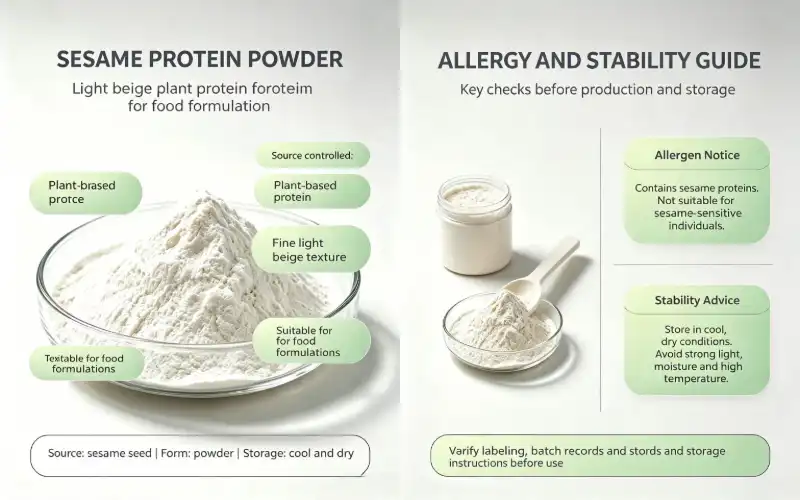
Keeping Semen Pruni Extract between 15°C and 25°C in relative humidity under 60% preserves its active profile far longer than ambient warehouse conditions in humid climates. Nutraceutical formulators generally treat this range as standard practice across dried botanical powders, since enzymatic activity and mold growth both accelerate above these thresholds.
Cool, Dry Environments Protect Prunuside A
A climate-controlled storeroom, free from direct sunlight and steam-producing equipment, gives Semen Pruni Extract and its constituent Prunuside A its longest working life. Warehouses lacking dehumidification should invest in silica desiccant packs placed inside outer cartons, a low-cost step that meaningfully slows moisture uptake during long transit or seasonal storage.
Refrigeration Guidance for Bulk Supplies
Bulk drums intended for extended storage, beyond six months, benefit from refrigeration around 4°C to 8°C. Sigma packages its Semen Pruni Extract in multi-layer, moisture-resistant liner bags precisely so cold storage does not introduce condensation once the container returns to room temperature before opening.
Packaging, Light Exposure, and Container Choices
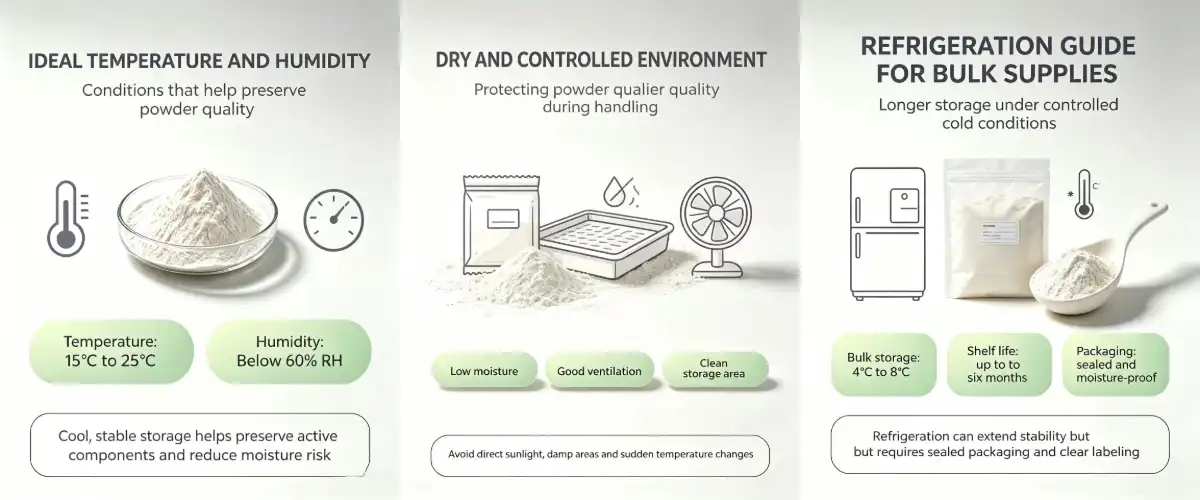
Opaque, airtight containers do more to protect potency than nearly any other single storage decision. Clear jars or thin plastic bags let ultraviolet light and oxygen reach the powder, gradually thinning its active compound concentration. Amber glass, foil-lined pouches, or food-grade HDPE drums with tight-sealing lids all outperform lightweight retail packaging for anything beyond short-term use.
Choosing the Right Packaging Materials
For Semen Pruni Extract and other seed-based botanicals, formulators and distributors frequently use the following packaging options: rigid corrugated outer boxes prevent crushing damage that exposes inner liners to air; moisture-barrier foil bags with heat-sealed edges keep humidity out during ocean freight; anti-static inner packaging reduces powder clumping during bulk transfer between vessels; and tamper-evident seals verify a container has remained closed since leaving the manufacturing fac Because a single weak spot, like a perforated liner, weakens all other precautions implemented along the supply chain, these packaging layers function together rather than separately.
Shelf Life, Degradation Signs, and Testing
Properly stored, Semen Pruni Extract typically holds strong potency for eighteen to twenty-four months when kept sealed, cool, and away from light. Once a container opens, exposure to kitchen or lab air shortens that window considerably, making resealing after each use an important habit rather than an afterthought.
Recognizing Reduced Potency
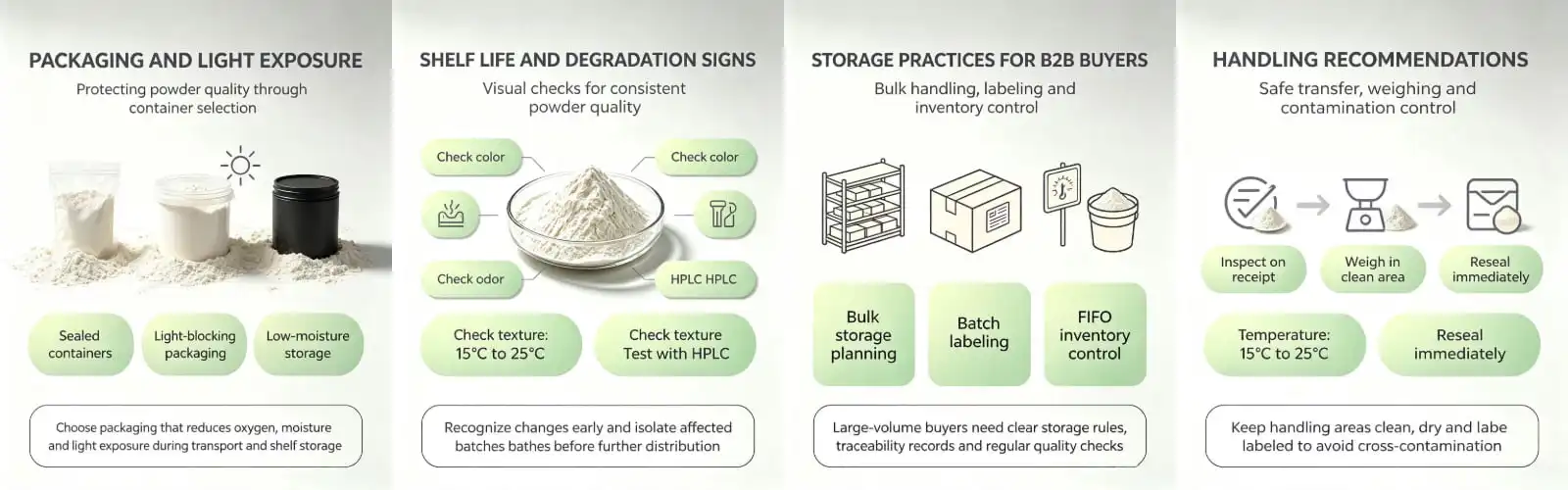
A shift toward clumping, darkening color, or a stale, musty odor usually signals moisture intrusion or oxidative breakdown. Manufacturers relying on HPLC profiling can confirm Prunuside A concentration directly, giving buyers documented proof of remaining strength rather than relying on appearance alone.
Storage Practices for B2B Buyers and Manufacturers
Companies sourcing Semen Pruni Extract for capsule, tablet, or tea-bag production face storage challenges beyond what a home user encounters, since bulk drums sit in warehouses for months before entering a production line. Rotating stock on a first-in, first-out basis prevents older batches from lingering past their optimal window, and labeling each drum with receipt date and lot number keeps quality teams informed at a glance.
Bulk Handling Recommendations for Manufacturers
Warehouse teams handling large volumes benefit from a few consistent habits: storing pallets off the floor to avoid ground moisture; keeping loading dock doors closed during humid weather to limit ambient humidity spikes; scheduling periodic HPLC testing on stored lots rather than only at intake; and training staff to reseal partially used drums immediately after sampling. These routines, taken together, keep raw material variability low across production runs and support consistent finished-product labeling claims.
Conclusion
Semen Pruni Extract rewards careful handling. A cool, dry, dark environment paired with airtight, moisture-resistant packaging preserves Prunuside A and the extract's broader phytochemical profile far longer than casual storage allows. Bulk buyers gain additional protection through refrigeration, desiccants, and periodic potency testing, while smaller-scale users simply need a sealed container away from heat and sunlight. Following these habits protects both raw material investment and the quality customers expect from finished botanical products.
FAQ
Does Semen Pruni Extract need refrigeration?
Refrigeration around 4°C to 8°C benefits bulk quantities stored beyond six months, though smaller retail amounts stay stable in a cool pantry away from heat sources.
How long does an opened container remain potent?
Once opened, resealing tightly after each use and storing away from humidity typically keeps quality strong for several months, though testing remains the most reliable confirmation.
What packaging protects the extract best?
Opaque, moisture-barrier materials such as foil-lined pouches or amber containers block the light and air exposure that degrade Prunuside A most quickly.
Can heat exposure ruin the extract permanently?
Repeated heat exposure accelerates oxidation and can permanently reduce active compound concentration, so avoiding proximity to stoves, radiators, or direct sunlight matters throughout storage.
Get Storage-Ready Semen Pruni Extract From Sigma
Sourcing consistent, well-preserved raw material starts with a manufacturer who controls storage from extraction through shipment. Shaanxi Sigma Biotechnology Co., Ltd. packages every batch of Semen Pruni Extract in moisture-barrier liners with documented Prunuside A specifications, giving formulators dependable potency batch after batch. Reach out to sarah@sxsigma.com or visit sxsigma.com to request samples, certificates of analysis, or bulk pricing from a trusted Semen Pruni Extract manufacturer.
References
1. Oshio, H., Miyamoto, M., & Sanno, Y. Studies on a new purgative constituent of Prunus japonica Thunb., prunuside. Yakugaku Zasshi, 1975.
2. He, L.Y., & Li, B.M. MicroHPLC determination of amygdalin in Semen pruni armeniacae and Semen pruni persicae. Biomedical Chromatography, 1988.
3. He, X., Wu, L., & Wang, W. Amygdalin: A pharmacological and toxicological review. Journal of Ethnopharmacology, 2020.
4. China Pharmacopoeia Committee. Pharmacopoeia of the People's Republic of China, Volume 1. China Chemical Industry Press, 2020.
5. Evaluation of the chemical profile from four germplasm sources of Pruni Semen using UHPLC-LTQ-Orbitrap-MS and multivariate analyses. Published research on Prunus seed authentication and chemical fingerprinting.
6. Colic, S.D., Fotiric Aksic, M.M., & Lazarevic, K.B. Fatty acid and phenolic profiles of almond grown in Serbia. Food Chemistry, 2017.


_1776308368292.webp)