How to Take Ashwagandha Powder: A Comprehensive Guide
Ashwagandha powder and Pure Ashwagandha Extract derived from Withania somnifera roots deliver adaptogenic benefits through different concentration levels and application methods. While traditional powder retains the complete botanical matrix, standardized extracts provide precise withanolide content ranging from 2.5% to 10%, ensuring batch consistency critical for pharmaceutical-grade formulations. Understanding proper dosing protocols, formulation compatibility, and supplier selection criteria empowers B2B manufacturers to develop efficacious products that meet regulatory standards while addressing consumer demand for natural stress management and restorative sleep support solutions.
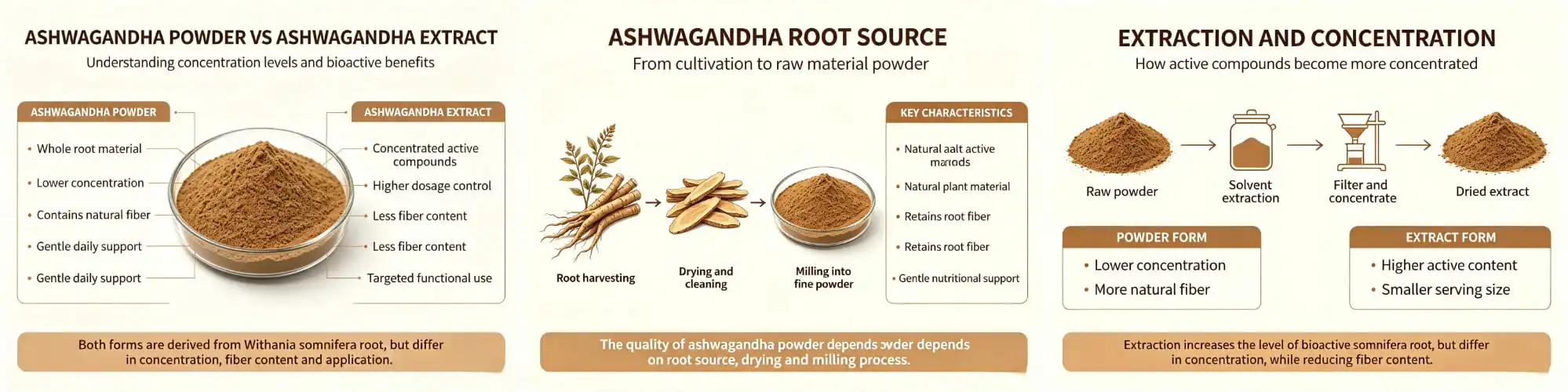
Understanding Ashwagandha Powder and Pure Ashwagandha Extract
Ashwagandha goods are made from the plant Withania somnifera, which is a nightshade family member that is mostly grown in India and some places of the Middle East. The most basic form of Ashwagandha is raw powder, which is made by drying and crushing whole roots into small pieces. This method keeps all the phytochemical parts, like alkaloids, saponins, and trace minerals, but it only gets withanolide amounts of 0.1% to 0.5%, which are fine for everyday health uses but not for clinical-grade products.
Botanical Origins and Processing Methods
Today's extraction methods turn raw materials into concentrated forms that are always strong. Food-grade ethanol is used in hydro-alcoholic extraction to separate lipophilic withanolides, which makes extracts with 5–10% active compounds. Water-based extraction works best for hydrophilic substances because they dissolve completely in water. However, it usually results in smaller amounts of withanolide. Advanced manufacturers use supercritical CO2 extraction to get a fine, yellow-brown powder that has more than 25% fatty acids. This process keeps the thermolabile compounds while getting rid of the solvent residues. As the market for clean-label products grows, this method fits in with that trend. It also meets legal concerns about residual solvents.
Quality Parameters for B2B Procurement
When purchasing Ashwagandha materials, teams need to look at more than just the percentages of withanolide. The flowability of encapsulation is affected by the spread of particle sizes. 80 mesh powder provides even mixing without bridging in hopper systems. Loss on drying levels below 2% stop the growth of microbes during storage and keep things stable in wet places. Heavy metal profiles that meet USP 2232 standards protect against cadmium and lead poisoning that is common in plants that come from areas with dirty soil. If the ash content is less than 5%, it means that there isn't much inorganic filler. HPLC fingerprinting checks the authenticity of the leaf against leaf adulteration methods that boost withanolide readings by adding cytotoxic withaferin A.
Industrial Application Diversity
Ashwagandha's economic flexibility is shown by the fact that it can be used in different types of businesses. Nutraceutical companies put standardized ingredients into pills and tablets that are meant to lower cortisol and improve brain function. For ready-to-drink stress relief mixes, functional beverage developers like to use extracts that dissolve in water. Because it is an antioxidant, Ashwagandha is added to anti-aging serums by cosmetic formulators. Lower-concentration powders are used in the animal feeding industry as feed fillers to help animals handle stress better. Different uses need different extraction conditions, particle types, and certification profiles. For example, organic certification is needed for high-end customers, Halal and Kosher certification is needed for markets that share the same culture, and HACCP certification is needed to make sure that food safety rules are followed.
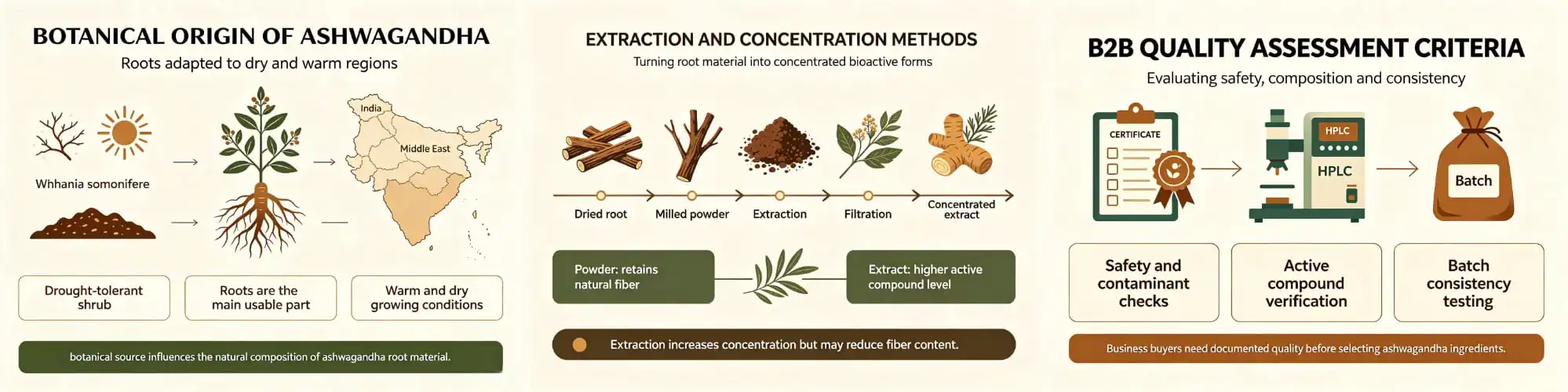
How to Correctly Use Ashwagandha Powder and Extract in Formulations?
This is precisely where Pure Ashwagandha Extract becomes the ingredient of choice for commercial formulations. By standardizing the withanolide content through a verified extraction process, Pure Ashwagandha Extract allows manufacturers to compress the clinically effective dose into just one or two small capsules (e.g., 300 mg fill weight at 5% withanolides). This not only solves the capsule-sizing bottleneck associated with raw powders but also improves the unit economics: lower shipping weight, smaller bottle sizes, and reduced excipient needs. The key to market success lies in qualifying a Pure Ashwagandha Extract supplier that provides batch-specific HPLC certificates, ensuring every production run delivers the exact 300–600 mg bioactive equivalent that clinical trials have validated.
Dosage Guidelines Across Product Categories
Manufacturers of dietary supplements usually set the single-dose delivery to 300 mg of extract per capsule. This lets people take them twice a day without having to take too many pills. Powdered drink mixes come in serving amounts of 1g to 2g, and their mildly bitter taste needs to be hidden by natural flavourings. Topical uses in cosmetics use extract concentrations between 0.5% and 2%, which balances how well the extracts penetrate the skin with how stable they are in emulsion systems. Veterinary uses follow protocols that are specific to each species. For example, daily doses for horses range from 5g to 10g, and daily doses for pets are based on their body weight.
Synergistic Ingredient Combinations
Ashwagandha's adaptogenic benefits are increased by strategic co-formulation, which also addresses other health processes. When combined with L-theanine, it boosts GABAergic neurotransmission, which makes you feel more relaxed without making you sleepy. Combinations of magnesium glycinate help muscles heal and keep the nerve system in check. Rhodiola rosea co-extraction makes dual-adaptogen products that work on both short-term stress responses and long-term building of resiliency. Adding phosphatidylserine improves brain ability, and combining it with melatonin makes sleep-starting formulas work better. These mixes need to be tested for stability to make sure that the ingredients will still work together during the shelf life when they are aged faster.
Common Formulation Pitfalls and Mitigation Strategies
Because Ashwagandha absorbs water and reacts badly to changes in temperature, it can be hard to make. When temperature control isn't good enough during production, moisture is absorbed, which makes the product less fluid and more likely to clump. Using 40% relative humidity thresholds and desiccant packaging systems helps keep the powder's properties. If you process withanolides at temperatures above 120°C, they break down slowly, so you need to use cold encapsulation technologies or enteric coating applications. Because of the risk of microbial pollution, all arriving raw materials must be tested for yeast, mould, pathogenic bacteria, and total plate count. Protocols for storage require that goods be kept in sealed containers in temperature-controlled areas below 25°C, away from direct light that speeds up oxidative degradation.
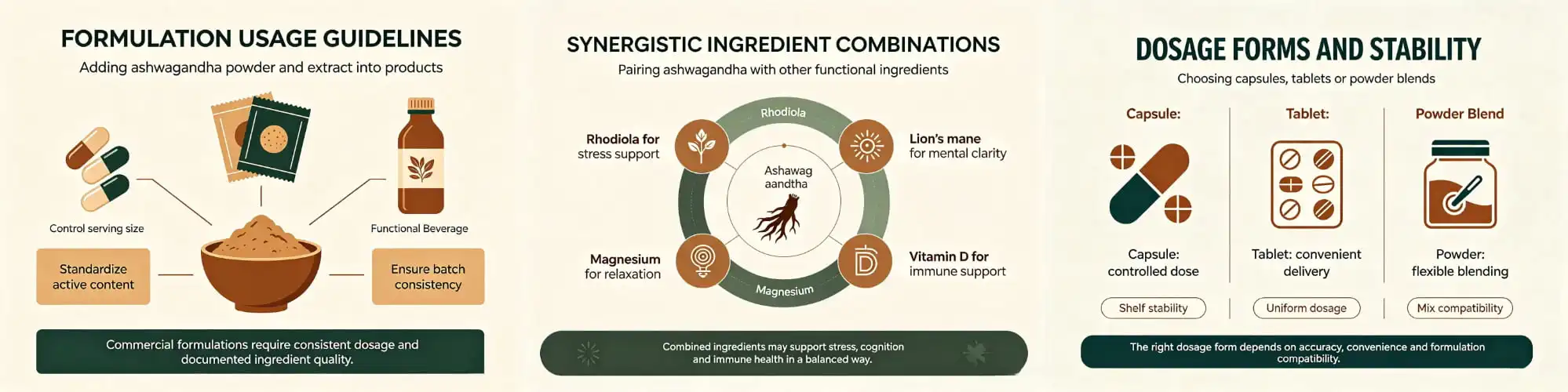
How to Choose the Best Pure Ashwagandha Extract Supplier?
Choosing the right supplier has a direct effect on the standard of the product, compliance with regulations, and business success. There is a wide range of quality in the global Ashwagandha market, from pharmaceutical-grade companies that follow GMP guidelines to commodity suppliers that sell inconsistent material. Setting up frameworks for evaluating suppliers protects procurement investments and the brand's reputation.
Critical Evaluation Criteria
All of these analytical and certification benchmarks ultimately determine whether a supplier can consistently deliver Pure Ashwagandha Extract that meets clinical and regulatory expectations. A credible supplier of Pure Ashwagandha Extract must provide batch-specific Certificates of Analysis generated through in-house HPLC, listing individual withanolides—such as Withaferin A, Withanolide A, and 12-Deoxywithastramonolide—rather than relying on generalized gravimetric totals. Stability data demonstrating uniform potency over 24 months under ICH storage conditions further validates that the Pure Ashwagandha Extract will maintain its labelled efficacy throughout its shelf life.
Full traceability documentation, connecting finished extract batches back to specific source farm locations, ensures supply chain transparency and enables rapid root-cause analysis in the event of contamination. When these analytical capabilities are paired with facility certifications—ISO 9001 for quality management, ISO 22000 for food safety, and FSSC 22000 for complete system requirements—the supplier proves not only technical competence but also full readiness to meet legal and audit standards, transforming Pure Ashwagandha Extract from a raw ingredient into a clinically defensible, market-ready product.
Organic Certification and Regulatory Alignment
Premium market groups are willing to pay more for organically certified materials, which meets customer desires for farming without pesticides. For USDA and EU Organic certifications, farming methods must be checked by a third party, processing must be separated, and there must be an annual inspection cycle. These certificates make it easier to get to markets in places with strict organic rules and back up claims of clean labels. In addition to organic status, there are regional regulatory requirements that need to be met. These include FDA GRAS approval for food applications in the U.S., Novel Food authorisation for European markets that opened after 1997, and TGA listing requirements for medicinal goods in Australia. Suppliers who keep legal documents up to date shorten the time it takes to start a product and lower the risk of not following the rules.
Bulk Purchasing Economics and Logistics
Prices that are based on volume show how economies of scale work in botanical extraction. Manufacturers usually offer different levels of pricing: spot sales for more than 100 kg, contract pricing for agreements of more than 1000 kg every three months, and strategic partnership terms for yearly amounts over 5000 kg. Optimising the load of containers lowers the cost of moving each unit. Depending on the density of the packaging, 20-foot containers can hold between 10,000 and 12,000. Even though it costs three to five times more than ocean transport, air freight is still a good option for urgent needs. When you choose Incoterms, like FOB for buyer-controlled logistics, CIF for seller-managed ocean freight, or DDP for delivered duty-paid convenience, you decide who is responsible for risk and cost along the whole international supply chain.
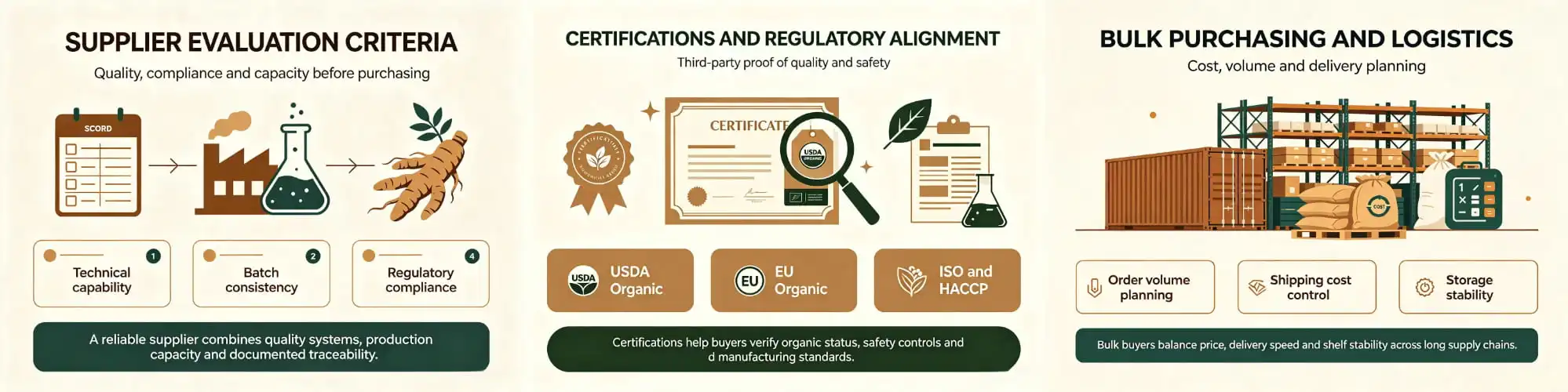
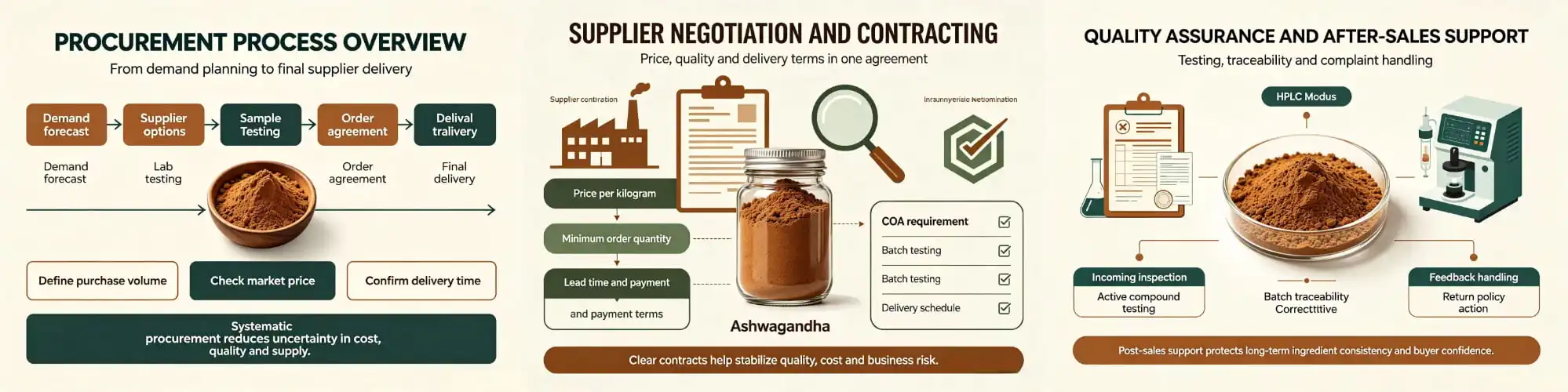
The Procurement Process for Pure Ashwagandha Extract and Powder
Systematic methods to buying keep supply disruptions to a minimum while cost structures are optimised. The first step in the acquisition process is predicting demand based on production schedules, the need for safety stock, and lead time factors. The agricultural seasonality of Ashwagandha causes price changes. After the harvest, when new crop supplies enter the processing channels, prices are lower.
Supplier Negotiation and Contract Structuring
Requests for quotes should include all scientific details, such as the amount of withanolide needed and how it should be analysed, as well as the particle size range, microbial limits, heavy metal standards, allergen status, and GMO statements. By getting samples from chosen providers, R&D can be confirmed through formulation trials and rapid stability studies before making a commitment. Payment terms balance managing cash flow with reducing supplier risk. Letters of credit protect foreign deals, and net-30 to net-60 terms award suppliers with long-term relationships. Quality agreements spell out the rules for accepting specifications, how to settle disagreements, and what needs to be done to fix material that doesn't meet standards.
Import Documentation and Customs Clearance
Getting Ashwagandha from other countries needs careful planning of all the necessary paperwork. On commercial bills, you can find full descriptions of the goods, their Harmonised System numbers (usually 1211.90 for plant extracts), their stated values, and the country where they came from. Phytosanitary certificates prove that plants are free of pests when farm trade rules require them. Shipments come with certificates of analysis that tell customs officials about the contents so they can set the right tariffs. Regulatory entries, like FDA Prior Notice for U.S. imports and TRACES notices for EU entry, must be made before the goods arrive in person to avoid being held. Customs agents with a lot of experience can handle classification issues and speed up the clearance process, which is especially helpful for shipments that need to be kept at a certain temperature and need cold chain upkeep.
Quality Assurance and After-Sales Support
Protocols for receipt checking ensure that incoming Pure Ashwagandha Extract meets purchasing specifications before warehouse acceptance. Following ISO 24153 rules for representative sampling guarantees statistical validity, supported by third-party laboratory reports of analysis. In case of disputes, the Pure Ashwagandha Extract supplier is notified and the material is quarantined until resolution. Reliable Pure Ashwagandha Extract suppliers offer technical support throughout product development, including formulation, stability, and regulatory documentation assistance. Batch tracking systems enable rapid quality reviews by linking finished product complaints to specific Pure Ashwagandha Extract lots. Long-term relationships are built on reliable Pure Ashwagandha Extract delivery, open communication, and collaborative problem-solving during supply chain interruptions.
Maximizing Value: Using Ashwagandha Extract in Your Business
Strategically combining Ashwagandha ingredients makes them stand out in wellness markets that are already very crowded. Product positioning opportunities exist in the areas of managing stress, getting a better night's sleep, recovering from athletic performance, improving cognitive function, and healthy ageing. For each role, you need a unique marketing story backed up by clinical data and formulation design.
Product Differentiation Through Extract Specifications
The amount of withanolide is a main factor that sets them apart. Brands that are trying to stay within their budgets use 2.5% extracts and charge low prices to attract price-conscious customers. This is called value branding. Premium brands list concentrations between 5% and 10%, and their higher prices are based on claims of effectiveness backed up by clinical dosing research. When compared to materials that have been mixed with leaves, root-only sources sends a message of truthfulness that is in line with traditional Ayurvedic practices. Consumers believe products with organic approval, non-GMO verification, and third-party testing seals, which is why they cost more on the shelf. Intellectual property moats and supply chain exclusivity are made possible by proprietary extraction methods, like Sigma's supercritical CO2 technology, which makes 80 mesh powder with ≥25% fatty acids.
Competitive Positioning Against Alternative Adaptogens
The term "adaptogen" refers to a group of different plants that all have benefits that are similar and different. Ashwagandha has a lot of strong evidence from clinical studies, especially studies that show it can lower cortisol levels and help testosterone levels. Rhodiola rosea is better for short-term stress because it works faster to boost energy, while Ashwagandha is better for nighttime use and building long-term resilience. Maca root helps with energy and hormone balance, so it works with other foods instead of competing with them. Holy basil is high in antioxidants and helps the metabolism. Combination products that use more than one adaptogen appeal to a wider range of consumers, but they are more difficult to make and cost more.
Future Market Trends and Sourcing Strategies
As consumers become more educated, they want more information about how products are extracted, tested, and how they are sustainable. Traceability systems that use blockchain are becoming more common in quality botanical supply chains. These systems provide farm-to-formula proof. The effects of climate change on traditional farming areas mean that we need to explore controlled environment agriculture and grow crops in different areas. Concerns about ethical sources can be addressed by sustainable harvesting standards like Fair Trade and Rainforest Alliance. Biotechnology advances, like plant cell culture and biochemical production, may help traditional farming while also making sure there is a steady supply. When business-to-business buyers keep an eye on these trends, they position themselves as leaders in innovation. They can reach new consumer groups and protect supply chains from problems caused by farming in the future.
Conclusion
To make Ashwagandha powder and Pure Ashwagandha Extract, you need to know a lot about botanical quality factors, extraction methods, dosing protocols, and how to judge a seller. Product development that works well strikes a balance between the need for effectiveness and the need to make the product in a way that is practical, affordable, and in line with regulations. B2B manufacturers can take advantage of growing consumer interest in botanical solutions for stress relief, better sleep, and overall wellness improvement in nutraceutical, functional food, and cosmetic products by forming strategic partnerships with suppliers that offer certified materials, technical support, and reliable logistics.
FAQ
What distinguishes root-only from leaf-containing ashwagandha extracts?
Traditional Ayurvedic methods call for root-only samples to have high levels of withanolide A and low levels of withaferin A, a cytotoxic chemical that is higher in leaf material. Adding leaves lowers the cost of production, but it may also raise the risk of poisoning and lower the safety profile needed for food supplement uses.
How does extraction solvent choice affect product applications?
When you extract with water, you get fully soluble material that is great for making drinks, but the percentage of withanolide is smaller. Hydro-alcoholic extraction recovers the most bioactive compounds and is best for capsules. However, it is less useful for liquid applications because the compounds are less soluble in water.
Which analytical method provides accurate withanolide quantification?
HPLC research finds and counts individual withanolide chemicals, giving exact information on their potency. Gravimetric methods measure all precipitated substances without being specific, and the results are often two to three times higher than what is actually present of withanolide compared to HPLC results.
What represents appropriate clinical dosing for stress support?
In clinical studies that show cortisol reduction and stress management benefits, 300 mg to 600 mg daily of a high-concentration extract (>5% HPLC withanolides) is usually given in two separate doses.
Partner with Sigma for Premium Ashwagandha Extract Supply
Shaanxi Sigma Biotechnology Co., Ltd. is a recognised manufacturer that uses modern supercritical CO2 extraction to make Pure Ashwagandha Extract that is safe for use in medicine. Our yellow-brown fine powder meets international standards for heavy metals and contains at least 25% fatty acids at an 80 mesh particle size. It also loses less than 2% of its weight when it dries. Certifications in ISO 22000, HACCP, and Halal allow access to markets around the world, and 10–20 tonnes of safety stock allows for delivery times of 5–7 days. Technical teams offer advice on formulation, help with stability, and full paperwork support, including help with COA, MSDS, and regulatory files.
Our "technology plus origin" advantage, which combines Shaanxi's best botanical resources with modern extraction infrastructure, helps procurement managers find reliable Ashwagandha extract suppliers. Get in touch with sarah@sxsigma.com to talk about custom specifications, ask for samples, and build long-term supply partnerships that are backed by our quality guarantee and 24/7 communication promise.
References
1. Chandrasekhar, K., Kapoor, J., & Anishetty, S. (2012). "A Prospective, Randomized Double-Blind, Placebo-Controlled Study of Safety and Efficacy of a High-Concentration Full-Spectrum Extract of Ashwagandha Root in Reducing Stress and Anxiety in Adults." Indian Journal of Psychological Medicine, 34(3), 255-262.
2. Mishra, L. C., Singh, B. B., & Dagenais, S. (2000). "Scientific Basis for the Therapeutic Use of Withania somnifera (Ashwagandha): A Review." Alternative Medicine Review, 5(4), 334-346.
3. Pratte, M. A., Nanavati, K. B., Young, V., & Morley, C. P. (2014). "An Alternative Treatment for Anxiety: A Systematic Review of Human Trial Results Reported for the Ayurvedic Herb Ashwagandha." Journal of Alternative and Complementary Medicine, 20(12), 901-908.
4. Singh, N., Bhalla, M., de Jager, P., & Gilca, M. (2011). "An Overview on Ashwagandha: A Rasayana (Rejuvenator) of Ayurveda." African Journal of Traditional, Complementary and Alternative Medicines, 8(5 Suppl), 208-213.
5. Wankhede, S., Langade, D., Joshi, K., Sinha, S. R., & Bhattacharyya, S. (2015). "Examining the Effect of Withania somnifera Supplementation on Muscle Strength and Recovery: A Randomized Controlled Trial." Journal of the International Society of Sports Nutrition, 12(1), 43.
6. Winters, M. (2006). "Ancient Medicine, Modern Use: Withania somnifera and Its Potential Role in Integrative Oncology." Alternative Medicine Review, 11(4), 269-277.


_1776308368292.webp)