How Does Pure Ashwagandha Extract Support Stress and Sleep Naturally?
Pure ashwagandha extract supports stress and sleep naturally by concentrating the active compounds of the Withania somnifera root, especially withanolides, into a consistent, measurable dose. Human studies suggest these compounds may help the body respond to everyday stress, lower perceived stress scores, and improve sleep onset and sleep quality in some adults. Results depend on the extract profile, dose, study length, and the individual. In this guide, I explain how the extract works, what the research shows, and how brand teams can judge specifications, quality, and suppliers before they buy.
What Is Pure Ashwagandha Extract?
Before you look at different suppliers, you should know what the ingredient is and what "pure" means.
A Concentrated Form of Withania somnifera
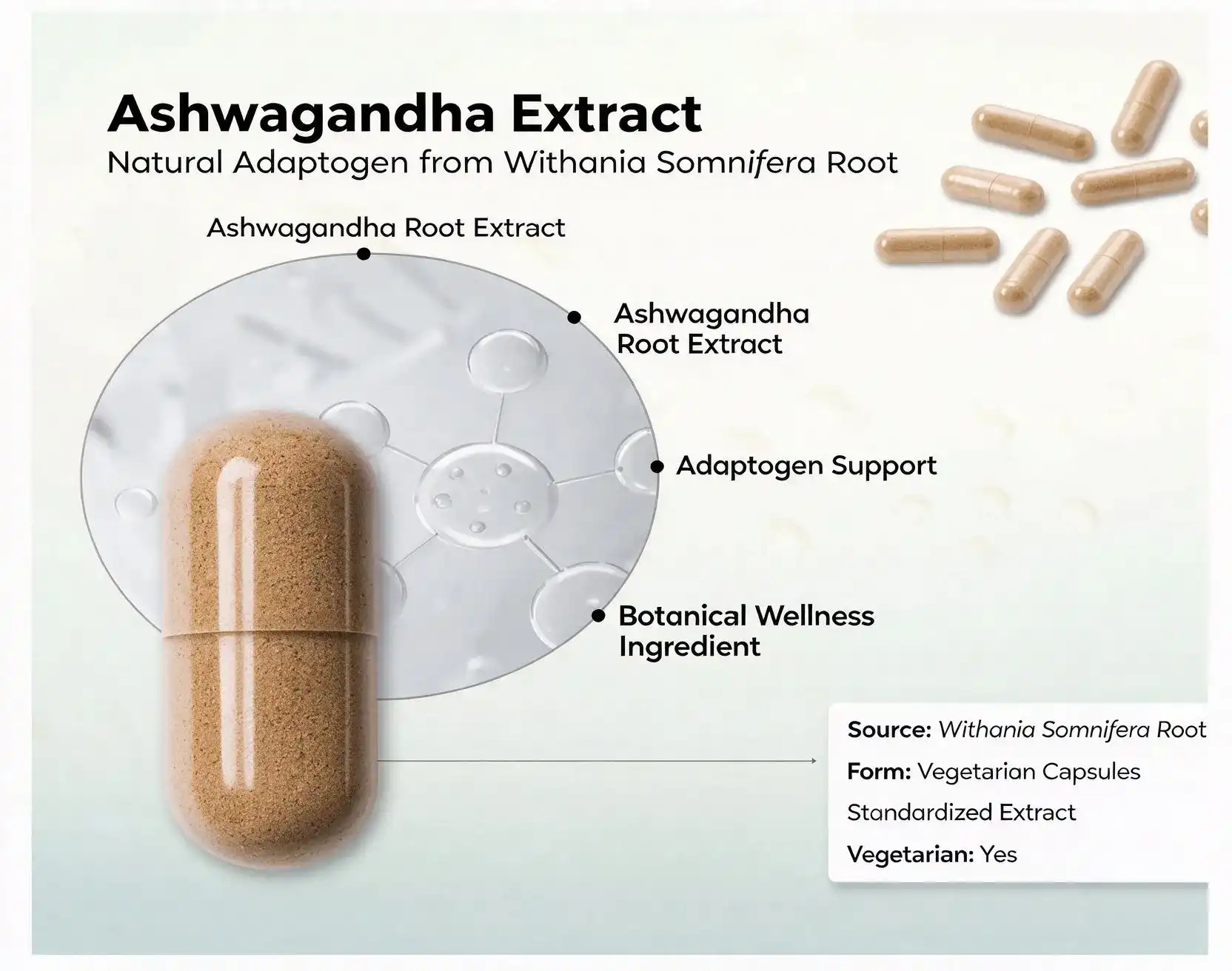
An Ayurvedic doctor has used the root of this bush for hundreds of years. It is a nightshade plant. The active chemicals in the root, or occasionally both the root and the leaf, are combined in pure ashwagandha extract. The plant is taken out of its place with water or a cleaner. A lot of people know about withanolides as markers. Their name comes from the group of steroidal lactones that researchers use to describe and standardize the stuff. The chemicals change when the plant part is added, which is why I always ask the seller to write that on the form. A root-only extract and a root-and-leaf extract may look and act differently in a study, even though they look the same in the jar.
How an Extract Differs From Raw Root Powder
Raw root powder is made up of ground up plant matter. To have the same amount of marker content, a serving needs to be heavier because it has cellulose and other matrix compounds. An extract gets rid of a lot of that fat. So the pill will be smaller, the amount will be easier to guess, and there will be more capsules, tablets, powders, gummies, and drinks to choose from. In low-cost mixes, you can use cheap powder. An uniform extract should be used for things that need a clear marker level. A full-spectrum extract has a bigger range of natural compounds, and pills that are already made are good for programs that are ready to sell. I check the form to make sure it fits the idea of the offering before I talk about price.
What "Pure" Should Mean on a Specification
"Pure" isn't a legal word for plant extracts, so I see it as a claim that needs to be cleared up. An honest seller will list the species, the part of the plant used, the method of extraction, any carriers or excipients, and offer group testing. The quality isn't just based on the amount of withanolide, even though that is important. How well an extract works in a finished product is also affected by how it tastes, how well it is tolerated, and how safe it is. Because of 21 CFR Part 111 rules from the FDA, companies that make dietary supplements need to be sure that the ingredients they use are real. Clear paperwork from the supplier of the ingredients will save you time in the long run.
How May Pure Ashwagandha Extract Support Stress and Sleep Naturally?
Read about sleep and stress to get a better idea of how this plant really works.
Supporting the Body's Response to Everyday Stress
Adaptogens are plants that have been looked into to see if they can help the body deal with stress. Ashwagandha is one of these plants. One study from 2012 in the Indian Journal of Psychological Medicine looked at 64 adults who took 300 mg of a strong root extract twice a day for 60 days. They were less worried and had less cortisol in their blood than the people in the control group. A 2019 study in Medicine looked at 60 worried people who took 240 mg every day. They discovered that their cortisol and DHEA-S levels were lower in the morning. This doesn't mean that ashwagandha is a cure, though. With their work, they show that the extract might work well in formulas that help with stress.
Sleep Onset, Sleep Quality, and Nighttime Relaxation
Sleep research has grown really quickly. For 10 weeks, 60 people in Cureus (2019) took 300 mg of root extract twice a day. They said that people who were given the drug slept better and fell asleep faster than people who were given a placebo. In 2021, PLoS ONE published a study that looked at five randomized trials with about 400 people. It found a small but noticeable change in the quality of sleep. It seemed to work better for people who had trouble sleeping when they took at least 600 mg every day for eight weeks or more. The numbers were interesting, but I didn't think they were a sure thing because the study methods and excerpts were different.
One Part of a Broader Routine
It's true that stress and sleep are linked. A tense day often makes it hard to sleep at nite, and the next day's stress is worse when you don't get enough sleep. So, I talk about pure ashwagandha extract as one possible part of a bigger plan that includes working out regularly, eating well, going to bed at the same time every nite, and not drinking too much caffeine late at nite. People who have trouble sleeping, anxiety, or a medical condition should see a therapist. Customers should know that vitamins should be used along with healthy habits and not instead of them. This should be made clear on packages and product pages.
What Does the Evidence Say About Pure Ashwagandha Extract Benefits?
Study looks good, but it only looks at the extracts they tested.
What Human Studies Have Measured
Scientists have studied how ashwagandha impacts stress levels, sleep quality, ease, general health, workout recovery, physical ability, and some brain tests. Supplement makers care most about how much you sleep and how stressed you are. The dose, plant part, extraction ratio, and level of uniformity used in each study are all different. There was only one study that looked at an extract that was known to contain 35% withanolide glycosides. We don't know much about another extract from what that study found. The same goes for brand-name ingredients like KSM-66 and Sensoril, which have their own training and licensing plans. I look at the plant name, extraction method, marker chemicals, and amount of a study against the stuff I want to buy before I believe it.
Dosage and Formulation Considerations
The dose is not based on the weight of the raw powder; it is based on the ratio of extract to plant part, the format, the purpose, and the standardization. I don't think those numbers are always right because each of the studies above used a different amount of extract every day—between 240 mg and 600 mg. Formulators need to check the product's shelf life, ability to dissolve, flow, and hold water. They should also look at its bacteria limits, pill capacity, and taste-masking power. There are different types of extracts, such as pills, tablets, powders, liquids, candies, and drinks. However, each has its own problems with stability. Technical documents, a safety study, data on stability, and rules for the target market should be used to decide how much of a serving to give.
Safety and Compliant Claims
The same amount of thought needs to be put into safety. Some side effects that have been mentioned are stomach issues and feeling sleepy. In 2020, Liver International put out a case study that showed ashwagandha products can hurt the liver. Talk to a doctor first if you are pregnant or breastfeeding, have thyroid issues, or take drugs that make you sleepy or weaken your immune system. A supplement can say in the US that it "supports relaxation" as long as the company has proof, tells the FDA within 30 days of marketing, and prints the required disclaimer. It could say that it can help with things like worry, sadness, or not being able to sleep. The rules are different for the UK and Australia, so I think they should be looked at again for each place.
How to Choose and Verify Pure Ashwagandha Extract?
After the science makes sense, choose a standard and go over the paperwork that goes with it.
Choosing the Specification
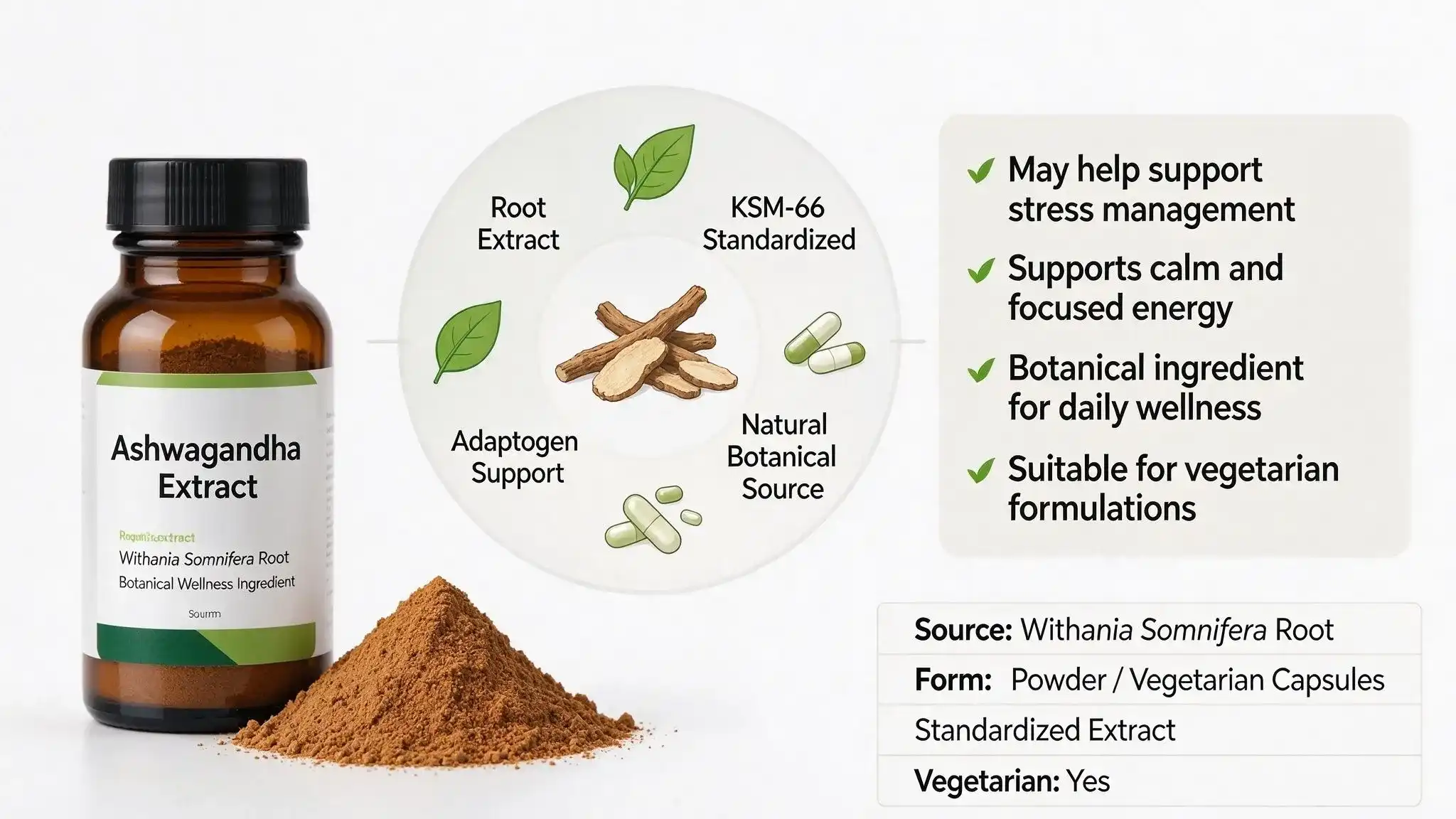
A full-spectrum extract keeps more of the root's original type, but it changes more from lot to lot for what it's made of. An example of a standard extract is withanolides, which are usually found by using HPLC to measure them. Because it's easier to plan doses and keep better track of batches, prices tend to go up. More than a certain number is not always better. What you say must be backed up by the amount of food given, how it tastes, how well it's accepted, how much it costs, and the proof you use. Prices, availability, and the length of time that a certificate is valid are all different for organic and conventional options. Finally, I use test batches to be sure my choice is the right one. The material must use root or root-and-leaf.
Reading a Certificate of Analysis
Not just any leaflet will do; a Certificate of Analysis (COA) that is unique to a batch tells me more. First, I look over these:
- Identity and assay: The COA should list the test method, like HPLC, along with the species, plant part, extraction ratio, and marker content. As important as it is to pass, it's also important to compare more than one batch. Also, find out if the test was done by the supplier's own lab or a lab from outside the company.
- Safety limits: To be safe, check for heavy metals, solvent residues, herbicide residues, and microbe counts. Each one has a capped number and a resulting number. Ask them about their ideals and the rules they follow, such as the USP or EP limits that your product needs. Checking a line that only says "conforms" isn't very useful.
- Adulteration checks: To get readings for lift markers, you can add leaf matter or species that look like Withania somnifera. This is done to check for adultery. Before you send each lot to be made, check that the part of the plant that was declared matches the written specification. In order to confirm identity, you can use microscope, HPTLC fingerprinting, or DNA.
These checks find mistakes before they get sent to the factory floor.
Certifications and Supplier Evaluation
look at the certificate's expiration date, the organization that issued it, and the things and websites that it covers. There are different kinds of papers that show different things. Some are GMP, HACCP, ISO, Halal, Kosher, organic, or non-GMO. Words like "premium" and "pharmaceutical grade" need numbers to back them up for pure ashwagandha extract. Next, I look at each supplier's minimum order number (MOQ), wait time, experience with exporting, expert support, and total landed cost. The landed cost includes freight, customs fees, insurance, testing, storage, and other costs. Tests by a third party, a pilot batch, a quality agreement that covers changes and swaps that haven't been allowed, and then regular requalification are all steps that must be taken. If you want to get a good deal during the busy season, buy early.
Sigma Ashwagandha Extract: Product Information and Supply
In this way, our Ashwagandha Extract meets the above requirements.
Product Specifications
We currently have a fine yellow-brown powder of Ashwagandha Extract in stock. On the product sheet, it says that the particles are 80 mesh, lose no more than 2% of their weight when dried, and have the right amount of heavy metals for international standards. It says that the active ingredient is fatty acids that are at least 25%, and that they are taken out using supercritical CO2 extraction. It's okay to use for Halal, ISO, and food additives. The storage room stays cool and is locked up. While the sheet doesn't say how much withanolide is in this grade, teams that need one should let us know what their goal is before they place an order.
Production Process and Quality Control
Picking the raw materials, grinding and screening them, getting the ethanol out of them, filtering, vacuum-concentrating, drying, sieving and mixing them again, testing, and packing are the steps in our process. The place where we work, Shaanxi, really does make medical materials. We work on lines that use low-temperature concentration and fine separation to make continuous countercurrent extractions. In quality control, the raw materials are checked first, and then the finished product is checked. Our team can check each step to make sure everything is the same. The information sheet for the product talks about a natural plant source, a high level of active ingredients, stable product quality, professional production, and supercritical extraction technology.
Applications, OEM Options, and Delivery
The product sheet says that the stuff is made from 100% natural plant extracts and can help people who have trouble sleeping, are mentally stressed out, or just want to relax in a natural way. To follow the rules in each country, brands should change how they say things to people. We keep 10–20 tons of key goods in stock as a safety net and can send them out in 5–7 business days. One of the things we do for OEM/ODM clients is set the extraction ratio, particle size, packaging, and labeling. You can get free samples, be sure of the quality for a year, and ship by sea, air, or fast with customs papers.
Conclusion
Pure ashwagandha extract is made from the root of the Withania somnifera plant. It contains an ingredient that can be tested and has been linked in human studies to lower cortisol levels, less stress, and better sleep in some people. The part of the plant that was used, how it was extracted, the marker compounds that were used, the dose, and the length of the study all affect the results. This means that proof from one extract doesn't always work in another.
It's not the highest amount of withanolide, but it's the right amount for the product and what it's supposed to do. Batch-specific COAs, up-to-date certifications, identity testing, and landed-cost comparisons are ways to tell the difference between reliable content and marketing language. In the US, structure/function wording needs to be backed up and can't say that anything is sick. With clear instructions, a format that has been checked, and legal words, a plant that looks good can become a product that can be protected.
FAQ
Is pure ashwagandha extract the same as raw powder?
No. You get the whole plant if you grind the root into a powder. Because a pure ashwagandha extract concentrates some chemicals, a smaller amount can be used as a clear marker.
Is higher withanolide content always better?
No. Because it changes the amount size, taste, comfort, and cost, the percentage has to match the test method and the proof. What you choose should depend on how well the end product works.
What should a credible COA include?
It's important to write down everything that is measured, including heavy metals, pesticides, residual solvents, microbial counts, identity or adulterant checks, and the botanical name, plant part, assay method, and result. A batch number should be linked to each item.
How can I verify a supplier?
Check the most recent certificates, request batch COAs and samples, do your own tests, and look over records of capacity, lead time, and traceability.
Request a Pure Ashwagandha Extract Specification or Supplier Consultation from Sigma
Sigma is a business in Shaanxi that makes pure ashwagandha extract. For 12 months, they promise quality and give free trials. They can also help with OEM and ODM orders. Send sarah@sxsigma.com the part of the plant you want, along with its size, shape, annual production amount, and the market it will go to. We'll get back to you with news about the product and a sample plan.
References
1. Indian Journal of Psychological Medicine, 2012. "A Prospective, Randomized Double-Blind, Placebo-Controlled Study of Safety and Efficacy of a High-Concentration Full-Spectrum Extract of Ashwagandha Root in Reducing Stress and Anxiety in Adults."
2. Medicine, 2019. "An Investigation into the Stress-Relieving and Pharmacological Actions of an Ashwagandha (Withania somnifera) Extract: A Randomized, Double-Blind, Placebo-Controlled Study."
3. Cureus, 2019. "Efficacy and Safety of Ashwagandha (Withania somnifera) Root Extract in Insomnia and Anxiety: A Double-Blind, Randomized, Placebo-Controlled Study."
4. PLoS ONE, 2021. "Effect of Ashwagandha (Withania somnifera) Extract on Sleep: A Systematic Review and Meta-Analysis."
5. Journal of Ethnopharmacology, 2021. "Clinical Evaluation of the Pharmacological Impact of Ashwagandha Root Extract on Sleep in Healthy Volunteers and Insomnia Patients: A Double-Blind, Randomized, Parallel-Group, Placebo-Controlled Study."
6. Liver International, 2020. "Ashwagandha-Induced Liver Injury: A Case Series from Iceland and the US Drug-Induced Liver Injury Network."