Best fucoxanthin extract dosage for metabolism
For metabolic health goods aimed at consumers, the best amount of fucoxanthin to use is usually between 2.4 mg and 8 mg of pure fucoxanthin per day. For industrial-grade Fucoxanthin Extract Powder at ≥10% standardization, however, it needs to be carefully calculated to be effective. Brown seaweed extracts that are highly bioavailable and consistent from batch to batch provide measured thermogenic effects. This is why precise dosage is so important for R&D teams making dietary supplements and functional foods that help with weight control and metabolism.
Understanding Fucoxanthin and Its Role in Metabolism
Metabolic study has become interested in marine carotenoids, and fucoxanthin stands out because of the way its cells work. This xanthophyll pigment comes mostly from brown seaweeds like Undaria pinnatifida and Laminaria japonica. It has interesting thermal qualities. In contrast to native carotenoids, fucoxanthin causes the production of uncoupling protein 1 (UCP1) in white adipose tissue. This turns stored fat into heat energy through a process known as thermogenesis.

Natural Origin and Extraction Standards
Fucoxanthin is found in the thylakoid membranes of brown seaweed that comes from cold coastal settings. The hard part is separating this lipophilic compound while keeping its biological function. In the business world, supercritical CO2 extraction is the best way to do things because it works at low temperatures, doesn't leave behind any fluid waste, and keeps the carotenoid's structure. This green technology meets the requirements of both the FDA-regulated U.S. market and the EU's food safety standards. Procurement managers care a lot about quality standards. A good brown kelp extract should say how much active ingredient it has (usually at least 10% fucoxanthin content) and show proof of all the tests it has been through, such as an HPLC purity analysis. Physical factors like 80-mesh particle size make sure that ingredients are spread out evenly in formulas, and moisture levels below 3% stop the growth of microbes while the product is being stored.
Cellular Mechanisms and Metabolic Impact
Fucoxanthin affects the development of adipocytes and the breakdown of fats in many different ways at the molecular level. A study in the Journal of Agricultural and Food Chemistry shows that fucoxanthin turns on genes that help break down fatty acids while stopping genes that make fat at the same time. Because it does two things, it is especially useful for metabolic formulas.
Human studies show results that can be measured. The people who took 2.4 mg of fucoxanthin every day lost a lot of weight and had smaller waists, according to a 16-week scientific study. This happens because the marine substance raises mitochondrial activity and makes insulin more sensitive. This makes it a scientifically sound ingredient for health supplement brands. It's easy to see how metabolically specific fucoxanthin is when you compare it to astaxanthin or lutein. Astaxanthin is the best antioxidant, but fucoxanthin's ability to speed up thermogenesis in brown fat tissue makes it a better choice for weight loss. This helps R&D teams explain why they chose certain ingredients in recipe environments that are competitive.
Optimal Fucoxanthin Dosage for Enhancing Metabolism
To figure out the right dose, you have to balance clinical effectiveness data with product delivery methods and legal limits. The metabolic benefits seen in research studies can help, but for business use, they need to be changed to fit specific product forms and target groups.
Evidence-Based Dosage Ranges
According to clinical research, taking between 2.4 mg and 8 mg of pure fucoxanthin every day has significant metabolic benefits without any bad effects. But when formulators work with standardized extracts that have 10% active content, they have to do the math backwards: to give 2.4 mg of fucoxanthin, they need 24 mg of Fucoxanthin Extract Powder. When planning capsule fills or serving amounts for functional drinks, this formula is very important. Dietary supplements usually have 200 to 500 mg of pure extract per dose, which gives you 20 to 50 mg of fucoxanthin. This higher range causes problems with bioavailability because fucoxanthin absorption is much better when eaten with fats. Nanoemulsion carriers and encapsulation technologies can help the body absorb more of the drug, which could mean that lower doses are needed to keep the drug working.

Product-Specific Considerations
For each purpose, a different method is needed. Lower amounts of fucoxanthin, about 1 to 3 mg per dose, may be found in functional foods like meal replacement bars or health drinks that are spread out over the course of a day. In contrast, dietary pills that are concentrated and aim to help you lose weight may provide 4–8 mg in a single tablet. The amounts of purity have a direct effect on how much to take. A 10% fucoxanthin extract is very different from research-grade material that is 20% or higher concentrated. Independent testing is needed by quality assurance teams to make sure that active material is correct, since differences can affect both predictions of effectiveness and legal compliance. As long as the heavy metal level is less than 10 ppm and the number of microbes is below what is considered safe, the product is safe at all doses.
Safety Boundaries and Regulatory Compliance
The U.S. government considers fucoxanthin to be Generally Recognized as Safe (GRAS) when used correctly. However, the maximum dose varies by application type. For some amounts, European markets need Novel Food permission. When making formulations for overseas markets, procurement workers must make sure that product specs match these regional needs. Toxicological studies show that there are large safety gaps, with no adverse effects seen at doses that are much higher than the metabolic benefit levels. Still, careful dosing tactics help keep the brand's image safe and lower legal risk. Certificates of Analysis (COA), Material Safety Data Sheets (MSDS), and clinical safety summaries are some of the documents that help with QA/QC review when choosing a provider.
Sourcing and Quality Standards for Fucoxanthin Extract Powder
Where to Get Fucoxanthin Extract Powder and Quality Standards. The certificates are the first part of evaluating a supplier, but there is a lot more to it than that. Marine extracts have a unique supply chain that can be hard to manage, so they need to be carefully checked out before they are used in different batches.
Critical Quality Benchmarks
ISO 22000 and HACCP certifications show that quality management is done in a planned way, and Halal and Kosher certifications let you sell to specific groups of people. However, buying teams should learn more about what manufacturers can do. Does the supplier have specific ties for getting brown seaweed? Can they provide proof of where and when the crops were harvested?
Protocols for lab tests tell the difference between reputable sources and stock sellers. Each batch should go through a full screening for toxins, an HPLC analysis to check the amount of fucoxanthin it contains, and a UV spectrophotometry analysis to check its purity profiles. Heavy metal tests (for example, arsenic, mercury, cadmium, and lead) must show levels well below what is allowed by law, ideally below 10 parts per million (ppm). Total plate counts, yeast, mold, and pathogen lack should all be recorded in a microbial study. The physical qualities are all important. Loss on drying below 3% keeps ingredients from sticking together and increases the shelf life. A particle size of 80 mesh makes sure that complex mixtures blend smoothly, whether they are dry powder blends or liquid suspensions. Consistency in appearance—a fine brown powder that isn't discolored or smelly—indicates proper treatment during processing.
Supplier Relationship Development
Long-term relationships are more valuable than one-time deals. Suppliers who give expert support help formulation teams figure out the best dose and solve problems with how other ingredients work with it. Customization lets you change the specs for specific uses, like changing the particle sizes for instant-dissolve forms or making special packages for storage needs that are sensitive to moisture.

The quantity of inventory has a direct effect on planned production. When suppliers keep 10–20 tons of safety stocks of key goods on hand, they can reliably meet customer needs even when demand changes with the seasons or when the market suddenly goes up. Just-in-time manufacturing methods are easier to use when delivery times are between 5 and 7 working days after the order. This cuts down on storage costs and keeps ingredients fresh. In business-to-business ties, clear ways to communicate are very important. Suppliers who offer 24/7 contact access, aggressive batch availability updates, and quick answers to technical questions show that they are committed to the success of the relationship. Giving samples for research and development testing without charging extra speeds up the product development process and lowers the risk of recipe errors.
Integrating Fucoxanthin Extract Powder into Metabolic Product Formulations
Fucoxanthin Extract Powder Incorporated into Metabolic Product Formulations. Fucoxanthin's metabolic traits can be used to help make new products while also dealing with problems that come up with the recipe. Because this pigment is lipophilic, it needs to be processed and paired with other ingredients in a smart way.
Dietary Supplement Applications
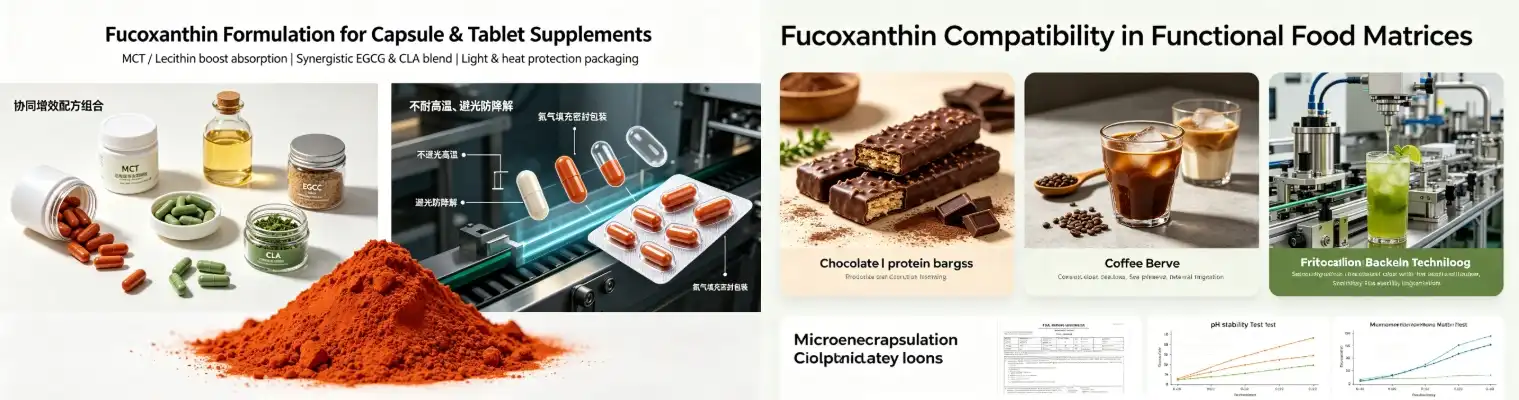
In the food supplement market, capsules and tablets are still the most common forms. It is easier for the body to absorb and use fucoxanthin extract when it is mixed with medium-chain triglycerides (MCT oil) or lecithin. Some formulas use metabolism-boosting ingredients that work well together, like green tea extract (EGCG) or conjugated linoleic acid (CLA). These ingredients work together to create benefits that are strong enough to explain the higher price.
Dosage forms affect how well people follow the directions. People who value ease may like daily regimens that give 4-6 mg of fucoxanthin in a single capsule, while spreading doses out throughout the day may improve absorption rates. When designing a product, formulators have to find a mix between science ideas and how people actually use it. Manufacturing considerations include stability under normal sealing settings. When it is being processed, fucoxanthin can handle mild heat, but too much heat or long-term light exposure speeds up degradation. The active ingredients stay safe for a long time in opaque pill shells and nitrogen-flushed packing.
Functional Food Integration
The mechanical difficulties of adding marine extracts to food matrices are special. Fucoxanthin has a brown color and a small marine taste that need to be hidden in some situations. These qualities work well with chocolate-based protein bars, coffee-flavored drinks, and savory soup mixes. Fruit-flavored goods, on the other hand, might need more flavor development.
Stability needs to be tested in a variety of pH settings and production conditions. Pasteurization, retort cleaning, and storing fucoxanthin at room temperature for a long time could all affect its preservation. Formulators who work with drinks might look into microencapsulation technologies that keep the carotene safe until it is eaten. Regulatory labeling requirements vary by product category. If a functional food claims to help with metabolism, it needs to back up those claims with clinical proof that follows the FDA's structure/function claim rules or similar regional standards. Regulatory defensibility is improved by clear paperwork that links formulation dose to written research.
Customization for Target Markets
Some athletic performance goods may mix fucoxanthin with L-carnitine and caffeine, which can help with energy before a workout and burning fat during the workout. Fucoxanthin could be combined with fiber sources and appetite-suppressing ingredients such as chromium picolinate in weight control goods aimed at a wider range of people. Formulations for diabetic care need to pay extra attention to how they affect blood sugar and how they combine with other medicines. Even though fucoxanthin can help with insulin sensitivity, goods aimed at this group should go through more safety testing and maybe even lower doses to lower any risks.
Future Trends and Market Outlook for Fucoxanthin Metabolic Products
Fucoxanthin Metabolic Products: What the Future Holds and How the Market Will Grow. New developments in distribution methods should make fucoxanthin more useful in many areas. Bioavailability problems have been fixed by technological progress, which has also opened up new product categories that were previously limited by formulation problems. Brown Seaweed Extract, as a natural source of fucoxanthin, stands to benefit directly from these advances in delivery and bioavailability.
Emerging Delivery Technologies
Nanoemulsion systems are a big step forward because they reduce the size of fucoxanthin particles to the nanoscale range and make it much easier for water to mix with them. This technology makes it possible to use clear beverages and improves absorption in the mouth. Some studies show that nanoemulsified fucoxanthin is 2-3 times more bioavailable than regular powder types. This could mean that smaller doses are needed to get the same effect. Liposomal packaging is another interesting option. By enclosing fucoxanthin in phospholipid bilayers, producers protect the carotene during digestion and make it easier for cells to take it in. This method works well for presenting premium supplements and supports higher prices by providing better results.
Market Expansion Dynamics
The markets for natural products that help the metabolism are growing quickly in both North America and Europe. Natural extracts with a lot of research are becoming more popular as people look for alternatives to manmade chemicals that come from plants and the ocean. The clean label trend makes people want ingredient lists that are short and easy to understand. Brown seaweed extract meets this need well. Regulatory environments are always changing. Fucoxanthin is usually allowed in dietary supplements and functional foods under current rules. However, producers should keep an eye on new rules about Novel Food labels, especially in EU markets. Proactive compliance methods protect access to markets and stop the need for expensive reformulation.
Strategic Procurement Recommendations
When making goods with fucoxanthin, business-to-business buyers should look for supply partners with full quality systems, not just basic certifications. By asking for batch analysis data from several production runs, patterns of stability can be found that show how reliable the supply will be in the long term. Product creation goes more smoothly when suppliers are ready to give thorough specifications, processing documentation, and quick expert help. Having a variety of source ties lowers risk, especially for businesses that are increasing the amount of goods they make. While main relationships can help with efficiency, qualified secondary sources can be used as backups in case of supply problems. Seasonal changes and sometimes limited harvests happen in the marine food industry, so it's smart to have backup sources. Keeping up with changes in study helps you predict how the market will change.
Conclusion
In conclusion. To find the best fucoxanthin extract dosage for metabolism, you need to look at clinical proof, product format, and quality buying methods. Doses that work best are usually between 2.4 mg and 8 mg of pure fucoxanthin per day, which is equal to 24 mg to 80 mg of a standardized 10% Fucoxanthin Extract Powder. Professionals in procurement have to make sure that suppliers are good by trying them thoroughly, certifying them, and evaluating their relationships with customers. Formulations that work well combine increasing bioavailability with the help of complementary ingredients and delivery methods with following the rules and getting people to like them. Fucoxanthin's market is likely to continue to grow in dietary supplements, useful foods, and other health-related products because more people want natural ingredients that help the metabolism.
FAQ
Q1: What is the recommended daily dosage of fucoxanthin for metabolic benefits?
A: Clinical tests show that 2.4 to 8 mg of pure fucoxanthin daily works, but the best dose relies on how the extract is standardized and the format of the product. To account for bioavailability factors, dietary products usually have 20 to 50 mg of 10% standardized extract per dose. Functional foods may spread out smaller amounts over several daily meals. When setting dosage guidelines, you should always think about the target audience, the delivery method, and the ingredients that work well together.
Q2: How does fucoxanthin extraction method affect dosage requirements?
A: Fucoxanthin's chemical structure and bioactivity are better preserved by supercritical CO2 extraction than by solvent-based methods, which could make the process more effective. With this green technology, extracts stay more pure and don't break down as quickly, so formulators can get the metabolic benefits they want at lower doses than with less effective extraction methods. Check the extraction method when evaluating the seller to make sure that the dose estimates are based on the real bioavailable content.
Q3: What quality certifications should I require from fucoxanthin suppliers?
A: Food safety management systems with ISO 22000 and HACCP standards are shown, and third-party tests for heavy metals, microbial contamination, and active ingredient content proves the quality of the product. Getting extra licenses like Halal, Kosher, or GMP makes it easier to get into more markets. Ask for batch-specific analytical results that show the amount of fucoxanthin in the material using HPLC, as well as the particle size distribution, moisture levels, and contaminant screening. This will help you make sure that the given materials always match the specs.
Partner with Sigma for Premium Fucoxanthin Extract Powder
For High-Quality Fucoxanthin Extract Powder, Work with Sigma. Shaanxi Sigma Biotechnology provides pharmaceutical-grade marine ingredients that meet the strict requirements of companies that make metabolic health products. Our Fucoxanthin Extract Powder comes from brown kelp and keeps at least 10% of its active ingredient through supercritical CO2 extraction. This means that there is no solvent waste and the powder works the same way every time. With ISO 22000, HACCP, and Halal approvals, our goods make it easier for businesses around the world to follow the rules. We keep a large collection on hand so that we can deliver quickly—within 5–7 business days—so that we can meet your production plans without any problems. Our technical team helps with formulation, gives unique specs, and provides full paperwork that includes HPLC analysis and heavy metal testing results. Contact sarah@sxsigma.com to ask for samples or talk to one of our metabolic ingredient experts about your particular needs.
References
1. Maeda, H., Hosokawa, M., Sashima, T., Funayama, K., & Miyashita, K. (2007). Anti-obesity and anti-diabetic effects of fucoxanthin on diet-induced obesity conditions. Molecular Medicine Reports, 1(6), 897-902.
2. Abidov, M., Ramazanov, Z., Seifulla, R., & Grachev, S. (2010). The effects of Xanthigen in the weight management of obese premenopausal women with non-alcoholic fatty liver disease and normal liver fat. Diabetes, Obesity and Metabolism, 12(1), 72-81.
3. Miyashita, K., Nishikawa, S., Beppu, F., Tsukui, T., Abe, M., & Hosokawa, M. (2011). The allenic carotenoid fucoxanthin, a novel marine nutraceutical from brown seaweed. Journal of the Science of Food and Agriculture, 91(7), 1166-1174.
4. Woo, M. N., Jeon, S. M., Kim, H. J., Lee, M. K., Shin, S. K., Shin, Y. C., & Choi, M. S. (2010). Fucoxanthin supplementation improves plasma and hepatic lipid metabolism and blood glucose concentration in high-fat fed C57BL/6N mice. Chemico-Biological Interactions, 186(3), 316-322.
5. Beppu, F., Niwano, Y., Tsukui, T., Hosokawa, M., & Miyashita, K. (2009). Single and repeated oral dose toxicity study of fucoxanthin in mice. Journal of Toxicological Sciences, 34(5), 501-510.
6. Zhang, H., Tang, Y., Zhang, Y., Zhang, S., Qu, J., Wang, X., Kong, R., Han, C., & Liu, Z. (2015). Fucoxanthin: A promising medicinal and nutritional ingredient. Evidence-Based Complementary and Alternative Medicine, 2015, Article ID 723515.


_1776308368292.webp)