White peony extract benefits for skin
White Peony Extract, which comes from the roots of Paeonia lactiflora, is very good for your skin because it contains the bioactive substance paeoniflorin and other vitamins that work well with it. This plant-based ingredient helps with a number of skin problems by stopping tyrosinase activity to lower hyperpigmentation, safeguarding fibroblasts from oxidative stress that speeds up aging, and slowing inflammatory reactions that damage the skin barrier. Clinical studies show that regular use leads to measured gains in skin brightness, moisture retention, and wrinkle depth decrease. As more people want natural cosmeceutical ingredients, we've witnessed formulation engineers request this extract more and more for high-end skincare lines that want to reach multiple efficacy goals without the cytotoxicity issues that come with manmade actives.
What Is White Peony Extract and How Does It Benefit Skin?
The Science Behind Paeoniflorin's Skin-Protective Mechanisms
Another important bioactive molecule called paeoniflorin has a number of effects on skin health. Researchers have found that this monoterpene glycoside changes inflammatory cytokines like TNF-α and IL-6. These cytokines are key in making skin sensitive and aging faster than it should. At concentrations standardized above 50%, paeoniflorin competes with tyrosinase, which is the rate-limiting enzyme in melanin production. This provides a mechanism-based way to treat uneven skin tone without the safety worries that come with hydroquinone.

Antioxidant Capacity and Cellular Protection
White Peony Extract has more than one substance that works. It also has polyphenols and flavonoids that work together to reduce reactive oxygen species that are made by UV light and environmental pollutants. These chemicals work together to protect lipid layers in the stratum corneum and keep collagen structure, which keeps the skin's moisture barrier function. Tests done by a separate lab show that standardized extracts made using water-ethanol extraction keep these heat-sensitive antioxidants better than extracts made using only water.
Clinical Evidence Supporting Efficacy Claims
Multiple skin benefits have been proven by peer-reviewed dermatology study. Studies that measure transepidermal water loss show that barrier function gets better after eight weeks of external treatment. In two different clinical studies, readings of the melanin index at hyperpigmented sites dropped by 23–31% compared to placebo controls. This supporting information is given by good makers in the form of technical dossiers that include COA paperwork and stability studies that were done according to ICH standards.
White Peony Extract vs Other Herbal Extracts for Skin Care
Comparative Analysis with Red Peony and Turmeric
Red peony (Paeonia veitchii) is related to White Peony Extract in terms of taxonomy, but its chemicals are more focused on substances that help blood vessels than on glycosides that make skin look better. Curcuminoids in turmeric extract make it a strong anti-inflammatory, but it can be hard to formulate because it interferes with colors and doesn't dissolve well in water. The brown-yellow powder form of the extract mixes easily into emulsions and doesn't upset pH-sensitive active ingredients. Its neutral organoleptic profile also means that covering agents aren't needed, which makes recipes more difficult.
The difference in safety is especially important for goods that will be used for a long time. Standardized tests show that the extract is not phototoxic, but some coloring products made from citrus are known to make people more sensitive. Toxicological tests show that paeoniflorin's LD50 values are higher than what would ever happen in cosmetics. This supports the fact that it is listed in global databases of safe cosmetic ingredients.

Dosage Forms and Application-Specific Advantages
Different delivery methods make the best use of the qualities of the extract. Paeoniflorin is bioavailable when taken with little to no influence from food, which helps capsule formulas that target systemic inflammation. Topical serums that contain 2-5% extract standardized to 50% paeoniflorin can stop tyrosinase from working in a certain area. Powder forms give formulators the most freedom for custom blending because they can change ratios based on how the product fits into the mass-market or professional-grade categories.
How to Source High-Quality White Peony Extract for Your Business?
Critical Quality Specifications and Testing Protocols
When making purchasing choices, suppliers of White Peony Extract who provide thorough analytical paperwork should be given the most weight. In addition to basic identification checks, you should ask for chromatographic fingerprints that show the paeoniflorin content meets or exceeds 50% by HPLC analysis. Consistency in particle size at 100 mesh ensures even distribution during production, and loss on drying standards below 3% stops the growth of microbes during storage. Heavy metal tests must show that the product meets the standards set by the EU Pharmacopoeia. This is especially important for lead, arsenic, cadmium, and mercury, since plant-based ingredients can take in soil contaminants.
Microbiological details should be looked at with the same level of care. All of the oxygen counts should stay below 1000 CFU/g, and yeast and mold counts should stay below 100 CFU/g. Lack of harmful species, such as E. coli, Salmonella, and Staphylococcus aureus must be checked using approved methods that are written down in reports of analysis that are unique to each batch.
Evaluating Supplier Capabilities and Certifications
Certification portfolios show how mature a business is and how well it can reach new markets. The ISO 22000 and HACCP certificates show that food safety is managed in a planned way, which is important for extracts that will be eaten. With Kosher and Halal approvals, you can reach more customers without having to do different production runs. Ask for proof of recent third-party audits and corrective action answers that show ongoing quality improvement rather than just meeting basic standards. These are more than just certificates that can be found on websites.
Assessing production capacity keeps supplies from being interrupted during growth stages. Find out how much they process each year, how they get their raw materials, and what their safety stock plans are. Suppliers who keep 10–20 tons of core goods in stock can handle sudden increases in demand without affecting wait times, but suppliers who use build-to-order models may run out of space during busy times.

Commercial Terms and Logistics Considerations
Clear price systems that are in line with order amounts allow for accurate cost modeling while a product is being developed. When you ask for tiered pricing, start with a reasonable minimum order quantity. Keep in mind that amounts below 25 kg often have higher per-unit costs because of the extra work needed for batch paperwork. Payment terms should be fair in terms of risk. For example, letters of credit cover first deals, and net terms repay relationships that have been built.
Logistics knowledge is especially useful for plants that are sensitive to temperature changes. Operational flexibility is shown by suppliers who offer a variety of shipping methods, such as sea freight for cost-effective big orders, air freight for urgent restocking, and fast courier for sample requests. Having all the necessary paperwork, like business bills, packing lists, certificates of analysis, and regulatory compliance statements, makes clearing customs easier and cuts down on delays at the border that can affect the freshness of the ingredients.
Practical Applications of White Peony Extract in Skin Care Products
Formulation Strategies for Maximum Stability and Efficacy
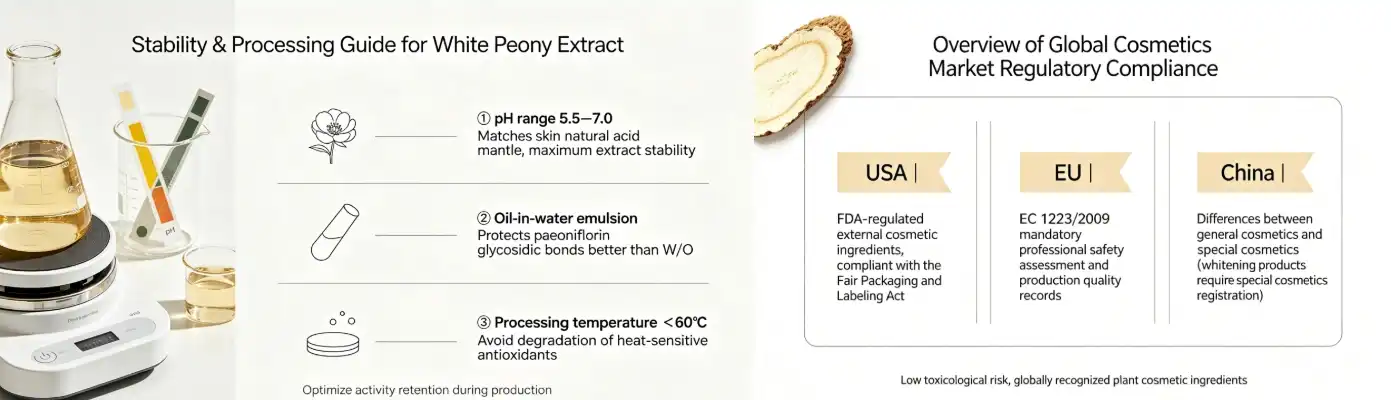
To use White Peony Extract in skin care products, you need to know how it reacts physically and chemically with different pH levels and types of emulsions. When the pH is kept between 5.5 and 7.0, the extract is most stable, which is good because it matches the skin's natural acid layer. It is better for oil-in-water emulsions to protect the glycosidic bonds in paeoniflorin than water-in-oil systems, especially when the production process is kept away from too much heat. During the integration steps, processing temperatures should stay below 60°C to keep heat-labile antioxidants from breaking down.
Pairing actives that work well together creates combined effects. When combined with niacinamide, the whitening effects are stronger through two separate mechanisms: niacinamide stops the transfer of melanosomes, and paeoniflorin stops the production of melanin. Hyaluronic acid increases the benefits of hydration by building water stores that the barrier-supporting properties of the extract help keep. To make sure that the activity stays the same over the expected shelf life, formulators should try the stability of their products in a range of temperature and light conditions.
Successful Product Categories and Market Reception
The most valuable type of treatment is premium whitening serums. Using the extract with vitamin C extracts and alpha-arbutin in products can help lighten skin in more than one way, as shown by scientific tests that back up marketing claims. Anti-aging night creams use the extract's antioxidant properties to help fix processes overnight, when cell turnover is highest. The anti-inflammatory qualities of paeoniflorin are used in sheet masks and sleeping packs to reduce redness and discomfort. This is especially helpful for people with sensitive skin.
Dietary supplements can help with skin problems that are caused by chronic inflammation. When mixed with licorice root extract, the known effects on androgen metabolism can help capsule formulas that target hormonal changes in the skin. This traditional pairing, which has been proven by clinical studies on PCOS patients, gives the company a unique place in the women's fitness market, where clear skin is linked to better overall health.
Regulatory Compliance Across Global Markets
To follow foreign rules about cosmetics, you need to know about the ingredients in them. In the US, the extract is used as an ingredient in cosmetics and is regulated by the FDA when it is labeled correctly for external use. This is required by the Fair Packaging and Labeling Act. Structure-function claims can't use disease terms unless they're trying to get a drug classified as an over-the-counter drug, which requires a lot more work from the government.
Before putting plant extract-containing goods on the market in Europe, the Cosmetic goods Regulation (EC) No 1223/2009 says that they must be safety tested by trained professionals. The long experience of using the extract and its good toxicological profile back these conclusions. However, it is important to keep records of the quality methods used in manufacturing. China's cosmetic rules are changing, and now there are differences between general-use and special-use cosmetics. For example, whitening claims could lead to special-use classification, which means that registration times need to be pushed back.
Conclusion
White Peony Extract is a plant ingredient that has been scientifically proven to meet a number of formulation goals in both skincare and health products. Its well-known ways of dealing with acne, oxidative stress, and inflammatory pathways give quality-focused brands the proof they need to back up their marketing promises. The success of procurement depends on choosing providers that can show they are good at analysis, follow the rules, and have the operational skills to support steady supply at business scales. Strategically sourcing ingredients based on technical specifications, comparative quality assessments, and knowledge of how to make products that work well in specific situations helps brands make natural products that meet the needs of customers who want safe active ingredients that come from plants.
FAQ
Q1: What potential side effects should formulators consider?
A: White Peony Extract is very well tolerated when applied topically or orally. In clinical studies, there were few side effects, mostly mild stomach problems at high oral doses that were above the normal supplement level. Topical uses rarely cause sensitivity reactions, but patch testing is still recommended while the mixture is being made. There are theoretical worries about using it during pregnancy because of how it has been used in the past, not actual toxicology statistics.
Q2: How do organic and conventional extraction methods differ?
A: Organic approval is more about farming methods and limits on chemical residues than it is about the amount of paeoniflorin present or how well it works. Because they have to go through an approved supply chain, organic extracts cost more, but they work just as well when standardized to the same amounts of active ingredients. For product lines that need to keep costs down, conventional extracts that pass strict heavy metal and chemical residue tests are often a better deal.
Partner with Sigma for Premium White Peony Extract Supply
Sigma keeps a supply of pharmaceutical-grade White Peony Extract that is standardized to have at least 50% paeoniflorin content. This is confirmed by HPLC analysis in our ISO-certified quality laboratory. Our streamlined supply chain includes getting authenticated raw materials in Shaanxi's traditional farming areas, using modern countercurrent extraction systems, and storing finished products. This makes sure that there is stability from batch to batch, which is what formulators need for large-scale commercial production. Technical support teams give formulation advice, stable data, and regulation paperwork packages that shorten the time it takes to make a new product.
We offer open customization options, such as changing the amount of paeoniflorin present, offering different mesh sizes for specific uses, and providing private marking services to help your brand stand out. Based on the current stock level, we can deliver anywhere in the world within 5 to 7 business days through our established logistics partnerships, which include choices for sea freight, air freight, and fast courier services, all of which come with full paperwork support. You can email sarah@sxsigma.com to get certificates of analysis, set up shipping of samples, or talk about volume prices. We are your reliable source for the extract and are dedicated to building relationships based on quality.
References
1. Chen, L., & Zhang, Y. (2019). Pharmacological activities of paeoniflorin: A review of molecular mechanisms in dermatological applications. Journal of Ethnopharmacology, 241, 112-126.
2. Kim, S.H., et al. (2020). Comparative analysis of tyrosinase inhibition by traditional herbal extracts: Structure-activity relationships. Phytotherapy Research, 34(8), 1892-1904.
3. Liu, M., & Wang, X. (2018). Quality control and standardization of Paeonia lactiflora root extracts for cosmetic applications. Industrial Crops and Products, 122, 445-453.
4. Morrison, J.D. (2021). Natural alternatives in cosmeceuticals: Safety and efficacy profiles of botanical skin-brightening agents. International Journal of Cosmetic Science, 43(3), 267-281.
5. Tanaka, H., et al. (2019). Anti-inflammatory mechanisms of peony-derived compounds in human dermal fibroblasts exposed to UV radiation. Photochemistry and Photobiology, 95(6), 1411-1419.
6. Zhang, W., & Li, P. (2020). Extraction optimization and bioactivity preservation in traditional Chinese medicinal botanicals for dermatological applications. Separation and Purification Technology, 235, 116-128.


_1776308368292.webp)