What Is St. John's Wort Extract Used For and How Does It Work Safely?
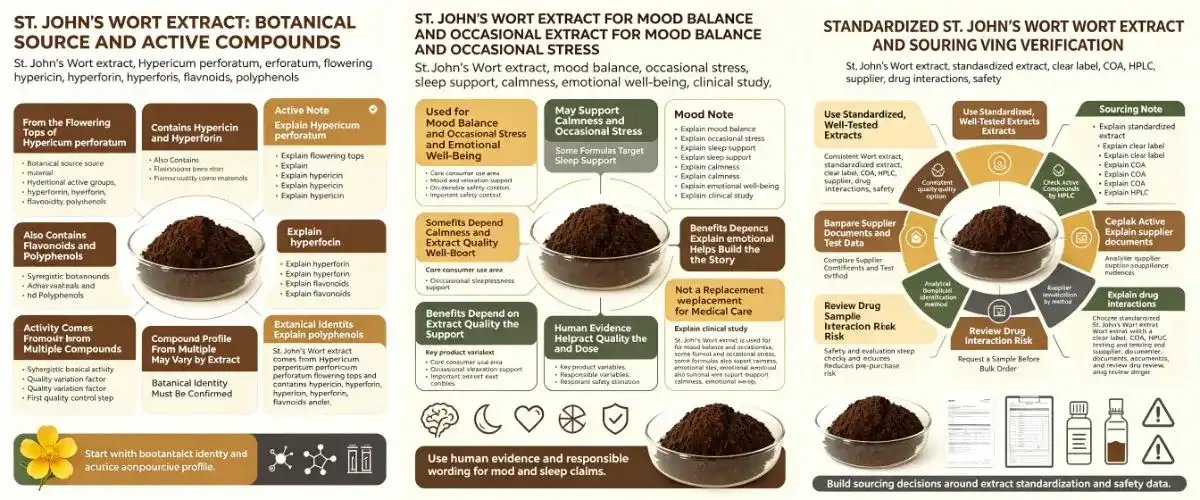
St. John's wort extract is a concentrated ingredient made from the flowering tops of Hypericum perforatum. Brands use it mainly in products for mood balance and occasional stress, and some formulas also target restful sleep and antioxidant support. Its activity comes from compounds such as hypericin, hyperforin, and flavonoids, which researchers link to brain chemical signaling. Safe use rests on three things: a standardized, well-tested extract, a clear label, and a medical check for anyone taking prescription drugs. I explain the uses, the mechanism, dosage logic, safety, and sourcing below.
What Is St. John's Wort Extract?
Botanical Source and Extraction
The active ingredient in St. John's wort extract is Hypericum perforatum L., an annual plant with yellow flowers. It is best to use flower tops and other parts that grow above ground because they have the most marker chemicals. The plants are picked, dried, and cut. They are then soaked in a mixture of water and ethanol. The plant fiber is removed through filtration, and the fluids are dried and concentrated to make a fine powder. This process focuses on the active ingredients and gets rid of a lot of the cellulose compared to the raw plant. Sigma uses ethanol to make its extract on steady countercurrent lines with low temperature concentration.
Key Compounds in the Extract
Most of the attention is on three groups of compounds. You can see that hypericin and pseudohypericin are naphthodianthrones because they are red. They are normal ways for the business to measure quality. A phloroglucinol called hyperforin is being studied to see what part it plays in activities that have to do with mood. Having said that, it breaks down quickly when oxygen gets to it. A lot of interesting things happen in antioxidants, like flavonoids like hyperoside, quercetin, and rutin. One chemical alone can't explain the whole action, which is why the plant as a whole is important. This is because HPLC is a good way to find out what the hypericin amount is. After following the method, they check the amounts of hyperforin and polyphenols.
Sigma Product Specification
Our St. John's wort extract has at least 0.3% hypericin content. The screen size is 80 mesh, and the total plate count is 1,000 cfu/g or less. The ashes stay at a level of 5% or less. The stems and flower heads of Hypericum perforatum L. are used as raw materials. The item you want is in stock and has been certified as ISO, HACCP, and Halal. It's simple to store: just put it somewhere cool and dry and seal it up. It's also best to pack in dark things because hypericin is light-sensitive. The powder is easy to work with, which is good for making pills and capsules. It can also be used to make cosmetics, medicines from plants, and food supplements.
What Is St. John's Wort Extract Used For?
Mood Balance and Occasional Stress
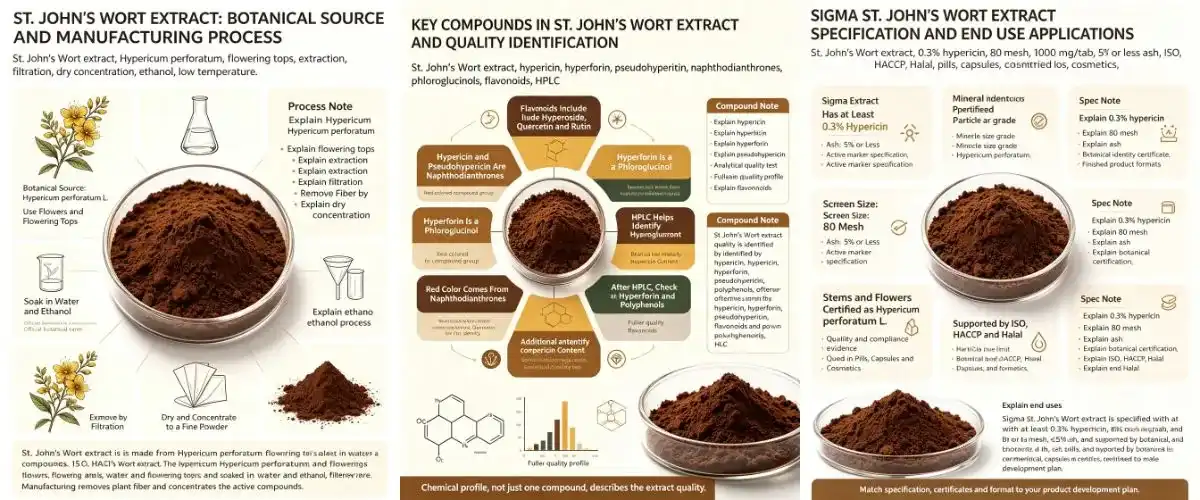
For hundreds of years, people in Europe have used St. John's wort extract to improve their mood. People in the US are sold supplements that claim to help keep your mood calm and deal with worry. There are no diseases that supplements can claim to treat. However, people with mild to moderate sadness are used in clinical studies to test standardized products. A 2008 review by Cochrane looked at 29 trials with 5,489 patients and found that the extracts worked about as well as regular antidepressants. They worked better than a fake medicine. A smaller number of people also dropped out because of side effects. This only works for the ingredients that were looked at; it doesn't work for all pills or teas. So, the design of the product should match the preparations that were looked at.
Restful Sleep and Antioxidant Support
In evening formulas, brands often mix St. John's wort extract with ingredients that help you calm down. To be clear, the herb does not make you sleepy. It's likely that sleep helps because it makes you feel better and less stressed. This is why it is not used by itself as a sleep aid, but as part of a mood-and-sleep mix. In the lab, flavonoids and phenolic substances have been shown to get rid of free radicals. This is why companies in the health and beauty industries are interested in it. As I always tell brands, they need to be careful with how they word their claims and make sure they match the proof they have.
Supplements, Herbal Formulas, and Cosmetics
This dry powder extract can be used in several different items. Powder is easy to measure, mix, and fill into capsules and tablets most of the time. It is mixed with other plants that calm you down in herbal recipes. It is being thought about by people who make makeup for use in serums and creams that highlight antioxidants from plants. There are different needs for each use. Because light changes hypericin, supplements need to be carefully checked for impurities and have warnings on the label. But goods also need to be checked to make sure they are safe for skin and don't change color when exposed to light. Before you pick a style, you should know who the product is for, what it claims to do, how much is in each piece, and who will buy it. That short brief keeps expensive rework from having to be done later.
How Does St. John's Wort Extract Work?
Active Compounds and Possible Pathways
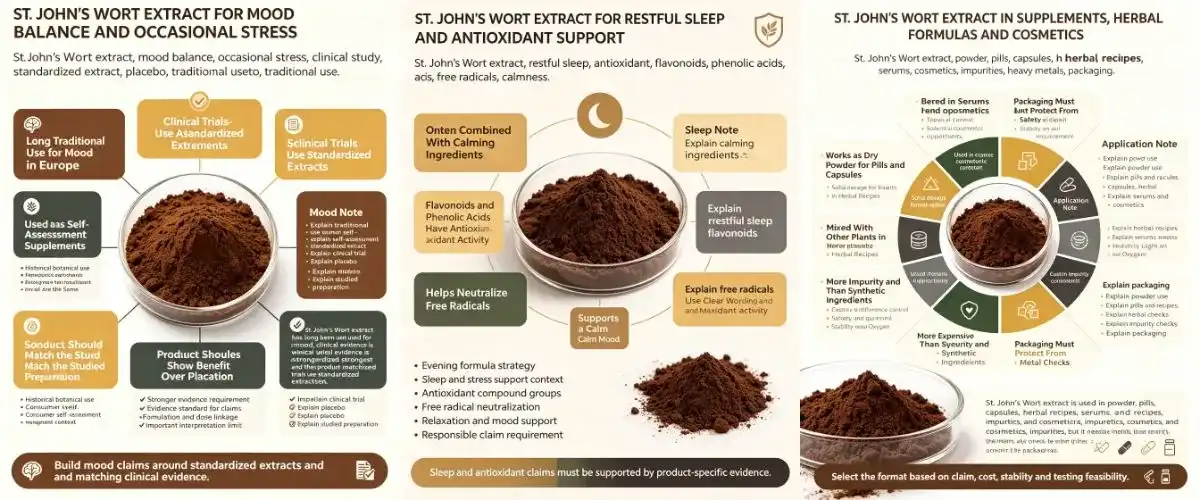
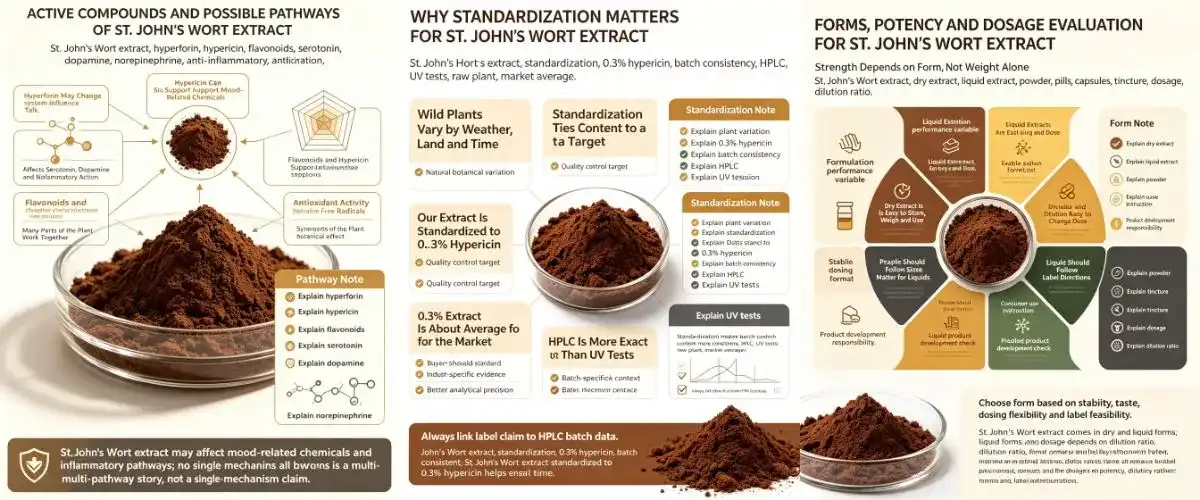
The researchers don't just talk about one way. The lab has found that hyperforin can change how nerve cells take back up chemicals in the brain that make them more available. These chemicals include serotonin, dopamine, and norepinephrine. There is a chance that flavonoids and hypericin can have extra effects on the pathways that handle inflammation and stress. Researchers Butterweck and Schmidt looked at the herb in 2007 and found that flavonoids, hyperforin, and hypericin all seem to play a part in how well it works. I never say that one mechanism is a proven medical fact because there are so many parts to the whole.
Why Standardization Matters
Sometimes plants in the wild change because of the weather, the land, or the time of year. Standardization tells a marker substance how much of it should be in each batch so that it always has the same amount. A level of 0.3% hypericin, which is what our St. John's wort extract powder says it has, is about average for the market. Being strict doesn't mean that more is better. The buyer knows what's inside. I believe you should ask for an analysis report with HPLC data for each lot. HPLC gives a more exact reading because it can tell hypericin apart from other colors that UV tests can mix up.
Forms, Potency, and Dosage Evaluation
How strong something is changes based on its shape. It is easy to store, weigh, and fill the dry extract powder because it is strong. It's easy to change the dose of liquid extracts, but they need extra checks to make sure they don't grow microbes. The tea doesn't taste as strong and isn't as regular. Because the extract ratio and marker content are different, there is no one dose that works for all of them. It is not possible to compare milligrams of raw plant to milligrams of an extract that has been boiled down. When the job is done, people should read the directions on the package and talk to a doctor or nurse. Brand teams should write down the serving size, standardization goal, dose form, and shelf life in the product outline. After that, they should look over a sample and a technical data sheet before giving their OK.
Is St. John's Wort Extract Safe? Side Effects and Interactions
Common Side Effects
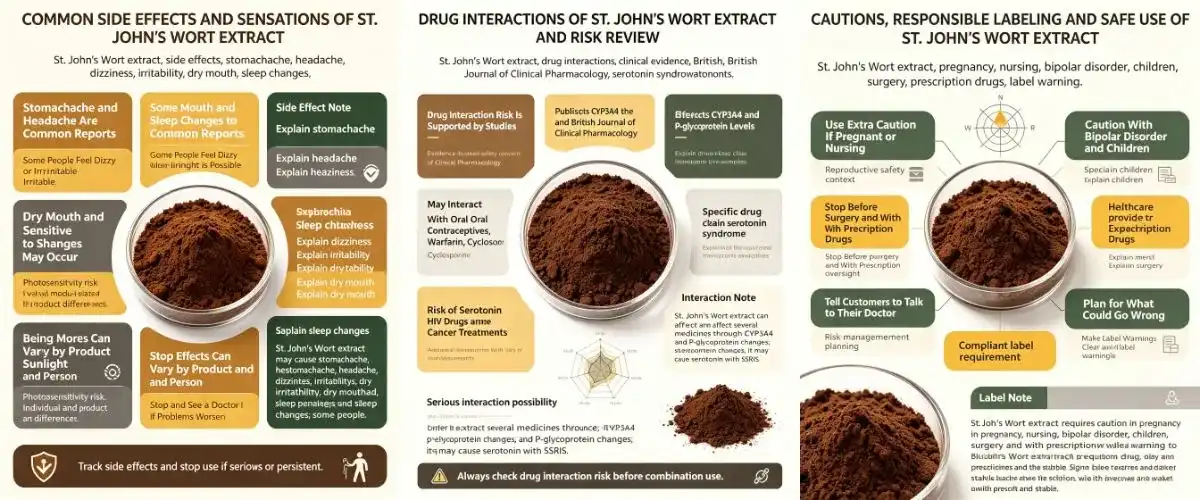
There aren't many bad side effects. A lot of people have said they have stomachaches, headaches, dizziness, irritability, dry mouth, changes in their sleep patterns, and being more sensitive to sunlight. Since hypericin changes with light, people with fair skin or who spend a lot of time outside should stay out of the sun. It was found that fewer people dropped out of trials for St. John's wort extract because of side effects than for studies for other drugs. But fewer is not the same as zero. People who start taking a product and then get sick should stop taking it and see a doctor.
Drug Interactions
Being around other people is the most dangerous part of safety. Henderson and others studied reports of drug interactions and found that St. John's wort extract lowers the amount of several medicines in the blood. This was published in the British Journal of Clinical Pharmacology in 2002. When hyperforin links to a receptor, it raises the amounts of CYP3A4 and P-glycoprotein, which are liver enzymes. Some of the medicines that might be affected are oral contraceptives, warfarin, cyclosporine, HIV drugs, and some cancer treatments. You might be more likely to get serotonin syndrome if you take the plant along with SSRIs or other antidepressants. Since this isn't a complete list, each case should be looked over by a doctor or pharmacist.
Cautions and Responsible Labeling
You should be extra careful if you are pregnant, nursing, have bipolar disorder, a child, or are about to have surgery. On the label, brands should make it clear that the product may combine with prescription drugs and make people more sensitive to the sun. They should also tell customers to talk to their doctor. For safety, it's also important to have a plan for what to do if something goes wrong, be able to track things, and make sure they are stable. Sigma is in charge of quality from picking the raw materials to checking the end product. We can give you test scores and awards if you ask. Each brand still decides what goes on its label and has to follow the rules of the market it's in, like the US Food and Drug Administration's rules.
How to Choose a St. John's Wort Extract Supplier
Documents and Tests to Request
A trustworthy seller tells you about things before you buy them. I think you should ask for a list of what the product is, an analysis report for the most recent batch, identity tests, and data on microbes. As well as asking about heavy metals and pesticides, make sure you know how stable this plant is and what solvents are left over for ethanol extraction. As part of normal trade, the plate count must be less than 1,000 cfu/g, Salmonella and E. coli must not be present, and the chemicals must not be above the limits set by EC 396/2005. Weeds can get into crops, so you should also ask for pyrrolizidine alkaloid screening. Once you have the results, you should take a sample to a different lab to make sure they are correct.
Bulk Buying, OEM, and Private Label
If you want to talk about technical issues and plan your supply, it's better to buy St. John's wort extract from the manufacturer directly than from a bunch of different sellers. See what you can find out about the company, the factory, the shipping terms, and the export papers. ISO 9001, ISO 22000, and HACCP are all used by Sigma, a business and industry group in Shaanxi. Ten to twenty tons of safety stock are kept for important items, and they can be sent out in five to seven business days. As part of our OEM/ODM services, we promise quality for 12 months and give free samples. It is up to you to pick the extraction ratios, particle sizes, labels, and packing. For an OEM, the first step in a simple process is to choose the extract and look over samples. The next steps are to approve the recipe, check the labels, make a trial batch, and make a plan for restocking.
Common Mistakes and a Simple Decision Path
A lot of people make these four errors. People who buy extracts think that all of them are the same, so they only compare prices per kilogram, look at hypericin but not hyperforin or stability, or trust a source without checking the papers for each lot. Some people might not believe medical claims that you make, which is another risk. These slip-ups can't happen on an easy path. First, check that the format works with the thing. Second, find out what the rules are in your market for tests, claims, and certificates. Third, check out how the sellers handle quality checks, minimum order number (MOQ), lead time, customization, and getting in touch. Fourth, look over a sample and say it's okay to make a short batch. Finally, make sure you agree on the specifics and how to let people know about changes before you place big orders.
Conclusion
St. John's wort extract is standardized as Hypericum perforatum, which is mostly used in formulas to help with sleep, mood, and occasional stress. Studies that looked at certain extracts in people with mild to moderate depression are the most convincing. Flavonoids, hypericin, and hyperforin all work together in different ways, so one test cannot fully explain everything. Every batch is the same because of clear benchmarks, uniformity, and HPLC tests. Medicines that are low in the plant should not be used by people who are pregnant or who are allergic to the sun. So, giving accurate labels and getting professional help are just as important as how strong something is. Proof of quality claims, a format and dose that work well together, and claims that make sense for the sales market make this the safest choice.
FAQ
Is St. John's wort powder the same as the extract?
No, powder is made up of ground-up dried herbs. St. John's wort extract is concentrated in a certain way and compared to a standard, such as hypericin.
Can I take St. John's wort extract with antidepressants?
Not until you talk to a doctor. It could raise the risk of serotonin syndrome and change how some medicines work. Talk to a doctor or pharmacist first.
Does hypericin at 0.3% mean a stronger product?
Not all the time. This level is a guideline that helps make sure that each batch is the same. How well and properly it works depends on the dose, the amount of hyperforin, and the quality of the medicine as a whole.
Can the Sigma powder be used in cosmetics?
We list health products, dietary supplements, cosmetics, and herbal formulations as ways that our product can be used. Still, every formula should have its own review of how safe it is for the skin and how well it stands up to light.
How should I store the powder?
Keep it somewhere dry and cool with the lid on. Light should not get to hypericin, so it should be kept in opaque containers.
Request St. John's Wort Extract Samples from Sigma
Sigma's St. John's wort extract has hypericin levels of 0.3% or more and is licensed by ISO, HACCP, and Halal. As the main manufacturer of this extract, we offer free samples, OEM/ODM customization, and a 12-month quality warranty. Send sarah@sxsigma.com your goal specification, volume, and final market, to get a price and technical papers.
References
1. Cochrane Database of Systematic Reviews, 2008, "St John's Wort for Major Depression"
2. Phytotherapy Research, 2014, "Hypericum perforatum: Pharmacokinetic, Mechanism of Action, Tolerability, and Clinical Drug–Drug Interactions"
3. British Journal of Clinical Pharmacology, 2002, "St John's Wort (Hypericum perforatum): Drug Interactions and Clinical Outcomes"
4. Wiener Medizinische Wochenschrift, 2007, "St. John's Wort: Role of Active Compounds for Its Mechanism of Action and Efficacy"
5. European Medicines Agency, 2009, "Community Herbal Monograph on Hypericum perforatum L., Herba (Well-Established Medicinal Use)"
6. Journal of Affective Disorders, 2017, "Clinical Use of Hypericum perforatum (St John's Wort) in Depression: A Meta-Analysis"