Wall-Broken Mullein Raw Powder vs Whole Leaf: Which Is Best for Buyers?
Wall-broken mullein raw powder is the better choice when your product needs a fine, even powder for capsules, tea bags, sachets, or beverage blends. Whole leaf mullein powder suits traditional teas and coarse blends. Neither format wins every time. The right pick depends on your formula, your equipment, your label, and your budget. In this guide, I compare both formats on processing, particle size, quality checks, and bulk buying terms. I also share what Sigma lists for its own powder, so you can judge it against clear specifications instead of marketing terms.
What Is Wall-Broken Mullein Raw Powder?
Definition and Processing
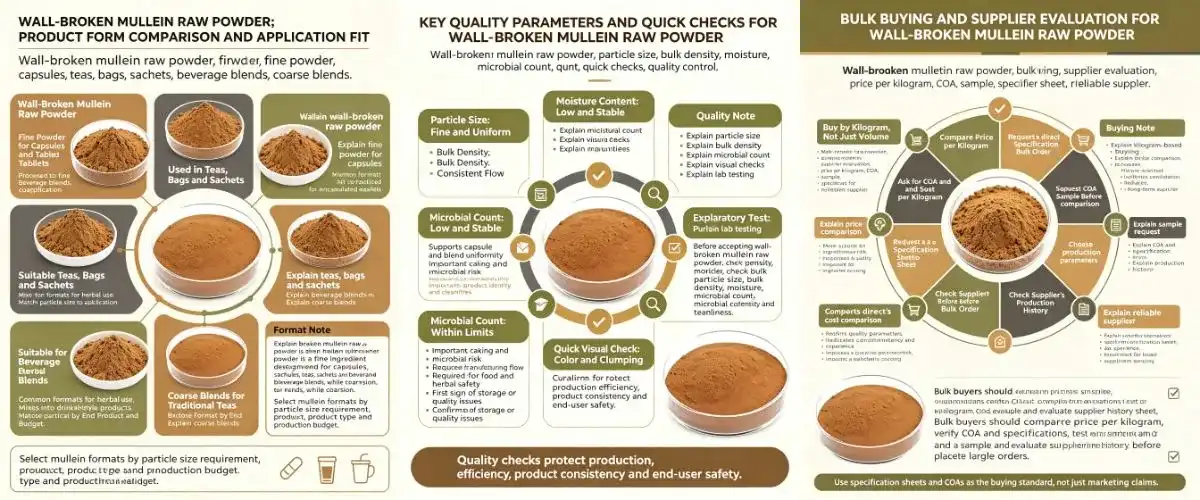
Wall-broken mullein raw powder is created from dried Verbascum thapsus and goes through an additional step to break open the walls of plant cells. Cell walls are made up of tough fibers, and regular spinning doesn't hurt many cells. Taking down the wall will allow more of them to happen. Sigma makes this powder at a low temperature to keep the nutrients from the leaf in it. The word means a process, not a certain result. This was written about in the Journal of Food Engineering in 2009. It was discovered that very fine grinding changes things like flow and density. When people buy something, I tell them to ask about the particle data, the test method, and the way the product was processed.
Whole Leaf and Regular Mullein Powder
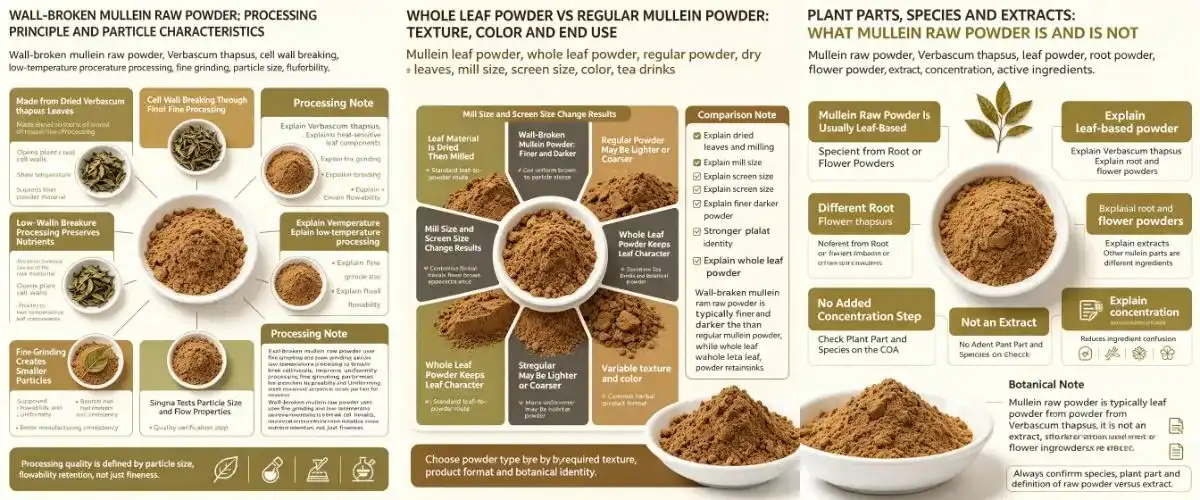
The leaf has been dried and then milled in the usual way. It is not always sold as mullein leaf powder. How good it is changes based on how dry the leaves are, the mill type, the screen size, and how long it is kept. A well-run mill can make a clean, even powder, so less grinding does not mean less quality. The gap is clear when you compare wall-broken mullein raw powder to regular mullein powder. The normal grade is harder and has cells that stick together better most of the time. It might be good for tea drinks where people can see the leaf and know what it is. Whole-plant powder can have flowers or stems in it, but it's not the same as whole-leaf powder.
Plant Part, Species, and the Extract Question
When people buy plants, they often mix up the species, parts, and extracts. For mullein flower, leaf, and whole plant powders, the rules are different. A book from the American Botanical Council in 1998 called the German Commission E monographs list mullein flower instead of leaf. That's why the spec sheet needs to name the part of the plant. Parts of mullein that are talked about in reviews like the one in Revista Brasileira de Farmacognosia are flavonoids, saponins, and mucilage. Ask for the plant's name, Verbascum thapsus, and make sure you know what it is. What is an extract? A raw powder is the milled plant itself, while an extract goes through extraction and concentration. The thing Sigma sells is a natural mullein leaf powder that doesn't have any extra stuff in it or caffeine.
Wall-Broken vs Whole Leaf: Core Comparison
Processing and Particle Size
This table shows how the two forms are different most of the time. No matter what provider does, the results will still rest on the tools and controls they use.
| Factor | Wall-broken mullein raw powder | Whole leaf mullein powder |
|---|---|---|
| Processing | Fine milling plus a cell-wall step | Standard drying and milling |
| Particle size | Fine, set by supplier specification | Fine to coarse |
| Cell structure | More disrupted | Less disrupted |
| Typical cost | Often higher | Often lower |
| Best fit | Capsules, sachets, beverages | Teas, traditional blends |
Sigma's 200 mesh wall-broken mullein raw powder is a fine, light brown powder. A 200 mesh screen has holes that are about 75 microns wide. However, mesh doesn't show all particle sizes. Get a report on the sizes. You shouldn't trust warning signs like "ultrafine" unless they are backed up by a test method.
Flow, Dispersion, and Blending
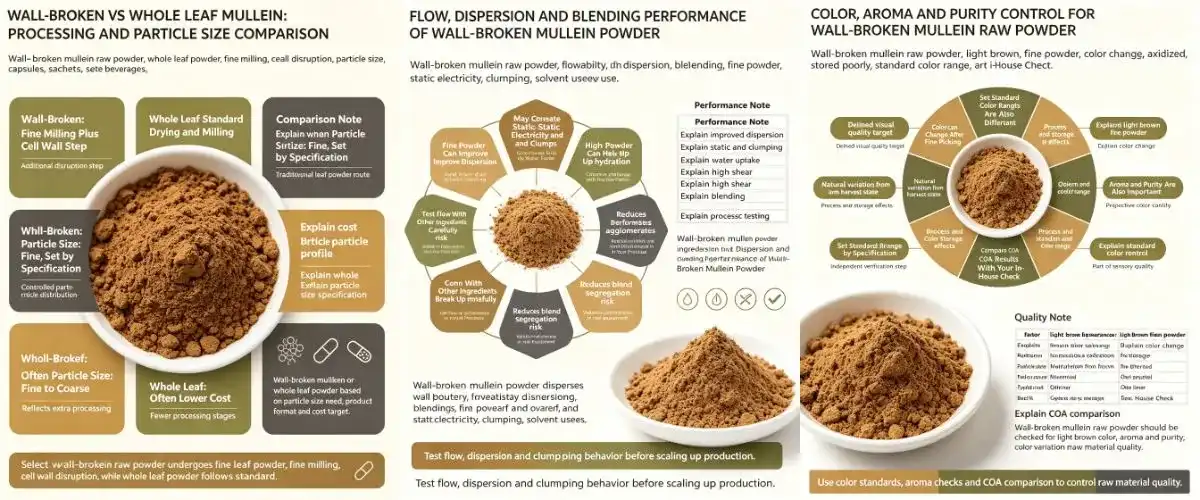
A lot of the time, powder that is smaller mixes better. This is helpful when only a little plant-based medicine needs to be put into a pill or sachet. The trade-off is having to deal with it. Fine powder can stick to things, hold static electricity, and form clumps. It soaks up water faster because it has more surface area. Most grades of whole leaf don't dust as much, but they can separate from blends with finer ingredients. I believe you should try out a trial number on your own line before you place a full order. If the powder flows well by itself, it might not work as well with other ingredients. That's why you should test it in the whole recipe.
Color, Aroma, and Purity
Sigma's powder looks like a fine, light brown powder. Food can change color when it is picked, dried, oxidized, or stored, so make sure your standard includes a suitable range. Just like how you look, how pure you are is important. Fine sand is sometimes mixed with store-bought mullein powder. This sand is found in tea bags and pills as grit. This problem can be fixed by Sigma by getting rid of vibrational impurities in more than one step. A quick way to tell if the ash level is right is to look at the ash limit. Sand can also raise the ash limit. Sigma says that ash should be 4% or less. Before you buy a lot of it, your lab can check a sample to see if that number is correct.
How to Choose by Application?
Capsules and Tablets
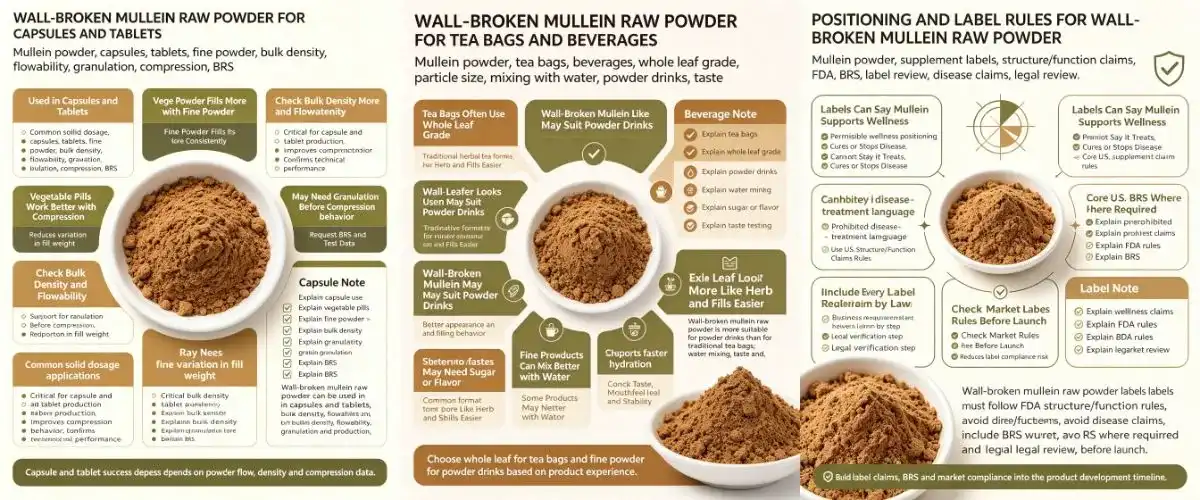
Sigma says this stuff can be used for many things, like putting vegetables inside capsules. Vegetable pills work better with a fine, even powder because it fills them more consistently. Make sure the mass density and flow are correct on your filling machine. Find out as soon as possible if you need a flow help. Tablets are stronger. A lot of the time, raw botanical powder doesn't pack down well on its own, so you might need to mix it with something else or granulate it. Before you make it bigger, check the particle size distribution, how wet it is, and how easily it can be compressed. Your formulator should ask for the test method and data if they want a certain cell-wall breakage rate. After that, they should tell Sigma what they need so we can see what documents we can send.
Tea Bags and Beverages
Tea bags and other things like them make us think more about particle size. A lot of people who buy tea like the better whole leaf grade because it looks like the herb and filters easily. If you use a certain kind of bag paper, a 200 mesh powder might get stuck in the cup. Sacks of drinks and drinks work in different ways. There is still plant fiber in wall-broken mullein raw powder, so it doesn't dissolve like sugar does when mixed with water. The drink will settle for a while. When it's done, look and feel it in your mouth. Sigma says it can be used for food and drinks.
Positioning and Label Rules
Labels on supplements in the US can say that they treat, cure, or stop disease, but they can't say that they do any of those things. The FDA's Small Entity Compliance Guide on structure/function claims spells out this rule. The book Phytotherapy Research says that people used mullein to help them breathe a long time ago. But your sign shouldn't say anything about diseases, and I believe that every claim should be checked by a lawyer. Sigma also says that this powder could be used to make mixtures for smoking plants. Check the rules in your own market first before going that way.
Specifications and Quality Checks
Identity and Origin Documents
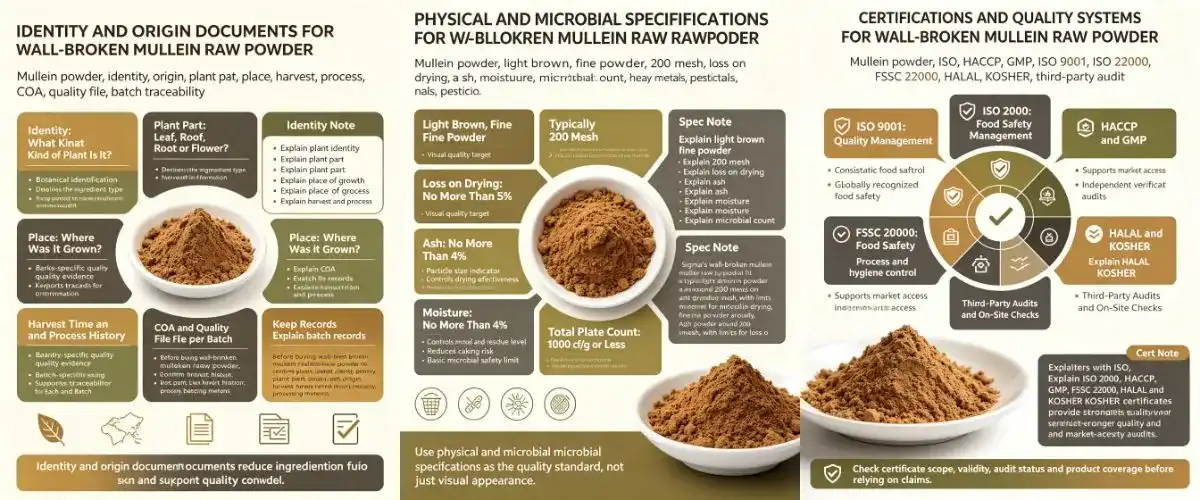
Begin by saying something about yourself. Discover what kind of plant it is, what part of the plant it is, where and when it was picked, how it was processed, and whether it grew in a garden or in the wild. 21 CFR Part 111 (FDA, 2007) says that companies that make vitamins for food must make sure that each thing is exactly what it says it is. It's only after they've checked out a source that they can trust their Certificate of Analysis. You can add the COA to your quality file, but it is not the same as it. Please let Sigma know what you need and we will let you know what we can do for your batch.
Physical and Microbial Specifications
Sigma's wall-broken mullein raw powder must be light brown, fine, 200 mesh, lose no more than 5% of its weight when dried, have no more than 4% ash, and have a total plate count of 1000 cfu/g or less. A fine powder that soaks up water quickly makes it important to keep track of how much water is lost while it dries. Ashes, like sand, show how many chemicals are in something. This number tells us how many microbes there are in general. A lot of people also want to know what the heavy metals and herbicides think. We'll tell you what tests are available if you tell us what tests your quality team needs.
Certifications and Quality Systems
On Sigma's list, you can see that this item has ISO, HACCP, and Halal certificates. Sigma is certified by ISO 9001, ISO 22000, FSSC 22000, HACCP, HALAL, and KOSHER. We make things in Shaanxi, and we make sure the quality is good from picking out the raw materials to checking the finished products. No matter which supplier you pick, make sure you check the scope, validity period, and issuing body as well as the certificate itself. Once you're done, look at both labels and see which ones say the same things. It doesn't really matter if the certificate doesn't cover the thing you buy or the site you buy it from.
Bulk Purchasing and Supplier Qualification
Price Drivers and Total Cost
What makes it different is the mesh size, the wall-breaking step, the number of raw leaves, the size of the order, and any customizations that are made. Always check the price against the quote before taking the deal. Make a lot that fails early tests, makes your tea bags rough, or stops a filling line. It costs more than it saves. See how much it costs to land, which includes taxes, tests, waste, and freight. Sigma makes things in its own workshops and gets its plants from Shaanxi. This keeps prices low without lowering the level of quality. Ask about prices for different amounts so that you can plan your orders for the whole year.
Packaging, Storage, and Shipping
It's important how fine powder is packed because it soaks up water. It's best to keep the things somewhere cool and dry, with the lid on. Talk to your supplier about moisture-barrier liners, how to load pallets, and whether you can use drums or bags. Keep the powder away from strong smells and immediately close any containers that have been opened. As part of its OEM/ODM services, Sigma designs packages and puts names on them. There are three ways to ship: by boat, air, or express. We handle all the paperwork and help with customs. We'll offer a shipping method that works if you tell us the port and conditions of where the package is going.
Sampling and Supplier Qualification
I believe there should be four steps: go over the paperwork, test a sample in your lab, make a pilot batch, and then give the go-ahead for a business batch. All of them should be asked the same questions about the species, the minimum order size, the processing temperature, the range of mesh sizes, the chemicals, the COA, and the processing temperature. Sigma says they have this powder in stock and will send you a free sample. Our team is here to help you seven days a week, 24 hours a day. We also promise that the standard of your orders will not change for a year. This is better proof than any brochure because it lets you compare whole leaf and wall-broken mullein raw powder grades with your own tools.
Conclusion
Wall-broken mullein raw powder is different from mullein powder with whole leaves. The wall-broken format makes a fine, even powder that works well in drinks, capsules, and sachets. It should be kept away from dust, static, and water, though. There is less waste when you use whole leaf powder, and it works with both teas and traditional blends. Label language is not as important as botany, mesh, moisture, ash, microbial limits, and plant part. A COA helps you check your own identity in line with U.S. rules for dietary supplements. Once you seal a jar of fine powder, it stays dry, and test samples show you how each type of powder works in your recipe. There are no disease claims that can be made on U.S. labels. The best format is the one that works best with your goods, your tools, and the checked rules.
FAQ
What is wall-broken mullein raw powder?
Dried mullein leaves are ground up very finely and then go through an extra step to break down the cell walls. This makes the powder. It is a raw powder, not an extract.
Is wall-broken mullein powder better than whole leaf powder?
Not all the time. The format suits fine blends, capsules, and drinks because its walls are broken. Whole leaf powder is great for mixed drinks and teas. Look at both of them in your own recipe.
Does it dissolve in water?
It spreads out in fluids, but it doesn't dissolve all the way because it still has plant fiber in it. Get ready to settle down.
How should I store it?
Keep it somewhere dry and cool with the lid on. Fine powder soaks up water very quickly.
Can I request a sample?
Yes. Sigma is happy to give samples away for free. Email sarah@sxsigma.com with what you need.
Stocked Mullein Powder, Zero Shortages — Pure, Certified & Ready to Ship | Sigma
Want to find a business that always has wall-broken mullein raw powder in stock? Sigma offers a pure natural, additive-free mullein leaf powder at 200 mesh, backed by ISO, HACCP, and Halal certificates, with free samples and OEM/ODM options. Email sarah@sxsigma.com with your mesh, packaging, and volume needs, or visit sxsigma.com for details. Our team will reply with documents and a quotation for your next production plan.
References
1. Phytotherapy Research, 2005. Turker and Gurel, "Common Mullein (Verbascum thapsus L.): Recent Advances in Research."
2. Revista Brasileira de Farmacognosia, 2013. Riaz, Zia-Ul-Haq, and Jaafar, "Common Mullein, Pharmacological and Chemical Aspects."
3. Journal of Food Engineering, 2009. Zhao et al., "Effect of Superfine Grinding on Properties of Ginger Powder."
4. U.S. Food and Drug Administration, 2007. Current Good Manufacturing Practice for Dietary Supplements (21 CFR Part 111).
5. U.S. Food and Drug Administration, 2002. Small Entity Compliance Guide on Structure/Function Claims.
6. American Botanical Council, 1998. The Complete German Commission E Monographs.