Pine Bark Extract vs Pycnogenol: Which Is Best for Buyers?
Pine bark extract is a better option for buyers who require adaptable specifications, a large quantity, and cost control. On the other hand, Pycnogenol® is better for brands that want a trademarked name that is backed up by their own research. They're linked, but you can't switch them out. Pycnogenol® is a secret ingredient taken from the bark of French maritime pine trees. Depending on the species, how it is extracted, and the test that is used to measure it, pine bark extract is a more general term that can mean different things. You can be sure of your choice because I compare identity, evidence, quality, compliance, and sourcing in this guide. I also talk about how our OPC 95% pine bark extract powder fits into that choice.
Pine Bark Extract vs Pycnogenol: What Is the Difference?
What "Pine Bark Extract" Covers
Different substances are named pine bark extract. Manufacturers employ maritime pine (Pinus pinaster) and Chinese red pine (Pinus massoniana). Producers choose temperature, solvent, and standardisation objective. Thus, two bottles with the same name may contain different polyphenols, colours, and dissolveability. This category includes flavonoids, phenolic acids, OPCs, and epicatechin and catechin monomers. I initially check the species, extraction process, and assay when someone wants me to sell anything. Three factors assist me identify the powder.
What Pycnogenol® Is
Horphag Research trademarks Hypnogenol®. Standard French maritime pine bark extract is utilised. Approximately 65–75% is procyanidins. This brand's pine bark extract was utilised in several human trials. These research examined skin water and endothelial cell function. The trademark owner must provide authorisation to use the name. Pycnogenol® from the same species marketed under a different name should never be termed such. When businesses choose artwork, they agree to license conditions and approval. Brands gain credit and a clear research narrative. That deal may make sense at high prices.
Why the OPC Number Needs Context
They're different. OPC 95% or higher and 65–75% procyanidins are distinct. UV-VIS tests reveal 95%, however HPLC pine bark testing show 65%–75%. You can't compare those figures side by side. Ask suppliers about their process, standard, and units. Next, obtain a current lot analysis certificate from each supplier. If your research director needs a clear comparison, send both samples to the same outside lab and employ the same approach. This one step during early supplier screening clarifies a lot.
Pine Bark Extract Benefits and Uses in Commercial Products
Core Functional Benefits
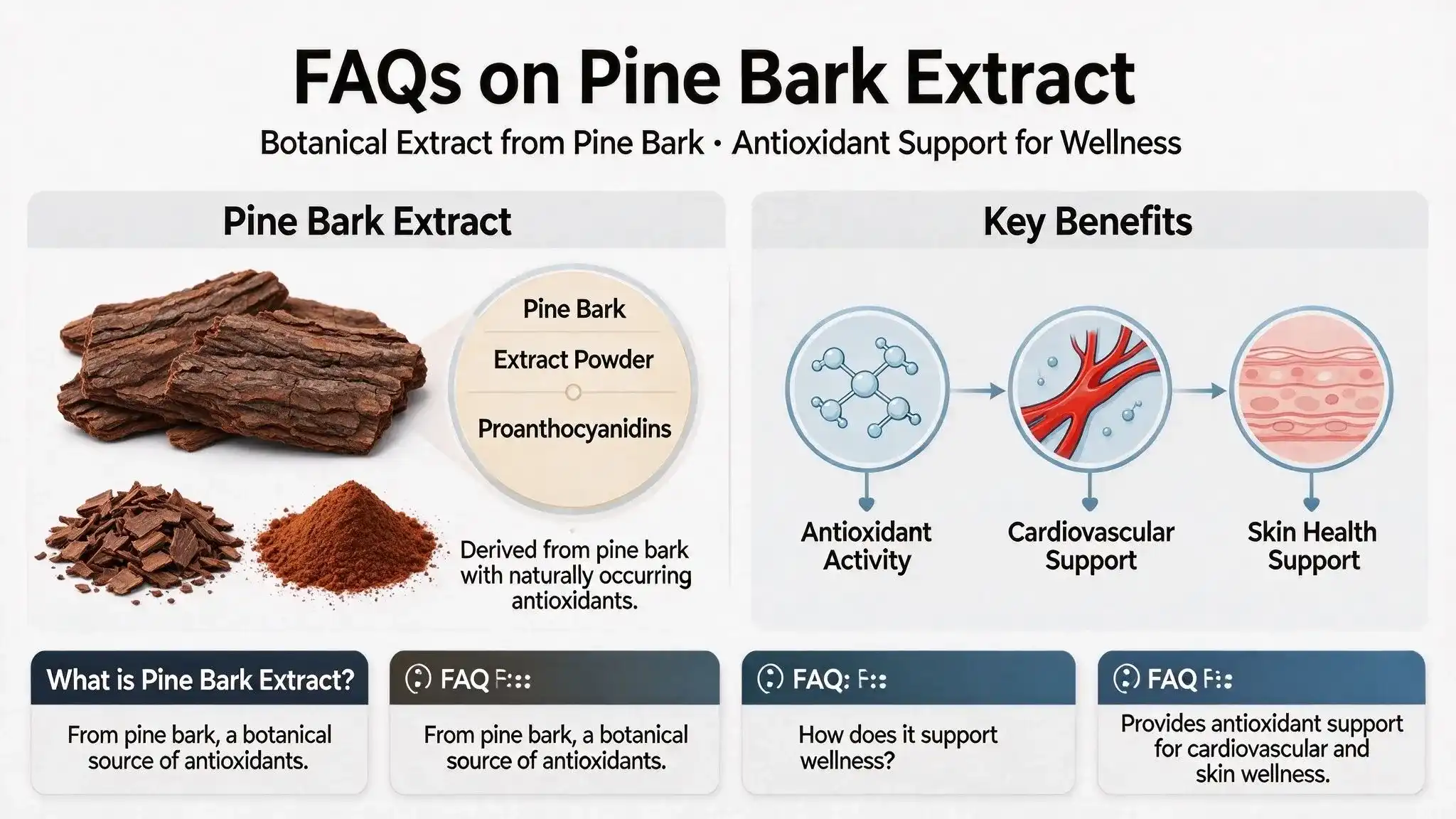
Pine bark extract is valued for its antioxidant activity, and research focuses on a few key areas. People with high blood pressure who took Pycnogenol® had better endothelial function, according to a study published in 2004 in the journal Life Sciences. Researchers who looked at women who have gone through menopause found that their skin is more hydrated and flexible after menopause.
The Journal of Ethnopharmacology put out a review in 2011 that also talked about anti-inflammatory properties. A Cochrane review from 2020 said that a lot of the evidence wasn't very strong and called for bigger studies. These studies only used brand-name extract, so I think of them as background information and not proof that all generic powders work. Your claims should be backed up by proof that has been looked over by the government.
Applications Across Formats
Pine bark extract is in healthy drinks, tablets, capsules, and powder sticks. Many beauty-from-within products employ it. Pink-red, 80-mesh, 3% ash, 95% OPC powder. Also mixable with water. It's suitable for water-soluble liquid and powder-stick compositions. Drink makers should employ stabilisers or chelating agents since polyphenols may brown or crystallise. For high-protein meal replacements, it sticks to proteins well. Mix everyday fillers with fine powder for capsule and tablet lines. Run a brief test run on your equipment to ensure fill weight and flow before ordering more.
Claims That Fit the US Market
US legislation DSHEA allows corporations to describe their goods but not treat or cure sickness. With the FDA disclaimer, "supports healthy circulation" is OK, but "lowers blood pressure" seems druglike. Brands have 30 days to notify the FDA of structure/function claims. Canada has its unique system due to Health Canada's natural health product regulations. Before going live, have a rules expert review every label, web page, and ad. I recommend this before choosing the final packing. The claims will effect your artwork and ingredients.
Which Is Best for Buyers? A Practical Decision Guide
Cost, Licensing, and Brand Value
Pycnogenol® has brand costs and license requirements, yet it boosts your profile and provides a clear research package. Off-brand pine bark extract is cheaper per kilogram and doesn't pay trademark fees. Choose the design, specs, packaging, and private label. Beyond the kilogram price. Just monitor the expenditures of testing, artwork approval, and minimum order quantity. If your market wants the brand name, the additional expense may be worth it. If shelf space relies on formulation value and profit, a decent generic extract will work better.
Supply Flexibility and Lead Time
Generic vendors usually offer additional grade, particle size, and volume options. We hold 10–20 tonnes of safety stock for key products and ship within 5–7 business days using our "ex-factory" strategy. After setting a production window or launch date, ship swiftly. Contact each vendor to check how much of the grade you want is in stock. This contains organics. Ask what they do when demand rises. Instead of generic replies, numbers and dates let you arrange your day.
Which Buyer Should Choose What
If you want a well-known brand, a lot of research, and a hefty price, try Pycnogenol®. If you want to custom label, purchase in bulk, establish standards, or have many formats, select a reputable pine bark extract. Contract manufacturers and OEM customers may evaluate the two choices' colour, flow, capsule size, and stability in a trial batch. Dispersibility and sediment should be tested for drinkmakers. A brand may have a name-brand star product and a generic OPC powder value line. No one stops them. First, briefly describe the product's structure, claims, yearly volume, and certifications.
Quality and Compliance Checklist for Pine Bark Extract Buyers
Documents to Request Before You Order
Before doing business with them, request a specification document, a current certificate of analysis, and verification that the plants are what they claim they are. Check food for heavy metals, pesticides, microorganisms, allergies, GMOs, and country of origin. Get market-acceptable certifications. Our company is ISO 22000, FSSC 22000, ISO 9001, HALAL, and KOSHER certified. Our pine bark extract is USDA Organic, ISO, and HACCP-certified. Make that each certificate is legitimate, from the proper facility, and covers the right product. Marked organic items must have a genuine organic certificate. This is because most providers offer organic and standard grades.
Testing OPC Content and Batch Consistency
Each batch must be identical to support your label claim. Request one "best case" certificate, not many fresh batches. You may identify different lots by comparing OPC findings to your procedure. Send a sample to a third-party lab for supplier certificate verification for the initial order. Check the pilot batch material again to compare it to the first sample. Before ordering, learn about our powder and acquire a certificate of analysis. At least 95% OPC and 3% ash are required. Ask about the solvent left behind because ethanol is used in extraction. Your supply agreement should specify potential revisions so everyone understands the minimum.
Sourcing, Traceability, and Patent Questions
North Americans want to know where the bark originates from and how effectively the trees are managed. Find out where the bark originated from and how the provider tracks it. Learn how various bark lots affect final batches. Patents and trademarks protect Pycnogenol®. Some jurisdictions allow process or use patents. Consult your lawyer about the extraction procedure and claims before launching. I'm no lawyer. Make sure your supplier doesn't offer Pycnogenol®-branded generic extract. Records of where food comes from, how it was prepared, and what it says on the label reduce the risk of lawsuits for stores and you.
Working With a Pine Bark Extract Supplier
A Typical Buying Timeline
Most sign contracts after 8–12 weeks. Market research takes one to two weeks, sample testing two to three weeks, and supplier review two weeks. A three-to-four-week pilot order for 50–100 kg follows. Talk about a bargain, then wait a week or two. Every squad requires different movement time. Early booking of third-party HPLC testing might delay sample preparation due to lab scheduling. Test the pilot on your genuine line—soft capsule, hard capsule, pill, or powder—to see how it works. An annual agreement defines conditions, lead time, pricing, and remedies.
Common Buying Mistakes
People often make these three blunders when sourcing pine bark extract. It's the first to compare headline percentages without technique and treat all pine bark extracts equally. Pycnogenol® only applies to one trademarked extract, therefore French maritime pine bark doesn't necessarily signify that. Third, buying the cheapest without scrutinising documentation, stock, and batch records. Marketing supplements for FDA-prohibited disorders is a fourth error. A detailed specification, method-matched testing, a pilot batch, and government review of every claim may eliminate all four. Labelling again after a few weeks would have cost extra.
What Sigma Offers Buyers
People who want to buy pine bark extract get this from our team:.
- Specification: Our pine bark extract is a reddish brown fine powder made by ethanol extraction. It offers OPC ≥95%, 80 mesh, ash ≤3%, and good water solubility. USDA Organic certification is available, and the powder suits food supplement and cosmetic use. Store it sealed in a cool, dry place. Typical uses include capsules, tablets, powders, and drinks.
- Supply and service: We keep stock ready and ship in 5–7 working days, with sea, air, and express options. Full documentation and customs support come with each shipment, and real-time order tracking lets you follow it. Free samples are available, our team stays in contact around the clock, and a 12-month quality guarantee backs your order.
- Customization: Our OEM and ODM services cover formula adjustment, specification changes, dosage form development, and packaging design. You can request custom extraction ratios, particle sizes, packaging, and labeling to match your brand and production line, whether you run soft capsules, hard capsules, tablets, or powder. Share your product brief and we respond with options.
With these services, your team will know exactly what to check at every step, from the first sample to the 5-year supply deal.
Conclusion
Pycnogenol® and Pine Bark Extract are not the same thing and are sold in different ways, despite the fact that they both come from plants. The trademark for Pycnogenol® makes it clear how it can be used in research and how it can be licensed. Since different tests and species use different types of generic pine bark extract, it is not possible to directly compare OPC numbers from different tests. The brand-name extract was used in studies that were published on skin hydration and endothelial function.
A Cochrane review said that a lot of the evidence was not very strong. For high-end positioning, the branded option is better. A qualified generic, on the other hand, is better for buyers who need to be able to change specifications, buy in bulk, and keep costs low. How the tests were done, the documents that were checked, the claims that are true, and the results from the pilot batch are more important than the name on the label.
FAQ
Is pine bark extract the same as Pycnogenol®?
In fact, Pycnogenol® is a brand name for a substance that comes from the bark of French maritime pine trees. If you buy pine bark extract from more than one source, the species, process, and test they use may be different.
How long does the powder keep?
A cool, dry place is all you need to keep it for 24 to 36 months. The original sealed drums are best.
Why does color vary between batches?
Because the raw wood and the temperature at which it was taken out can vary, the color can range from light red to dark brown. Standardization wants to reach a certain level of OPC, even though the color has changed.
Does it work in liquid drinks?
Yes, but the polyphenols might turn brown or sink to the bottom over time. Stabilizers and chelating agents should be tried out in a small batch before being used on a larger scale.
Request Sigma Pine Bark Extract Samples Today
You want to buy pine bark extract from a business that has it ready to ship. Sigma offers free samples of OPC ≥95% pine bark extract powder and helps with both OEM and ODM. Write to sarah@sxsigma.com and tell her what volume, format, and certification you need. Our team will get back to you with more information and a supply proposal. You can also visit sxsigma.com to learn more.
References
1. International Journal of Clinical Pharmacology and Therapeutics, 2002. "A Review of the French Maritime Pine Bark Extract (Pycnogenol), a Herbal Medication with a Diverse Clinical Pharmacology."
2. Life Sciences, 2004. "Pycnogenol, French Maritime Pine Bark Extract, Improves Endothelial Function of Hypertensive Patients."
3. Journal of Ethnopharmacology, 2011. "A Review on Biological, Nutraceutical and Clinical Aspects of French Maritime Pine Bark Extract."
4. Skin Pharmacology and Physiology, 2012. "Pycnogenol Effects on Skin Elasticity and Hydration Coincide with Increased Gene Expressions of Collagen Type I and Hyaluronic Acid Synthase in Women."
5. Cochrane Database of Systematic Reviews, 2020. "Pine Bark (Pinus spp.) Extract for Treating Chronic Disorders."
6. U.S. Congress, 1994. "Dietary Supplement Health and Education Act."