Huajuhong Wall-Broken Raw Powder vs Whole Powder: Which Wins?
When making tablets, sachets, and instant tea, Huajuhong wall-broken raw powder excels in fine, even blending. When it comes to simple, low-cost recipes where texture doesn't matter as much, whole powder wins. In some situations, neither format is better than the other. I suggest that you match the powder to your equipment, your dosage goal, and the rules of your target market, and then use a sample to make sure the match is good. Being real is more important than grinding. People still can't get what they want from a fine powder made from common pomelo peel. I talk about how they are made and compare the two formats in this article. I also show you how to look at suppliers before you place a bulk order.
What Is Huajuhong Wall-Broken Raw Powder?
Defining the Raw Material
People in Huazhou eat the peel of the Citrus grandis 'Tomentosa' pomelo to make huajuhong. It is called Exocarpium Citri Grandis in the Chinese Pharmacopeia, and naringin is used to check its quality. It has traditionally been made in Huazhou, Guangdong, China. This peel is used to make Huajuhong wall-broken raw powder, which is ground into a fine powder at a low temperature. It stays a natural powder made from plants. Instead of a concentrated fraction, it has the peel's natural fiber and plant compounds. Dosage, labeling, and price are all affected by this difference.
Whole, Wall-Broken, and Extract Powder
The peel is dried and ground into a whole powder, so the particles stay pretty big. An extra step of micronizing breaks down plant cells and narrows the range of particles in wall-broken powder, but it doesn't turn the material into an extract. Extract powder is not the same. A solvent is used to pull compounds out of the mixture, which is then concentrated and often given a carrier. That's why I never just look at the price per kilogram when comparing extract and raw powder. There are different amounts of plant material in one gram of extract and one gram of raw powder. First, make sure you understand the test method, marker compound, extraction ratio, and carrier.
Why the Format Matters for B2B Buyers
Mixing, filling speed, mouthfeel, shelf life, and label wording are all affected by the format. Powder that flows smoothly is needed for a tablet line. A tea bag filler might be able to handle a rougher grind. It's important for beverage mixes that the particles don't stick together. Breaking down walls changes the way things work, but it doesn't change what plants are. The powder is wrong if the peel is wrong. I tell buyers to decide on identity first, then particle size, and finally price. This order stops expensive re-mixing after the first run of production.
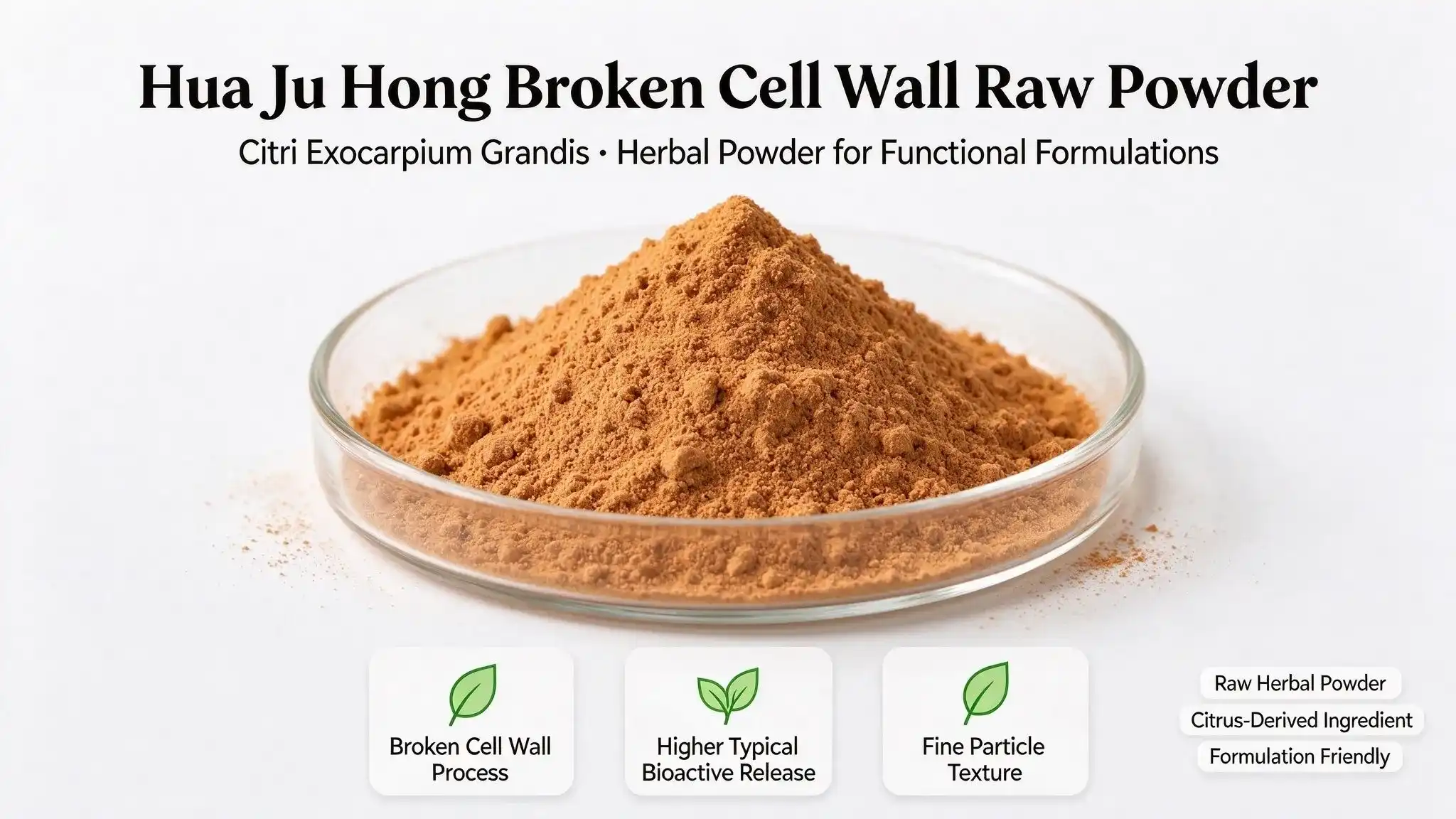
Huajuhong Wall-Broken Powder vs Whole Powder: Key Differences
Particle Size and Mesh Data
Our huajuhong wall-broken raw powder is 200 mesh, which means that particles can get through a screen that has holes about 74 microns wide. There are different grades of whole powder that are sold by different companies. Mesh doesn't give an average, it only gives a ceiling. Laser diffraction results for D50 and D90 are what I ask suppliers for when a formula needs tight particle control. A study published in 2009 in the Journal of Food Engineering looked at superfine ginger powder and found that grinding it even smaller changed its properties, like how dense it was and how easily it flowed. The same reasoning works for Huajuhong powder.
Flow, Dust, and Moisture
There are trade-offs with finer powder. Because smaller particles have more surface area, they can soak up water more quickly, stick together, and make more dust when they are moved. Our powder is easy to work with and loses no more than 5% of its weight when it dries. For best results, keep it sealed up in a cool, dry place. I think you should plan for dust control, dry areas for handling, and quick resealing of opened bags on the plant floor. In this case, whole powder is usually easier to work with. One reason why some people still buy it for simple blends is because of this.
Ingredient Retention and Cost
Since neither format is an extract, they both keep the plant matrix, which includes flavonoids like naringin that have been studied in citrus. Low-temperature milling keeps the grinding process from getting too hot, which is a smart move for botanical powders. The extra work usually makes the price go up, so see if the finer grade works better with your formula. Buyers are most likely to ask about these things, so the table below shows how the two formats compare.
| Factor | Whole Powder | Wall-Broken Powder |
|---|---|---|
| Processing | Dry and grind | Dry, grind, then wall-break at low temperature |
| Particle size | Coarser; varies by supplier | Finer; ours is 200 mesh |
| Handling | Less dusty | More dust; needs dry storage |
| Cost | Usually lower | Usually higher |
Start with this table and then check each row with lab data and samples.
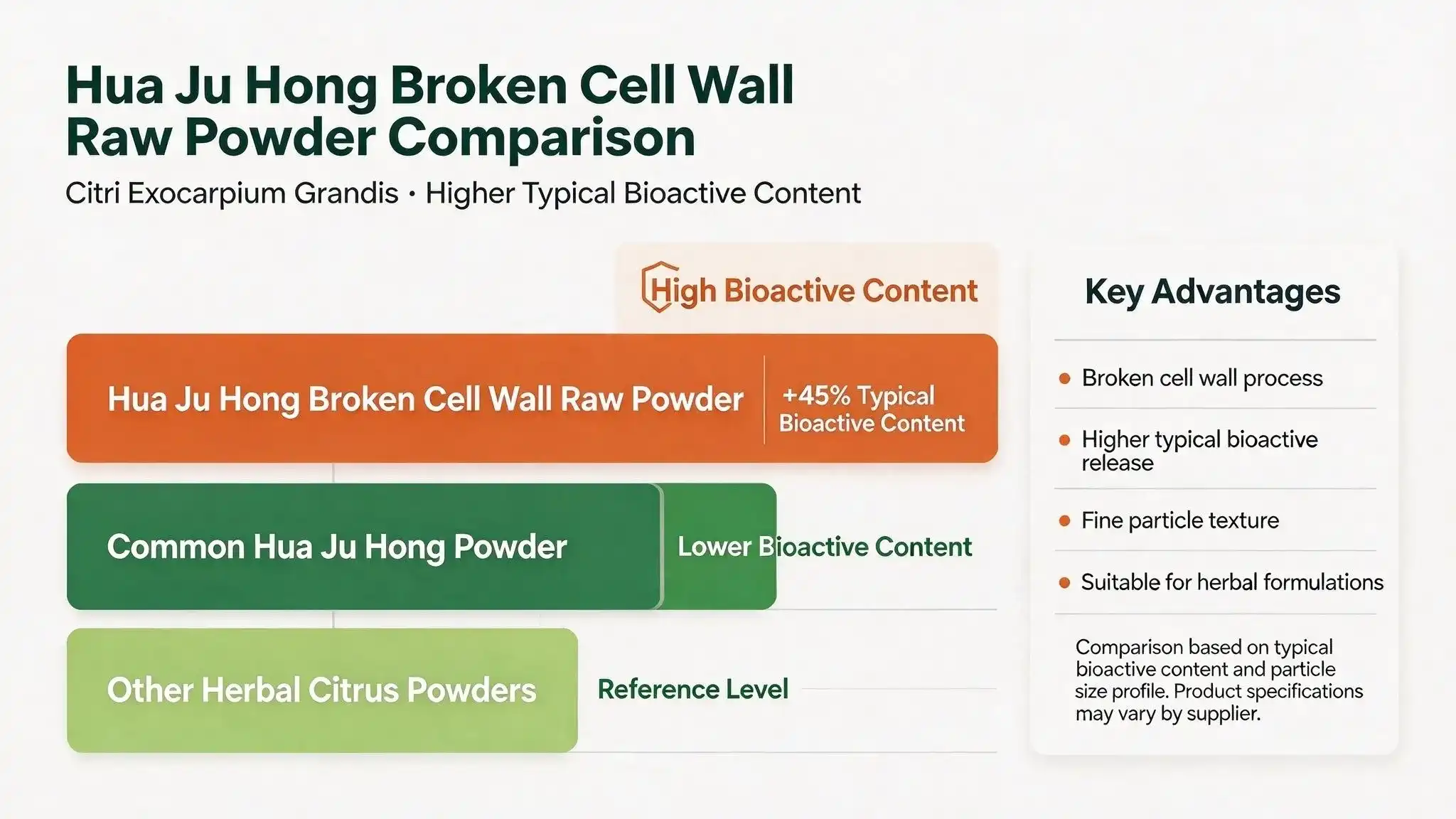
How Is Huajuhong Wall-Broken Raw Powder Made?
Authentication and Raw Material Selection
Identity is the first step in production. People often use common pomelo peel to pass off as Huajuhong on the market, so I use botanical authentication as the first quality check. Sigma only accepts "Zhengmao" Huajuhong that is 100% real and can be tracked all the way back to its source. As a way to tell the difference between real and fake items, buyers should ask for records of where the plants came from, what parts they were made of, and when they were harvested. Supplement makers in the U.S. should also care because of rules. FDA's 21 CFR Part 111 says that companies that make food must check the identity of every ingredient they use.
Drying, Low-Temperature Wall-Breaking, and Sieving
The peel is usually cleaned, dried to get rid of extra water, and then milled. The low temperature of the step in our process that breaks down the walls keeps the particles from getting too hot while they shrink for our huajuhong wall-broken raw powder. After that, the powder is sieved until it meets 200 mesh. Monitoring the particle size during a run makes sure that all of the batches are the same, so I ask every supplier how they do it. Also, find out about the controls for equipment hygiene and cross-contamination, since a shared line can let foreign powders in. The fine powder we make is light yellow, and if the color changes clearly from one batch to the next, we should know why.
Quality Testing, Packaging, and Storage
Lots that are done should come with batch records and a COA. It must have a loss on drying of 5% or less, an ash content of 5% or less, and microbial results that meet food standards. If testing for heavy metals, pesticide residue, or sulfur dioxide is part of your quality plan, check to see if the lot you want has those results. Fine powder soaks up water, so the way it's packed is important. Packs that are sealed and kept in a cool, dry place keep food fresh for longer. There are ISO, HACCP, and Halal certificates for this product.
Huajuhong Wall-Broken Raw Powder Benefits and Uses
Formulation Advantages
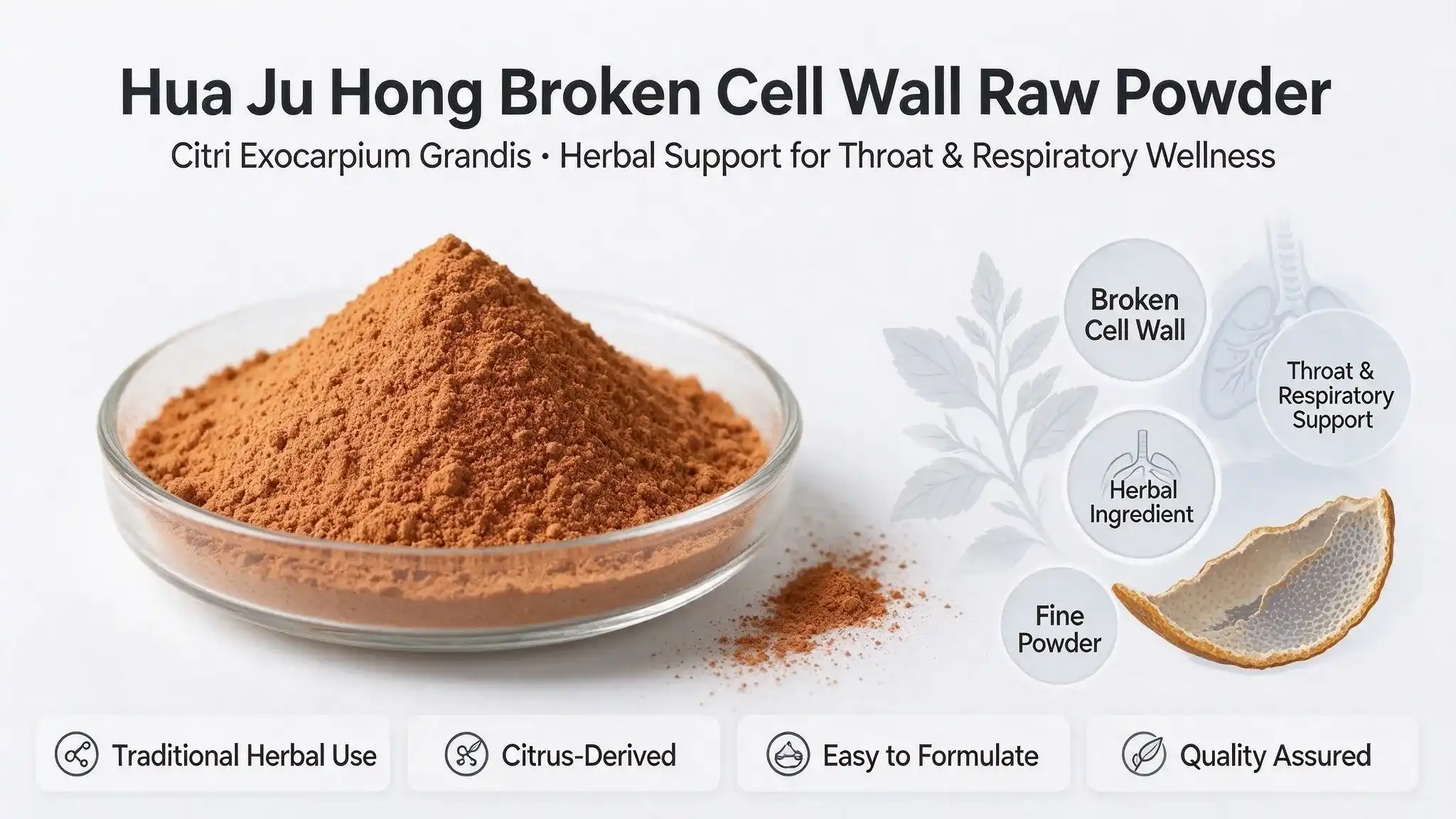
Three useful things can be done with a fine, free-flowing powder: mixing, dosing, and filling. In a blend, particles of the same size are less likely to separate, which means that each capsule or sachet is more likely to hold the same amount of material. Feeders and fillers also run more smoothly when there is good fluidity. Huajuhong has a mild flavor and is traditionally used to soothe sore throats and keep lungs healthy. However, I don't believe it can make medical claims. Structure/function rules say that U.S. labels have to follow them, so before a product goes on sale, a regulatory advisor should look over every claim.
Typical Applications
Our item helps people who make food and health products. Some common uses are making herbal tea every day, getting the ingredients for throat-care tablets, and putting them in dietary supplements that help the lungs. Buyers can also think about functional drinks, private-label blends, capsules, and sachets. When it comes to the US, the rules depend on the type of product: regular food or dietary supplement. Make up your mind early on. The 2016 draft guidance on new dietary ingredient notifications from the FDA explains when a notification may be needed. I think you should talk to a qualified advisor about the status of the ingredient.
When Whole Powder Still Makes Sense
In some recipes, whole powder should be used. It may be fine to have a rough texture in a simple herbal tea blend, and a lower price may be more important than particle control for huajuhong wall-broken raw powder. No matter what you decide, use your own equipment to run a pilot batch. Check the flavor, color, stability, flowability, dispersion, and how well it works with other ingredients. A small test often shows issues that a spec sheet can't, like clumping in damp places or color changes after being heated. Before you scale up, compare the results to your cost goal.
Whole Powder or Wall-Broken Powder: Which One Wins?
Match the Powder to Your Priority
When money is tight and the recipe is easy, choose whole Huajuhong powder. When particle control, blending consistency, or a custom specification are important, wall-broken powder is the way to go. If you want to concentrate or standardize something, choose extract powder. Then, look at the extraction ratio, marker compound, carrier, and dosage equivalence. No one format is best everyplace. It's a winner if it passes your sample test and has a good landed cost. I put identity first, then specs, and finally price.
Supplier Checks Before You Commit
Saying something is real needs proof. Get a current COA, records of where the item came from and how it was tracked, and certificates. Sigma is certified in ISO 9001, ISO 22000, and HACCP. This Huajuhong powder is Halal certified and in stock. We also keep 10–20 tons of safety stock for important products. These can be delivered in 5–7 business days, but you should make sure the exact item you need is in stock. Particle size, packaging, and labeling are some of the OEM options. Under the FDA's Foreign Supplier Verification Program rule, U.S. importers often need to show proof that the supplier has been checked.
Quotation and Import Documents
A clear quotation should include product, grade, mesh size, packaging, minimum order quantity, currency, Incoterms, payment terms, lead time, shelf life, and any accessible documentation. Review each offer and grade it on traceability, capacity, consistency, and reaction time. Start with a sample, then a trial order, and then a supply agreement following technical approval. For import, collect the certificate of origin, invoice, packing list, label, and make sure your customs broker classifies the goods under HS. Sigma offers free samples and a 12-month quality guarantee, lowering testing costs.
Conclusion
The best option depends on the formula because Huajuhong wall-broken raw powder and whole powder serve different purposes. Wall-broken powder has smaller particles, blends better, and flows well. In simple, cost-driven blends, whole powder works best because it has less dust and costs less. Unlike extracts, which vary in extraction ratio and dosage equivalence, both are still raw plant materials.
First, there is authenticity. Common pomelo peel is a known fake, and U.S. supplement makers are required by law to test their products for identity. Results from particles, moisture, ash, microbes, and packaging then determine how well the food works and how long it lasts. Line-by-line quotes and pilot tests show which powder works best for a certain product.
FAQ
Is wall-broken Huajuhong powder the same as extract?
It's not a solvent-based concentrate; it's a raw botanical powder, so it doesn't have that.
What particle size does Sigma offer?
The product we normally sell is 200 mesh. You can get particles of different sizes through OEM customization, so send us your target.
Can I use it in food and supplements?
Our powder is meant to be used in health and food products. Check with a regulatory advisor to make sure that the uses and claims on the labels of your U.S. products are legal.
Which documents come with an order?
For export papers, a COA, and certificates, ask for them. We agree with these requests and give away free samples for testing.
Request Huajuhong Wall-Broken Raw Powder Samples from Sigma
Sigma is here to help you find the best huajuhong wall-broken raw powder supplier for your tea, tablet, or supplement projects. Our 200-mesh light yellow powder is in stock and comes from a "Zhengmao" source that can be tracked. It has ISO, HACCP, and Halal certificates. To get a free sample or quote, email sarah@sxsigma.com with your application, annual volume, and packaging needs. For more information, go to sxsigma.com.
References
1. Chinese Pharmacopoeia Commission, Pharmacopoeia of the People's Republic of China (Exocarpium Citri Grandis monograph), 2020
2. Journal of Food Engineering, "Effect of Superfine Grinding on Properties of Ginger Powder," 2009
3. U.S. Food and Drug Administration, Current Good Manufacturing Practice for Dietary Supplements (21 CFR Part 111), 2007
4. U.S. Food and Drug Administration, Dietary Supplements: New Dietary Ingredient Notification Procedures and Timeframes, Draft Guidance for Industry, 2016
5. Food Chemistry, "Citrus Flavonoids: Molecular Structure, Biological Activity and Nutritional Properties: A Review," 2007
6. U.S. Food and Drug Administration, Foreign Supplier Verification Programs for Importers of Food for Humans and Animals, Final Rule, 2015