How to use soy peptide in drinks?
If drink companies want to meet the growing demand for plant-based, digestible nutrition, adding Soybean Peptide to their drinks is a simple but game-changing idea. Soybean Peptide, a protein that has been digested by enzymes and has a molecular weight of less than 1000 Da, dissolves fully in water and can be used in both hot and cold recipes. This ingredient can be quickly absorbed through the PepT1 transporter mechanism, which skips the normal protein digestion routes. This makes it great for making sports recovery drinks, meal replacement shakes, or functional health drinks. It's great for clean-label goods because it doesn't have any of the sour or beany tastes that come with regular soy proteins. The key is to figure out the best dose, mixing, and formulation conditions to keep the bioactivity while keeping the taste quality the same from batch to batch.
Understanding Soybean Peptide and Its Benefits in Drinks
What Makes Soybean Peptide Different from Traditional Soy Protein?
Because of how its molecules are structured, Soybean Peptide stands out. Enzymatically digested peptides are made up of short chains of 2 to 6 amino acids, while complete soy protein isolates need to be broken down in a lot of steps. Because they are structurally simple, the body can take them quickly without having to work hard to digest full proteins. It has been found that Soybean Peptides are taken up faster and more efficiently than free amino acids or whole proteins because they use the oligopeptide transporter PepT1 in the walls of the intestine. This solubility benefit is especially useful in recovery drinks for after a workout, since the speed at which nutrients are delivered directly affects the building of muscle protein and the healing of tissues.

We can move on from talking about structural benefits to talking about useful functional wins. Soybean Peptides have a number of health benefits that make them stand out in drinking uses. Oxidative stress speeds up the age of cells and causes prolonged inflammation. Antioxidants help fight this stress. Regularly drinking Soybean Peptides has been shown in clinical studies to improve the flexibility and moisture of the skin. This makes them a good choice for beauty-focused functional drinks. The high amount of arginine and glutamine helps the heart and immune system work well, which goes beyond basic diet to treat other health concerns. These benefits make Soybean Peptides a smart way to stand out in the beverage market, where customers are looking for ingredients that can do more than one thing and give them real health benefits.
How Does It Compare to Whey, Collagen, and Casein?
When you compare plant-based Soybean Peptides to those made from animals, you can see clear benefits that are in line with changing market trends. Even though whey protein helps build muscle, it can be hard for people who are allergic to dairy or lactose or who are concerned about animal rights when they buy it. People are interested in collagen peptides for joint and skin health, but they don't have all the amino acids that are needed for full protein diet. Casein is a slow-releasing protein that has some benefits, but it is hard to dissolve and has a high viscosity, which makes it harder to make drinks with.
Soybean Peptides get around these problems by providing a full range of amino acids without using animal products. Because it dissolves completely in water, the drinks will be very clear, even in acidic drinks like fruit juices and fizzy drinks, where other proteins tend to settle to the bottom. Because the taste profile is neutral, strong masking agents are not needed. This keeps the clean-label claims. Because these Soybean Peptides have molecular weights below 1000 Da and protein contents above 80%, they meet the nutritional and functional standards that quality-conscious B2B buyers look for. The move toward plant-based options isn't just a trend; it's a reflection of basic shifts in customer values around sustainability, managing allergens, and eating foods that aren't harmful to everyone, all of which Soybean Peptides naturally meet.
How Soybean Peptide Works in Beverage Formulations?
Solubility and Stability Across Temperatures
When it comes to making drinks, one of the best scientific things about Soybean Peptides is how well they dissolve. When the isoelectric point of traditional soy protein isolates is around pH 4.5, they have a big problem: they start to form and cloud the end product. This problem is fixed by hydrolyzed Soybean Peptides, which stay fully dissolved in both acidic and neutral pH ranges. This keeps the visual clarity that is important for ready-to-drink formats. This stability works at different temperatures, so the ingredient works the same way whether it's added to hot coffee-based functional drinks or cold sports recovery drinks. The 80-mesh fine powder form spreads out quickly without sticking, which cuts down on mixing time and boosts production efficiency.
Manufacturers who want to keep the biological purity of their products must also consider the temperature range that can be used during processing. While too much heat can change the structure of whole proteins and lower their nutritional value, short-chain Soybean Peptides are more resistant to heat. Standard pasteurization and UHT cleaning don't have a big effect on how well they absorb nutrients or what amino acids they contain. Because they are resilient, manufacturing processes are made easier, so beverage companies can add Soybean Peptides to their current production lines without having to make big changes to the equipment or learn new ways to handle them.
Flavor Profile and Consumer Acceptance
No matter how healthy a drink is, taste is still the most important part in its success. In the past, efforts to use soy-based proteins often failed because they had strong beany tastes and bitter aftertastes that had to be heavily covered up with sweeteners and fake flavors. These problems can be fixed in modern Soybean Peptide production by using certain enzymes and activated carbon adsorption methods. The end result has a neutral taste profile similar to pure water. This lets the formulators be flexible while still keeping the drink's intended flavor.
This taste balance is especially useful when the product doesn't have any flavor or only a light flavor, since protein ingredients tend to dominate the sense experience. Ingredients that add useful value without interfering with taste or smell are good for medical nutrition products, meal replacement powders, and clear protein drinks. Consumer acceptance testing regularly shows that Soybean Peptide fortified drinks get higher scores than those made with regular plant proteins. This directly leads to repeat purchases and brand loyalty. Developers of drinks can focus on making the formulations taste better, have the right amount of sweetness, and give flavors without having to worry about the off-notes of the ingredients.

Dosing Guidelines for Different Drink Categories
Dosing tactics that work rely on the type of beverage, the target audience, and the functional claims that are being made. Each dose of sports nutrition drinks usually has 5 to 10 grams of Soybean Peptides in it to help muscles heal and lessen the damage that exercise can do. This amount gives you enough branched-chain amino acids and glutamine to change biochemical pathways that help with adaptation and healing. Meal replacement shakes need higher concentrations—15 to 20 grams per serving—to meet macronutrient goals, keep you full, and help you keep your lean body mass while you're cutting calories.
Lower concentrations of 3–5 grams per dose can be used in wellness drinks that are meant to maintain general health. This makes the product more of a daily nutritional addition rather than a therapeutic intervention. This mild dose supports healthy heart function, skin, and immune system function without overpowering the drink's main taste profile. Dosing choices are also affected by regulations. For example, even though Soybean Peptides are usually considered GRAS, manufacturers must make sure that the benefits claimed on the label are supported at certain use levels. When R&D teams work with suppliers who give them a lot of technical information, like certificates of analysis and application guidelines, they can feel more confident when making these formulation choices.
Practical Steps to Incorporate Soybean Peptide in Your Drink Products
Market Rationale and Growing Demand
People are becoming more aware of health, sustainability, and dietary freedom, which has led to huge growth in the plant-based functional ingredient market. According to a study of the market, sales of plant-based proteins have grown at double-digit rates every year, with Soybean Peptide formulas being the fastest-growing group. This growth is because consumers are learning about the solubility problems with regular plant proteins and choosing ingredients that are better at absorption without making their stomachs hurt. Beverage brands that use advanced Soybean Peptide technology are ahead of the curve when it comes to this change. They can get a bigger part of the market from health-conscious customers who are willing to pay more for goods that work.
Differentiating yourself from other brands is getting harder in crowded beverage categories where most brands use the same basic proteins. If you switch to Soybean Peptides with molecular weights below 1000 Da, you get a clear scientific edge. This lets you make marketing claims about fast absorption, clean ingredients, and better effectiveness. Brand managers can tell people about these benefits through digital and on-pack material that explains the science behind Soybean Peptide nutrition. This builds trust and supports the premium image.
Addressing Common Formulation Challenges
To integrate Soybean Peptides successfully, you need to be able to identify and solve common composition problems. One of these problems is hygroscopicity, which means that small Soybean Peptides' open hydrophilic groups can easily absorb water. This could cause powders to clump together or ready-to-drink drinks to lose their shelf life. These risks can be successfully reduced by using the right packing materials, such as aluminum foil laminates and nitrogen flushing. Specifications for moisture content below 7% make sure that the raw material comes in the best shape possible for use in production.
Another thing to think about is how pH affects drinks that are sour. Even though Soybean Peptides can dissolve in a wide range of pH levels, formulation partners should make sure that they can work with other useful ingredients that might precipitate or react chemically in acidic conditions. Bench-scale tests that check color stability, settling, and taste evolution over a longer shelf life help find problems before they happen on a large scale. Validation of thermal processing factors is also needed. Soybean Peptides can handle normal pasteurization, but severe conditions or long-term heat exposure during concentration could affect some functional parts. When manufacturers work with experienced ingredient sources, they can use application labs to do these validation studies. This cuts down on the time it takes to get a product to market and the cost of reformulation.
Case Studies from Leading Beverage Brands
Several well-known brands have successfully added Soybean Peptides to their product lines, showing that they can be used in a wide range of products. To appeal to vegan athletes, a European sports nutrition business changed the ingredients in its recovery drinks from whey protein to Soybean Peptides. After the product came out, tests with customers showed that it tasted better and caused fewer stomach problems. This led to a 23% rise in return purchases within six months. The "clean label" message really hit home with female athletes who were worried about how dairy-derived proteins might affect their hormones.
An Asian meal replacement brand aimed at older people added easily absorbed Soybean Peptides to help with the loss of muscle strength and digestive ability that comes with getting older. In clinical studies, their formulation led to big gains in functional strength measures and keeping lean body mass compared to controls that used intact protein. These results backed up health claims that made the product stand out in the medical diet market, which is very competitive. The fact that these implementations worked so well shows that Soybean Peptides not only provide good technical performance but also measured business results when they are properly matched with the needs of target customers and market positioning strategies.

Procurement Considerations When Purchasing Soybean Peptide for Drinks
Supplier Selection Criteria for Quality Assurance
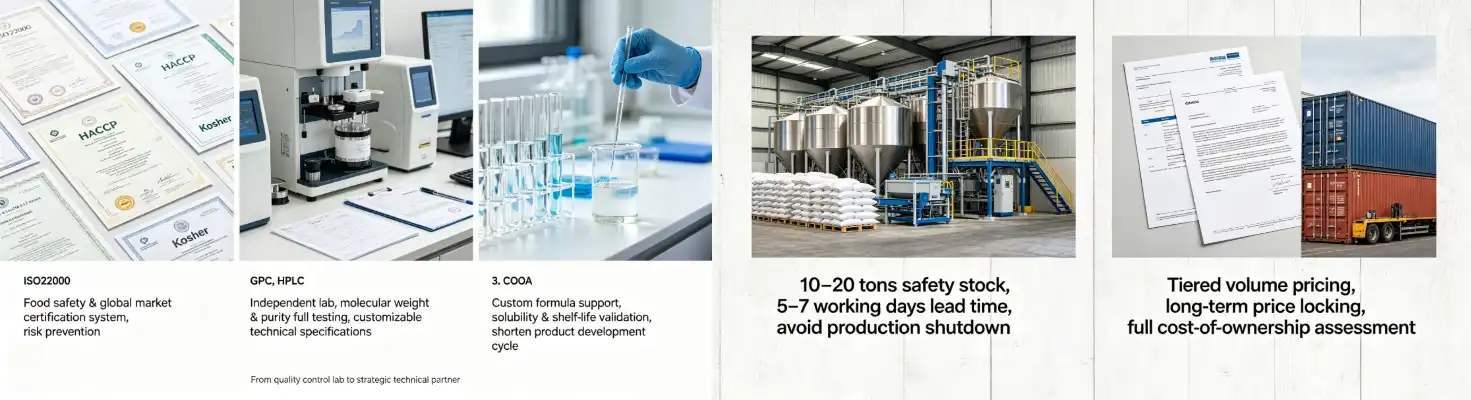
Picking the right Soybean Peptide provider has a direct effect on the quality of the product, the adherence to regulations, and the dependability of the supply chain. Teams that care about quality usually choose sellers that have a lot of different certificates. These can be for things like ISO 22000 for managing food safety, HACCP for controlling hazards, and religious certifications like Halal and Kosher that let more people into the market. These qualifications show that the company uses proactive quality management instead of reactive quality control. This lowers the chance that finished goods will be contaminated, tampered with, or not meet specifications, which could be bad.
Another important aspect of critical review is technical skill. If a supplier has their own lab, they can give you thorough certificates of analysis that show how the molecular weight is distributed using gel permeation chromatography, how much protein is present using Kjeldahl analysis, and how pure the product is using HPLC. Manufacturers of drinks can make recipes work best for certain uses by changing specs like particle size, degree of hydrolysis, and leftover enzyme activity. When suppliers offer application support like solubility tests and stability studies, they stop being transactional sellers and become strategic partners. This collaborative method shortens the time it takes to make a new product and raises the success rate of formulations, providing value that goes beyond the cost of raw materials.
Bulk Purchasing Strategies and Supply Reliability
For large-scale beverage production to keep up with plans and avoid costly breaks, ingredients must always be available. Suppliers who keep a large safety stock—usually 10 to 20 tons of key products—show that they can support growing brands without having to deal with supply problems. Lead times of 5 to 7 working days make it possible to plan production in a way that meets changing needs. This is especially important during sales times or times of the year when demand goes up. Procurement managers can make the best plans by keeping track of inventory costs and stockout risks, which can be done by sharing clear information about inventory amounts and production schedules.
The prices of Soybean Peptide ingredients are based on the costs of the raw materials, the difficulty of the processing, and how the market is changing. Large buyers can usually get better margins with tiered prices when they make volume promises, while smaller names may be able to get better rates through distributor networks. Long-term supply deals with price stabilization methods protect both parties from volatile product markets. This makes it easier to plan for costs and margins. Teams in charge of buying things should look at the total cost of ownership instead of just the unit price. They should think about things like consistent quality, which cuts down on waste, expert support, which speeds up development, and logistics dependability, which keeps production from stopping.
Regulatory Compliance for US and EU Markets
Global beverage brands have to deal with complicated legal environments where labeling rules, claims that can be made, and the status of ingredients that have been approved change a lot from one place to another. In the US, Soybean Peptides are usually considered GRAS, which means they can be used in regular foods without getting pre-market approval. But for some processing methods, enzyme sources, or transport materials, you might need more proof. Suppliers who know what the US market needs provide supporting documents like Generally Recognized as Safe findings, residue solvent analyses, and pesticide screening results that make regulatory applications easier.
The rules in the European Union are even tighter when it comes to new foods, allergen labels, and proving health promises. Soy proteins are well-known in EU food law, but Soybean Peptides made by certain enzymes may need a new food review based on how people have eaten them in the past. Allergen statements must clearly say that the product comes from soy, even though processing greatly lowers allergic epitopes. Working with companies whose specs are EU-compliant and whose technical paperwork is available in multiple languages makes it easier to get into new markets and makes sure that you will continue to follow the rules as they change. This knowledge of regulations is especially helpful for companies that want to make functional claims about skin benefits, heart health, or muscle health that need to be backed up by human clinical studies or thorough literature reviews.
Mixing and Storage Tips for Optimal Soybean Peptide Drink Products
Best Practices for Dissolving and Blending
Paying attention to the mixing order and tool choice is needed to get full dispersion without clumping or foaming for Soy Peptide. Instead of dumping the Soybean Peptide powder into the liquid phase all at once, it should be added slowly while being stirred around a little. This will avoid hydration gradients and clumps that aren't mixed. The best temperature range for fast breakdown is room temperature or slightly warm water (20–40°C), but the Soybean Peptides stay stable over a wider temperature range. High-shear mixers work better for difficult formulas because they make sure that particles are evenly hydrated and don't settle during later processing steps.
If pH changes are needed to keep the taste or smooth it out, they should be made after the Soybean Peptide has been dissolved to avoid localized concentration effects that could affect how well it dissolves. The Soybean Peptides can work in pH levels from 3.0 to 8.0, but very acidic or basic conditions during mixing can change the way the foam behaves and the color stays the same. Standard working procedures should be set up by beverage makers that include mixing speeds, durations, temperatures, and order to make sure that each batch is the same. When a technology is moved from research and development (R&D) to mass production, these processes become even more important because differences in tools can cause unexpected changes in how the product dissolves or what it looks like when it's finished.
Preservation and Packaging for Shelf Life
To keep a product's bioactivity over its entire shelf life, Soybean Peptides need to be protected from breakdown processes like oxidation, Maillard reactions, and microbial contamination. Using ascorbic acid, tocopherols, or rosemary extract in antioxidant systems helps keep the purity of amino acids and stops the growth of off-flavors. Chelating agents, such as EDTA, take in minor metals that speed up oxidative processes. This is especially important in mixtures that have polyunsaturated fatty acids or vitamins that are sensitive to light. These methods for stabilization make the drinks last longer on the shelf while keeping the clean label image that people expect from high-end healthy drinks.
The choice of packaging material has a big effect on how stable the final product is. Light can break down sensitive bioactive chemicals, but opaque cases or UV-protective bottles stop this from happening. Oxygen barrier features are important for goods that claim to have a longer shelf life at room temperature. Multi-layer structures that combine PET, EVOH, and polyethylene provide the best protection against oxygen entry. Headspace oxygen is lowered by washing with nitrogen during filling, which makes oxidative stability even better. Controlling the temperature throughout the distribution process—avoiding long-term contact above 25°C—protects both the quality of the senses and the usefulness of the product. Accelerated stability testing at 40°C/75% RH for three months helps guess how long something will last in real life and finds any problems with the formula before it goes on sale.
Conclusion
By adding Soybean Peptide to drinks, companies are making a strategic choice that helps with a number of issues: meeting consumer demand for plant-based nutrition; providing better bioavailability than intact proteins; and achieving clean-label positioning through neutral taste profiles. Complete solubility in water, stability across pH and temperature ranges, and fast uptake through peptide transporters are some of the technical benefits that can help beverage companies stand out in a crowded market. To make the application work, you need to pay close attention to the formulation parameters, choose a provider based on their quality credentials and technical support, and follow processing methods that keep the bioactivity intact throughout the shelf life. If a brand masters these elements, they are at the top of functional beverage innovation and can capture market share from health-conscious customers who value effectiveness along with taste and ease of use.
FAQ
Q1: Can soybean peptides be used in both hot and cold beverages?
A: Soybean Peptides are very stable at high temperatures, which means they can be used in hot coffee drinks, tea blends, and cold-pressed juices. The low molecular weight structure doesn't break down when the drink is processed normally, even when it is pasteurized. In cold uses, the product dissolves quickly without any help from temperature, while in hot forms, the clarity and bioactivity are kept at normal brewing temps.
Q2: What is the recommended daily intake for functional benefits?
A: Dosing depends on what you want to happen. To help muscle protein synthesis, sports rehab products usually use 5 to 10 grams per dose. 3-5 grams of Soybean Peptides are found in most health drinks to help the heart and immune system. To meet nutritional goals, meal replacements need 15 to 20 grams. Clinical data shows that taking it every day for 8 to 12 weeks makes changes that can be seen in body structure and functional signs.
Q3: How does absorption compare to whey protein for muscle building?
A: Soybean Peptides and whey hydrolysates both use the PepT1 transporter to be quickly absorbed, and they both reach similar blood amino acid peaks. Soybean Peptides have unique benefits because they contain more arginine, which helps the body make nitric oxide and keep blood vessels working properly. The full amino acid makeup, which includes branched-chain amino acids, successfully supports muscle protein synthesis and provides extra cardiovascular and antioxidant effects beyond just growing muscle.
Partner with Sigma for Premium Soybean Peptide Supply
Sigma has become known as a reliable company that makes Soybean Peptides for global beverage names that need regular quality and quick responses. Our off-white fine powder has a molecular weight of less than 1000 Da and a protein content of at least 80%. This makes sure that it is fully bioavailable and dissolves in water in your recipes. We keep a large quantity of 10–20 tons, so we can deliver within 5–7 business days to keep your production plans running smoothly. Our ISO 22000, HACCP, and Halal certificates show that we follow the rules needed to sell our goods in the US and EU markets.
Plus, our patented debittering technology gets rid of the bean taste that makes people not want to buy regular Soybean Peptide products. If you need bulk supplies for well-known product lines or help with custom formulations for new drinks, our expert team can help with Soybean Peptide application advice backed by detailed analytical data. Contact Sarah at sarah@sxsigma.com to request samples, discuss your specific requirements, and discover how our Soybean Peptide solutions can differentiate your functional beverage portfolio in increasingly competitive markets.
References
1. Chen, H., & Xu, S. (2019). Bioactive peptides from plant proteins: Production, biological activities and applications in foods. Journal of Food Science and Technology, 56(8), 3721-3734.
2. Li, Y., & Aluko, R. E. (2020). Structural and functional properties of soy protein-derived peptides. Food Chemistry, 315, 126289.
3. Nakamura, Y., Yamamoto, N., Sakai, K., & Takano, T. (2018). Absorption mechanisms of antihypertensive peptides and their application to functional foods. Current Pharmaceutical Design, 24(19), 2138-2145.
4. Park, S. Y., Lee, J. S., Baek, H. H., & Lee, H. G. (2021). Application of enzymatic protein hydrolysates in beverage development: Technological challenges and solutions. Comprehensive Reviews in Food Science and Food Safety, 20(2), 1956-1982.
5. Singh, B. P., & Vij, S. (2020). Functional significance of bioactive peptides derived from soybean: A review. Peptides, 128, 170308.
6. Wang, L., Ding, Y., Zhang, X., Li, Y., & Wang, R. (2022). Strategies for improving sensory properties and functional characteristics of plant protein hydrolysates in beverage applications. Trends in Food Science & Technology, 121, 145-159.


_1776308368292.webp)