How to Choose Quality Goji Berry Puree Supplier?
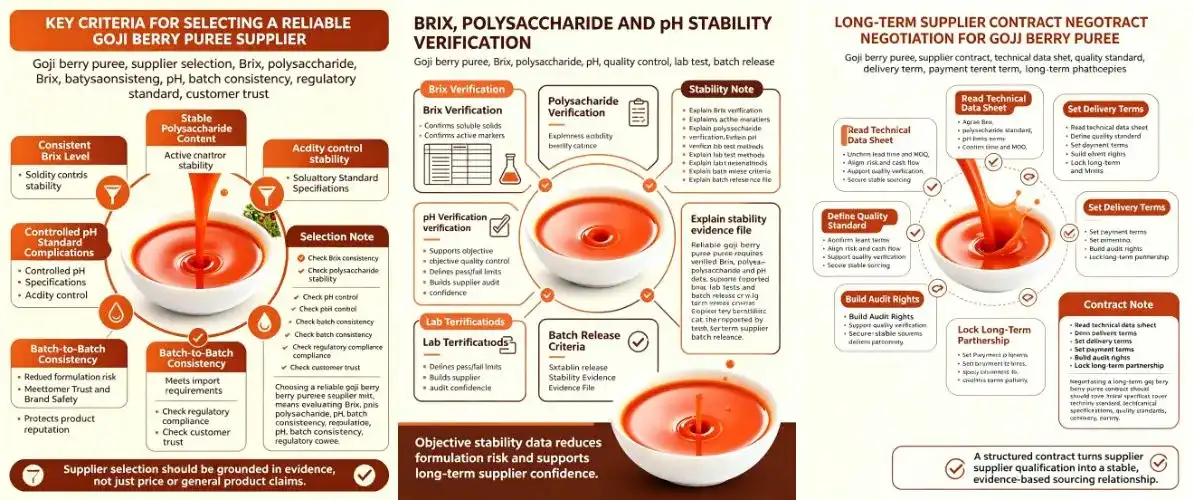
Choosing the right goji berry puree supplier is one of the most consequential decisions a functional food brand can make. A reliable supplier delivers a red viscous liquid that meets strict Brix, polysaccharide, and pH specifications batch after batch. The wrong one quietly undermines your formulation consistency, your regulatory standing, and your customer trust. In this guide, I walk through every stage of the evaluation process — from reading a technical data sheet to negotiating a long-term supply contract — so your sourcing decision is grounded in evidence, not guesswork.
Understanding the Goji Berry Puree Market and Product Essentials
What Is Goji Berry Puree and How Does It Differ from Other Forms?
Goji berry puree is made by cold-pressing fresh Lycium barbarum fruit into a thick red liquid. It is not made by rehydrating dried berries or mixing powder back together. This is important because cold-pressed wolfberry juice has much higher levels of heat-sensitive Lycium Barbarum Polysaccharides (LBP), zeaxanthin, and betaine than dried or powdered forms. A good puree has a solid content of at least 15%, a carbohydrate content of at least 1%, and a pH range of 3.5 to 4.5. This means that it can be used directly in production lines for drinks, yogurt, and supplements without needing to be changed.
Key Nutritional Drivers Behind B2B Demand
A lot of research has been done on the antioxidant profile of wolfberry concentrate. A study in the journal Food Chemistry confirms that goji preparations that are freshly pressed have higher ORAC values than their dried counterparts. Zeaxanthin dipalmitate is good for your eyes, which is a selling point that will appeal to people who spend a lot of time in front of screens. Betaine helps to keep cells hydrated. Because of these useful properties, the ingredient is very popular in the US functional beverage market, which was worth more than $196 billion worldwide in 2023 (Grand View Research).
Production Regions, Seasonality, and Pricing Dynamics
Premium wolfberries mostly come from Ningxia, China. Suppliers who can prove they get their berries from Ningxia charge more, which is fair because the carbohydrate amounts are more consistent. Since the harvest is at its best from July to September, contracts signed in the fourth quarter usually get better prices. Buyers who know about this seasonal cycle are able to get 20–30% better annual framework agreements than buyers who only buy on the spot.
Establishing Supplier Evaluation Criteria for Quality and Reliability
Quality Benchmarks Every Buyer Should Verify
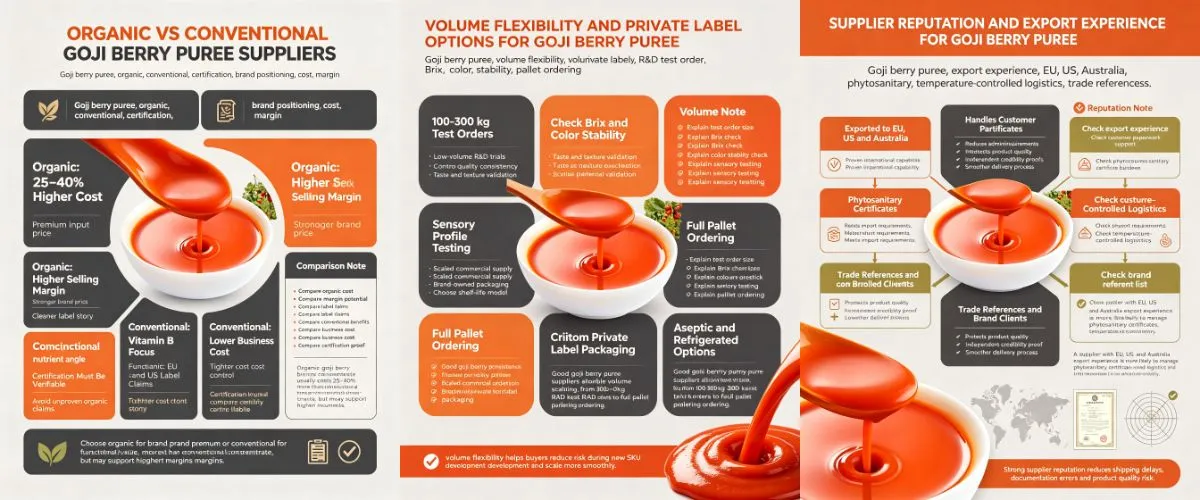
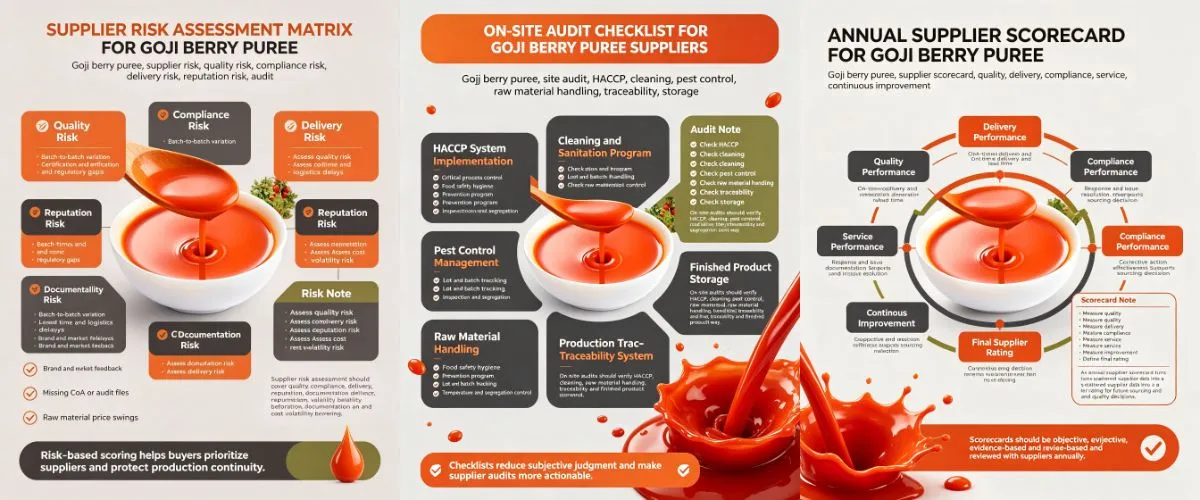
Ask for a full certificate of analysis (CoA) for each batch of Goji berry puree before you sign any supply deal. ≥15% solids, a pH range of 3.5 to 4.5, and ≥1% polysaccharides should all be confirmed by the CoA. Heavy metals must meet EU guidelines, and screens for pesticide residues should include at least 500 substances to meet FDA and EU MRL needs. It's a red flag when a supplier can't make batch-specific COAs instead of general ones.
Certification Requirements That Protect Market Access
To get into the US and EU markets, you need at least ISO 22000 and HACCP certifications. With KOSHER and HALAL certifications, you can reach more customers through more retail channels at the same time. If your brand wants to reach the natural and organic market, which makes up about 45% of US superfood sales, you should pay for USDA Organic approval. Ask each candidate supplier to send you the original certificates with dates on them, not scanned copies that might not be valid anymore.
Traceability and Third-Party Testing
It is necessary to be able to track batches. An honest seller will be able to connect each production lot to a specific farm, harvest date, and processing run. Ask to see their supplier audit records and make sure your first shipment comes with at least one independent lab report from a third party. Services like Eurofins and SGS regularly test Goji berry puree for cargo going to the US. A supplier who welcomes this process instead of fighting it shows that they have faith in their product.
Comparing Supplier Types and Product Varieties to Match Your Needs
Organic vs. Conventional: Matching Certification to Your Brand Positioning
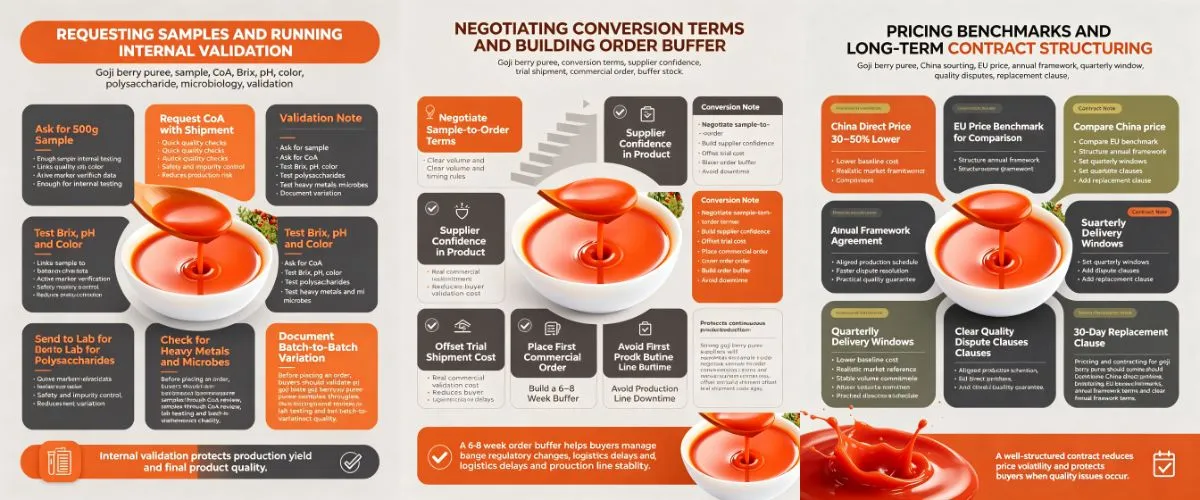
Organic wolfberry concentrate usually costs 25–40% more than regular wolfberry concentrate, but it has a higher selling profit and makes label claims easier in the EU and the US. Conventional certified-clean mush can still be used to fill vitamin capsules, where organic status is less important from a business point of view. It is important to make sure that the seller actually has the organic chain-of-custody certificate and not just saying "organic-farmed" without any proof.
Volume Flexibility and Private Label Options
The levels of service from a good provider are easy to see. Test orders of 100 to 300 kg let your R&D team check the Brix, color stability, and sensory profile before committing to full pallet volumes. When you work with suppliers who offer private label packaging, custom Brix adjustment, and aseptic or refrigerated format options, it makes your downstream production a lot easier. This is especially helpful when launching a new SKU that needs formula changes over several production runs.
Evaluating Supplier Reputation and Export Experience
A supplier who has exported to the US, EU, and Australia before shows that they know how to handle customs paperwork, phytosanitary certificates, and temperature-controlled logistics. Look for trade references, attendance at events in the field like Natural Products Expo West or Food Ingredients Europe, and client reviews that can be checked out. Suppliers who have been exporting consistently for five years or more are usually better at handling wait times and paperwork mistakes than younger suppliers.
Procurement Best Practices for Securing Quality Wolfberry Concentrate
Requesting Samples and Running Internal Validation
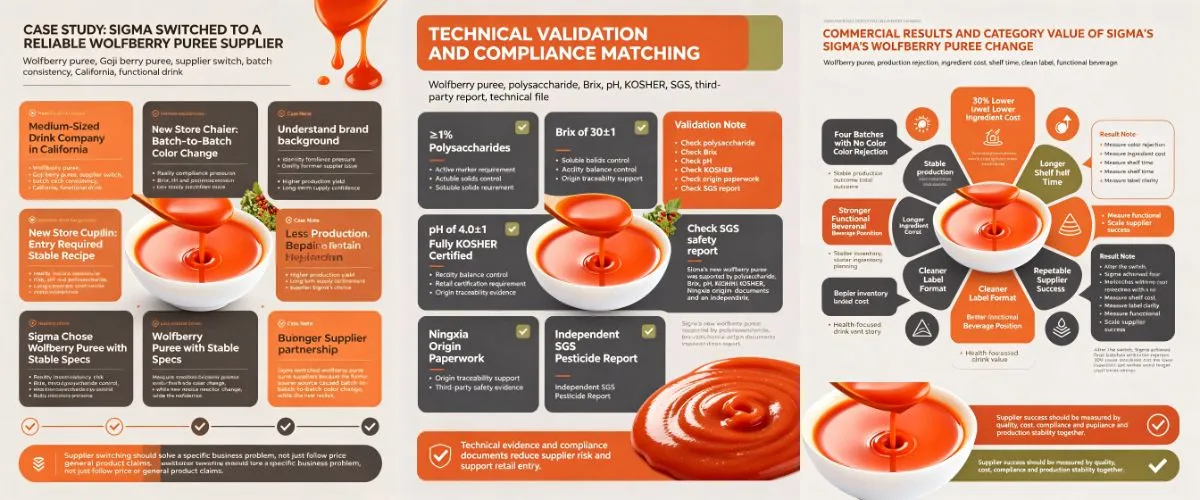
Before placing an order, you should always ask for a sample of at least 500g of Goji berry puree. When you get there, do your own Brix reading, color check, and smell test. Send a piece to a recognized lab so that they can measure the amount of polysaccharides and check for microbes. We use both visual and scientific testing to find problems that a CoA might miss, like batch color drift caused by changes in storage temperature during travel.
Before making a deal with a new supplier, most procurement managers know what steps to take:
- Define specifications in writing. Document your minimum polysaccharide content, target Brix range, acceptable color (L\a\b\* values if available), and shelf-life requirements before approaching any supplier. This protects you legally and makes supplier comparison objective.
- Negotiate sample-to-order conversion terms. A supplier confident in their product will offer a credited sample fee, meaning the cost of the trial shipment offsets against your first full commercial order. This reduces your financial exposure during validation.
- Build a 6–8 week buffer into your first order timeline. Regulatory clearance, cold chain logistics, and production line validation collectively require more calendar time than most buyers anticipate during initial planning.
All of these steps for Goji berry puree lower the chance that specifications won't match up on the production floor, and they also protect the visual precision that your customers expect.
Pricing Benchmarks and Long-Term Contract Structuring
Ningxia wolfberry sauce that comes directly from a Chinese maker is usually 30–50% cheaper than the same product sold in Europe or the US. Setting up a framework agreement for a year with delivery windows every three months makes your cash flow and the supplier's production schedule more stable, which usually means more consistent batches. Include a clause for quality disputes with clear timelines for fixing problems. For example, 30 days for a replacement shipment is a good industry standard.
Case Study: Sourcing Wolfberry Puree for a US Functional Beverage Brand
A medium-sized healthy drink company in California went to Sigma because their former supplier's colors changed from batch to batch. For a new store chain entry, their recipe had to have at least 1% polysaccharides, a Brix of at least 30°, and be fully KOSHER certified. After getting samples from three sources, they chose Sigma because it had confirmed Ningxia origin paperwork, an independent SGS pesticide report with 520 compounds, and a flexible 200 kg trial order with shipping costs covered.
After the tests were done, four batches of production showed no color rejection. The company launched their goji health shot line on time and got 38% off the cost of the ingredients they used from their old source. Their R&D lead said that the cold-pressed, preservative-free format meant that they didn't have to change the pH of their current recipe as much, which saved them money and time.
Conclusion
Picking a wolfberry puree supplier for Goji berry puree depends on having proof at every step: batch COAs, third-party lab reports, documentation that shows where the puree came from and can be tracked, and a supplier that is willing to support trial orders with clear pricing.
Cold-pressed puree from Ningxia that is certified by ISO 22000, HACCP, and KOSHER and has a solid content of at least 15% and a polysaccharide content of at least 1% is the technical standard for important functional food uses. It's important to be competitive on price, but being consistent across batches is much more important for protecting your brand than saving a few cents per kilogram.
FAQ
What certifications should a goji berry puree supplier hold for US market entry?
At minimum, suppliers should hold ISO 22000 and HACCP. For broad US market access, USDA Organic and KOSHER or HALAL certifications significantly expand retail eligibility. Always verify certificate validity dates directly with the issuing body.
How do I verify that the polysaccharide content claim is accurate?
Request HPLC-based polysaccharide quantification data, not just a generic CoA figure. Send your own sample to an accredited third-party lab such as Eurofins or SGS for independent confirmation before approving a supplier.
Is organic wolfberry puree worth the price premium for functional beverages?
If your product targets natural food retail channels or carries an "organic" label claim, the premium is justified. If the puree is used in a supplement where organic status is not a marketing requirement, certified-clean conventional puree is a cost-effective alternative.
How should goji puree be stored and what is the shelf life?
Unopened aseptic packaging maintains product integrity for 12–18 months stored below 25°C. Once opened, refrigerate and use within 48 hours. Cold chain shipment is recommended for orders crossing warm climate transit zones.
What is the minimum trial order volume to validate a new supplier?
Most credible suppliers accept trial orders of 100–300 kg. This volume is sufficient for laboratory validation and one or two production line test runs before committing to a full annual contract.
Partner with Sigma for Premium Goji Berry Puree Supply
Sigma sells verified Ningxia-origin products With 10–20 tons of safety stock ready for immediate shipment, Goji berry puree is produced in accordance with ISO 22000, HACCP, and KOSHER standards. Sigma is a reliable company that makes Goji berry puree. They offer free samples, unique Brix and packaging specs, and full COA paperwork with every order. To get a sample and price quote right away, email Sarah at sarah@sxsigma.com or go to sxsigma.com.
References
1. Grand View Research. Functional Beverage Market Size, Share & Trends Analysis Report. 2023.
2. Amagase, H., & Farnsworth, N. R. "A review of botanical characteristics, phytochemistry, clinical relevance in efficacy and safety of Lycium barbarum fruit." Food Research International, 2011.
3. Zheng, G., et al. "Compositional analysis of polysaccharides from Lycium barbarum and their antioxidant activity." Food Chemistry, 2015.
4. Wu, S. X., et al. "Effects of processing methods on the bioactive compounds of goji berry (Lycium barbarum)." Journal of Food Science and Technology, 2018.
5. Codex Alimentarius Commission. General Standard for Contaminants and Toxins in Food and Feed (CODEX STAN 193-1995). FAO/WHO, 2019 revision.
6. USDA Agricultural Marketing Service. National Organic Program: Regulations and Guidelines. 2022.