Butterfly Pea Flower Extract vs Synthetic Food Colors
When your product development team asks about replacing Brilliant Blue FCF with something consumers can actually read on a label, the conversation quickly leads to butterfly pea flower extract. Derived from the dried flowers of Clitoria ternatea, this natural blue colorant delivers anthocyanin content ≥25%, a vivid pH-sensitive color shift from blue to purple, and FDA compliance under 21 CFR 73.69. Synthetic alternatives like FD&C Blue No. 1 offer consistency at low cost, but face growing regulatory and consumer pushback. This comparison helps procurement managers make a grounded, evidence-based sourcing decision.
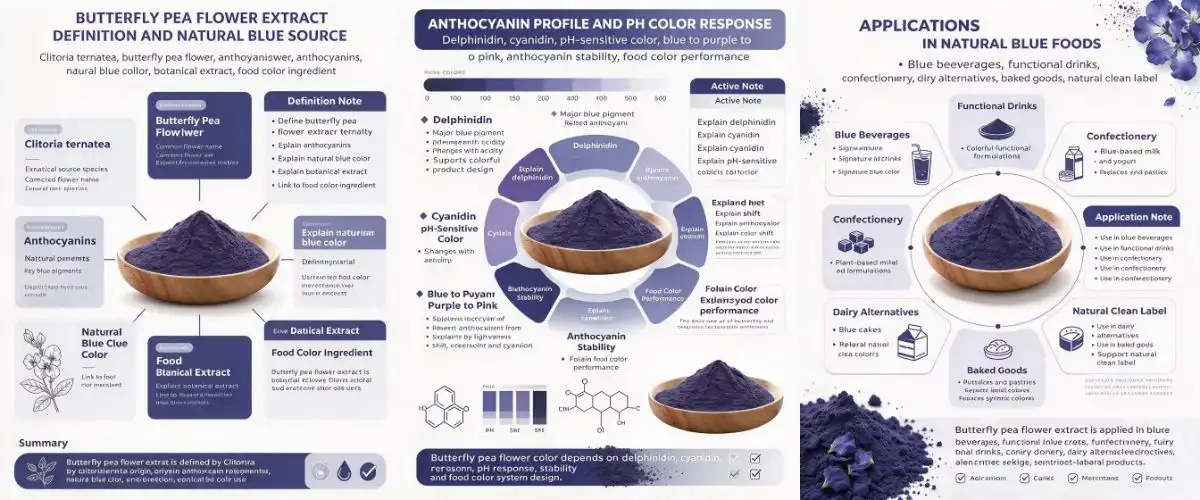
Understanding Butterfly Pea Flower Extract and Synthetic Food Colors
Before you compare the two, it's helpful to know what each one is and how it fits into your recipe.
What Is Butterfly Pea Flower Extract?
Butterfly pea flower extract comes from the flowers of the Clitoria ternatea plant. It is made by extracting the flowers with water and ethanol. Anthocyanins are the active chemicals. They are polyphenolic pigments that give the color its deep blue tone. A good food-grade powder should have a pH range of 3.0 to 5.0, anthocyanin content of at least 25%, and wetness content of no more than 5%. The extract dissolves in water, leaves no waste, and doesn't have any off-flavors at normal usage levels. These are all useful qualities that make it useful in production lines for drinks, sweets, and baked goods.
What Are Synthetic Food Colors?
Chemical synthesis is used to make synthetic food colors like FD&C Blue No. 1 (Brilliant Blue FCF) and FD&C Blue No. 2 (Indigo Carmine). These dyes come from petroleum. They are cheap, very stable, and give the same color performance from batch to batch. In the US, they are approved by the FDA under 21 CFR Part 74. However, they are "no-exemption" in EU markets where some synthetic dyes need to have warning labels. Also, consumer anger against artificial additives keeps growing in both North American and European markets.
Regulatory Standing: A Critical Baseline
The FDA allowed butterfly pea flower extract in water as a color ingredient that did not need to be certified (21 CFR 73.69) for certain types of food and drinks in 2021. The EU hasn't yet given the same approval for using food colors, so companies that want to sell in Europe need to carefully consider how they might be affected by regulations before deciding to use either one.
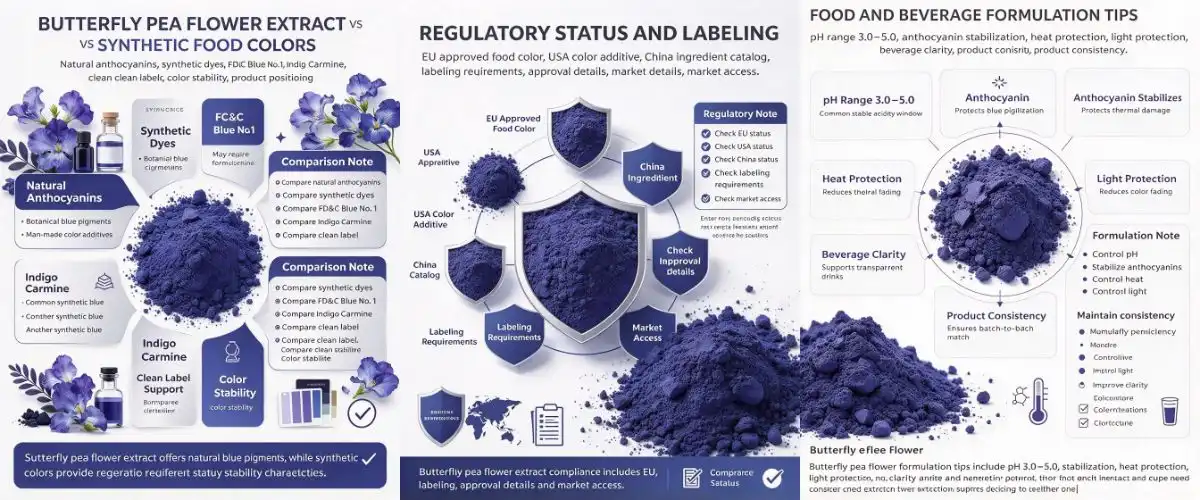
Key Differences Between Butterfly Pea Flower Extract and Synthetic Food Colors
Figuring out what the real differences are between these two colorants is what makes buying choices real.
Composition and Consumer Perception
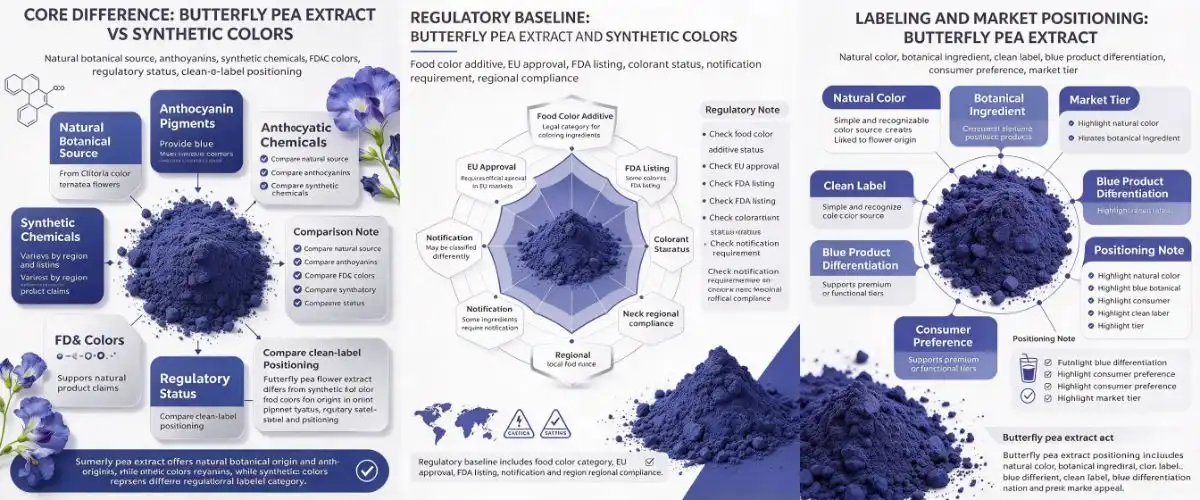
Butterfly pea flower extract has natural phytochemicals and antioxidants. The main phytochemicals are ternatins, which are a type of polyacylated anthocyanins. Synthetic dyes are only used as coloring agents because they don't have any bioactive parts. This difference has a direct effect on how the ingredient shows on a product panel for brands that sell to clean-label markets. In the EU and the US, people are reading labels more and more to find ingredients they know. For example, "butterfly pea flower extract" and "FD&C Blue No. 1" look very different.
Color Performance and pH Sensitivity
It is very helpful for high-volume manufacturing that synthetic blues keep their color under most processing conditions. Butterfly pea flower extract, on the other hand, turns a strong blue color between pH 4.5 and 8.0. Below pH 3.0, it changes to purple or violet. This behavior makes it hard to make acidic drinks, but it also lets people think of "color-changing" products—adding citrus juice to a blue drink makes it purple right now. This is not a weakness for brands that are driven by innovation; it's a way to stand out in the market.
Environmental and Sustainability Profile
Creating synthetic dyes uses a lot of energy and creates chemical waste. On the other hand, growing butterfly pea flowers is a low-input legume crop that fixes nitrogen in the soil. It will be easier for brands that want to report on sustainability or meet ESG goals to include the natural extract in their annual impact reports and supplier transparency disclosures.
Benefits of Butterfly Pea Flower Extract for B2B Clients
But there are other reasons why mid-sized food and drink companies are moving to this butterfly pea flower extract besides the comparison.
Functional Health Positioning
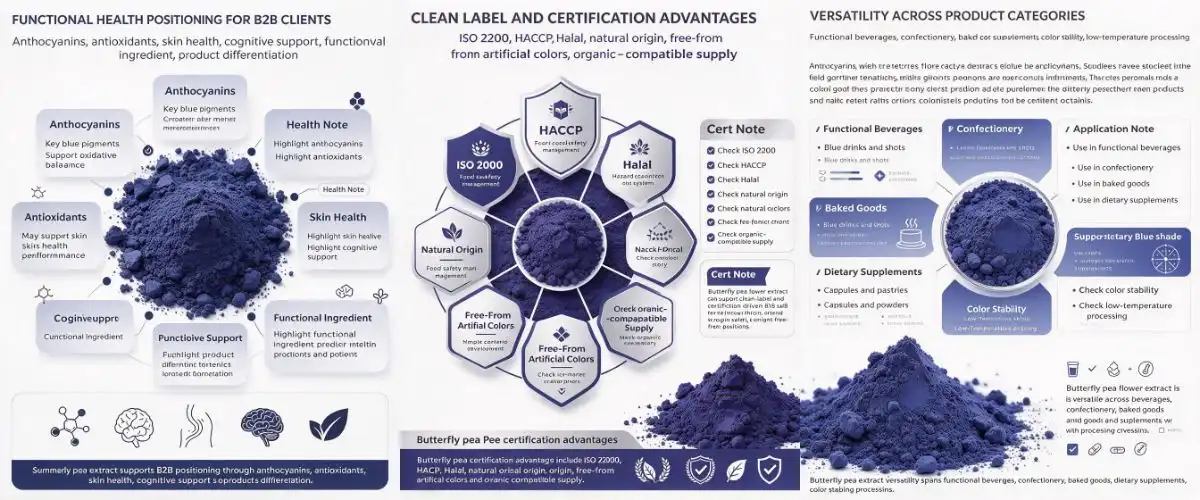
Anthocyanins, which are found in butterfly pea flower extract, are known to be antioxidants. Studies that have been studied by experts in the field show that ternatins and proanthocyanidins can protect neurons and reduce inflammation. This gives people who make products a double benefit: the extract can be used as both a coloring agent and a functional ingredient. This lets them charge more for their products and make health-related marketing claims.
Clean-Label and Certification Advantages
A butterfly pea flower powder that is approved by ISO 22000, HACCP, and Halal lets brands use a botanical name instead of a number to sign their products. In the natural products channel, claimants that a product is "free-from artificial colors" are what make people buy it. USDA Organic-compatible sourcing also makes it possible for finished products to be certified organic.
Versatility Across Product Categories
These are the main uses of this extract that make it useful in business for many different production lines:
- Functional beverages and RTD teas: Heat-stable under pasteurization conditions, the extract keeps its color through normal heat processing, so it can be used in drinks that come in bottles or cans.
- Confectionery and gummies: For candy and gummies: The powder spreads out evenly in gummy mixtures without clumping or leaving behind any visible residue. It dissolves instantly in water and has a fineness of 100 mesh.
- Baked goods: Long-term exposure above 150°C may weaken the color, but encapsulation methods or lower-temperature uses make it work well in cookies and fillings.
These application qualities directly address the problems that R&D teams run into on the production line when they try to use synthetic blue in methods that are already in use.
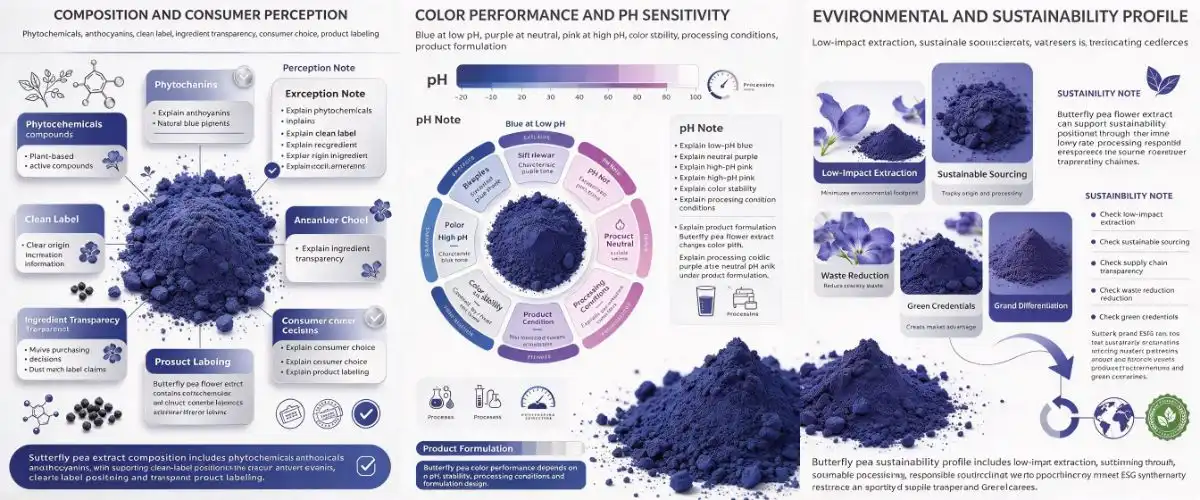
Practical Guide to Sourcing Butterfly Pea Flower Extract
To get this item on a large scale, you need to do more than just find a seller with the right price.
Quality Indicators to Verify Before Ordering
Any trustworthy company selling butterfly pea flower extract should be able to show proof that their product has an anthocyanin content of at least 25%, a mesh size of 100, no more than 5% moisture, and a pH between 3.0 and 5.0. Pesticide residue and heavy metal testing must meet FDA and EU food safety standards for brands that sell in regulated markets. To make sure there is consistency, ask for batch-level data instead of just product-level specs.
Certifications That Matter for Global Market Access
The most types of market entry needs are met by ISO 22000, HACCP, Halal, and Kosher standards. If your distribution includes the natural channel in the US, each shipment should come with FDA 21 CFR 73.69 compliance documentation. Suppliers who can't show these papers pose a real risk of not following the rules at customs and with customers.
Powder Form vs. Liquid Extract
Fine blue powder at 100 mesh is better than liquid extracts for making drinks and food because it is easier to store, has a longer shelf life, is lighter to ship, and can be dosed more accurately. For cold-process cosmetics, liquid extracts can be useful, but powder is the most common industrial form for food-grade production.
Cost and Procurement Considerations: Butterfly Pea Flower Extract vs Synthetic Food Colors
There is a real difference in price between natural and manufactured colorants, and buying teams need accurate information to build their business case. Most of the time, natural blue dyes like butterfly pea flower extract cost 10 to 50 times more per kilogram than man-made FD&C dyes. However, a concentrated extract is only used at very low levels—usually between 0.01% and 0.1% in a finished beverage—so the real difference in cost per unit is not that big. Part of the premium is also recovered by the higher prices that clean-label products fetch in stores; natural and organic drinks usually sell for 20–40% more than regular ones.
Understanding the Cost Premium
The cost of annual certification audits, testing records, and import compliance paperwork should be added to the total cost of sourcing. Working with a seller who already has FDA, ISO, and HACCP credentials makes it easier for your team to follow the rules and cuts down on the time it takes to get qualified. Your internal audit cycle can be cut from weeks to days if your provider has good records.
Regulatory and Certification Costs in Your Procurement Budget
Color variation from batch to batch is one of the main reasons formulators don't like natural blues. This is a real risk when extracts aren't standardized well. When looking at different providers, make sure you ask for stability data across various production runs and information on how they standardize their work. Suppliers who use low-temperature drying and ultra-fine grinding are better able to keep the amount of anthocyanin in big orders uniform.
Batch Consistency and Supply Security
The decision between butterfly pea flower extract and synthetic food colors comes down to where your brand is going, not just where it is today. Synthetic dyes are cheaper and more stable in isolated conditions, but they carry increasing regulatory and consumer-trust costs in clean-label markets. A high-quality natural blue colorant—standardized to ≥25% anthocyanin, certified to relevant food safety standards, and backed by solid stability data—gives procurement managers a commercially viable path to clean-label reformulation.
Conclusion
Butterfly pea flower extract or artificial food colors? It depends on where you want your brand to go, not just where it is now. Synthetic dyes are less expensive and more stable when they are used alone, but in clean-label markets, they cost more to regulate and make people trust. Procurement managers can make clean-label reformulation work with a high-quality natural blue colorant that is set to ≥25% anthocyanin, approved to relevant food safety standards, and backed by solid stability data. There is a rising market for natural colorants, this ingredient is supported by US regulations, and customer demand isn't going away.
FAQ
Is butterfly pea flower extract FDA-approved for use in beverages?
Yes. In 2021, the FDA said that the water-based extract of butterfly pea flower extract could be used as a colorant without having to be certified under 21 CFR 73.69. This covers specific uses for drinks. Brands that want to sell in the EU should know that they need to go through a regulatory review process before they can launch in those areas because the EU has not yet approved the use of food colors.
How does this extract compare to spirulina blue for beverage applications?
Phycocyanin from spirulina is not as stable in acidic environments as butterfly pea flower extract. Because it settles out in drinks with a pH below 4.5, phycocyanin isn't good for lemonades or carbonated drinks. Butterfly pea flower extract only changes colors from blue to purple when it comes into contact with acid. This keeps the product's look and even makes the color change appealing to customers.
What certifications should I require from a supplier?
Ask for at least ISO 22000, HACCP, and Halal or Kosher certificates, based on the people you want to buy from you. Documentation that shows you follow 21 CFR 73.69 and are in line with FDA rules is needed for US drinking applications. Reliable commercial sellers always provide records of analysis at the batch level that show the amount of anthocyanin, heavy metals, and pesticide residues.
What is the recommended usage level in beverages?
At a standard concentration of ≥25% anthocyanin, 0.01% to 0.1% of anthocyanin in a finished liquid product is enough to color it effectively. Even though these ingredients cost more per kilogram than synthetic colors, this low dose rate keeps costs down.
Does the extract affect taste in finished products?
At normal dosage levels, a high-quality extract made by drying it at low temperatures will only have a very faint plant note that is easy to cover up with sweeteners or citrus tastes. Earthy notes can come from extracts that aren't very good or were not processed properly. This is one reason why the method of extraction and the quality of the supplier are important.
Request a Sample From Sigma — Your Trusted Butterfly Pea Flower Extract Supplier
Sigma has butterfly pea flower extract powder that is safe for food, has anthocyanin levels of at least 25%, and is 100 mesh, ISO 22000, HACCP, and Halal approved. Because we dry at low temperatures, the food dissolves right away in water and doesn't leave behind any residue or bad tastes. Buyers who meet the requirements can get free trials, and our team will help you through the whole process. To begin the sourcing process right away, email Sarah at sarah@sxsigma.com or go to sxsigma.com.
References
1. Treyvaud Amiguet, V. et al. — Journal of Agricultural and Food Chemistry, 2012.
2. Paengkoum, P. — Asian-Australasian Journal of Animal Sciences, 2011.
3. U.S. Food and Drug Administration — 21 CFR Part 73: Listing of Color Additives Exempt from Certification, Federal Register, 2021.
4. Nair, V. et al. — "Clitoria ternatea and the ancient art of colour-changing foods and beverages" — Phytochemistry Reviews, 2019.
5. Bridle, P. & Timberlake, C.F. — "Anthocyanins as natural food colours—selected aspects" — Food Chemistry, 1997.
6. Grand View Research — Natural Food Colors Market Size, Share & Trends Analysis Report, 2023.