Bovine Bone Peptide vs Collagen Peptide: Key Differences
When sourcing ingredients for joint, bone, or sports recovery supplements, the choice between bovine bone peptide and standard collagen peptide matters more than most buyers initially expect. Both belong to the hydrolyzed collagen family, yet they differ significantly in source specificity, collagen type composition, bioactive mineral content, and targeted application. This article walks through those differences in a structured, procurement-focused way — covering definitions, functional performance, sourcing comparisons, and practical buying guidance — so you can make an informed decision that supports your formulation goals and supply chain requirements.
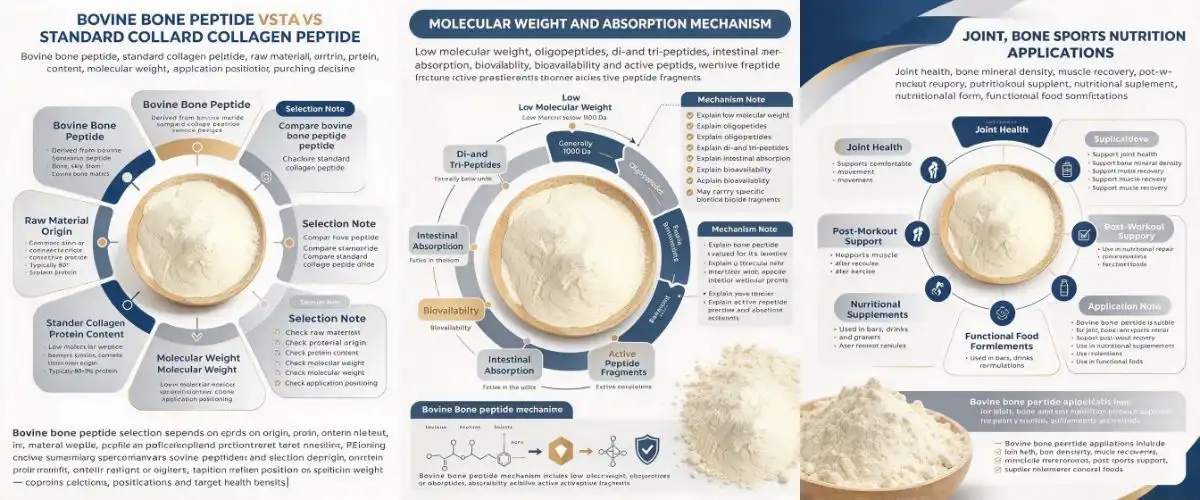
Understanding Bovine Bone Peptide and Collagen Peptide: An Overview
What Is Bovine Bone Peptide?
When enzymes break down bovine bone ossein, bovine bone peptide is a useful protein fraction with a low molecular weight. Some of the molecules have a molecular weight of less than 1000 Da, and most of the powder is made up of ash (≤3%). It turns into a fine, light yellow powder. Since the raw material is real bone tissue, it still has functional calcium and phosphorus, as well as Type I collagen that is found naturally in the body. These nutrients help make bones stronger. Because it is made from bone-specific matrix, it is very different from collagen that comes from skin or hide.
What Are General Collagen Peptides?
This is a big group of broken-down proteins that can be found in leather, fish skin, chicken tissue, and the membrane inside an eggshell. Based on where they come from, they give you Type I, Type II, or Type III collagen. Peptides from fish are often used in skin and anti-aging products, while peptides from chicken are more common in joint cartilage products. A lot of people use collagen from cow hide to take care of their skin and joints. Each source has its own amino acids, allergen risk, and digestion, which sourcing teams have to compare to the product they want to make.
Molecular Composition: A Side-by-Side View
The main difference between these ingredients is what they do besides the peptide chains themselves. These are mostly glycine, proline, and hydroxyproline, which are amino acids and proteins that come from collagen peptides. Bovine bone peptide has the same set of amino acids, plus calcium and phosphorus from the calcium and phosphorus structure in bone. If you mix Type I collagen peptides with chemicals that are linked to hydroxyapatite, bone-derived peptides have a direct molecular link to bone tissue that collagen from fish or hide can't copy.
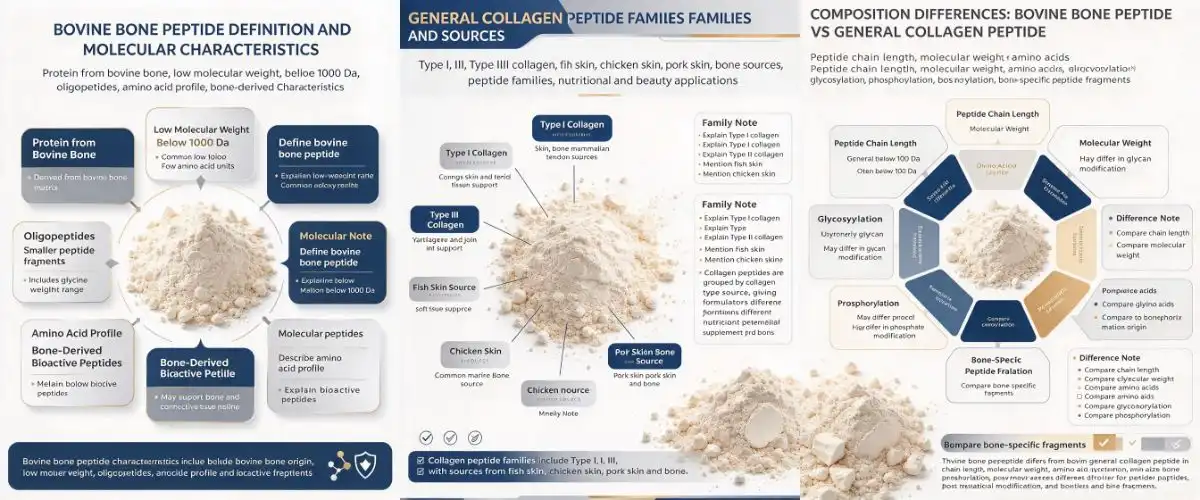
Key Functional and Performance Differences in Applications
Bone and Joint Regeneration
Osteoblasts are the cells that make new bones. Studies published in Bone Research and Nutrients show that Type I collagen peptides make them work better. Bovine bone peptide, which is unique to the matrix, transmits hydroxyproline-rich sequences that signal the external matrix to produce collagen. This specificity is a big plus over using generic collagen sources for companies that want to make products that help bones stay strong or heal faster after a break.
Skin Elasticity vs. Structural Support
Scientists have shown that standard collagen peptides, especially those from sea and cow hides, can make skin more elastic, keep moisture in, and smooth out wrinkles. Bovine bone peptide contains Type I collagen, which helps the skin keep its shape. However, its main job is to support bones and other structures. Brands that make "beauty and bone" items might find it helpful to mix the two. Bone-specific peptides are a better active ingredient story for brands that only care about bone or joint health.
Regulatory and Safety Profiles
Animal-based collagen needs to be BSE/TSE certified, which is an extra level of safety checks that must be done on both types of collagen. When sellers sell raw materials, buyers need to make sure the sellers tell them where the materials come from, how dangerous they are for BSE in that country, and what steps are taken to destroy the materials thermally. Sigma's bovine bone peptide is safe to use because it is HALAL and KOSHER approved. The food safety standards set by ISO 22000, HACCP, the FDA, and the EU are also met. With just one SKU, it can be sold in North America, Europe, and the Middle East.
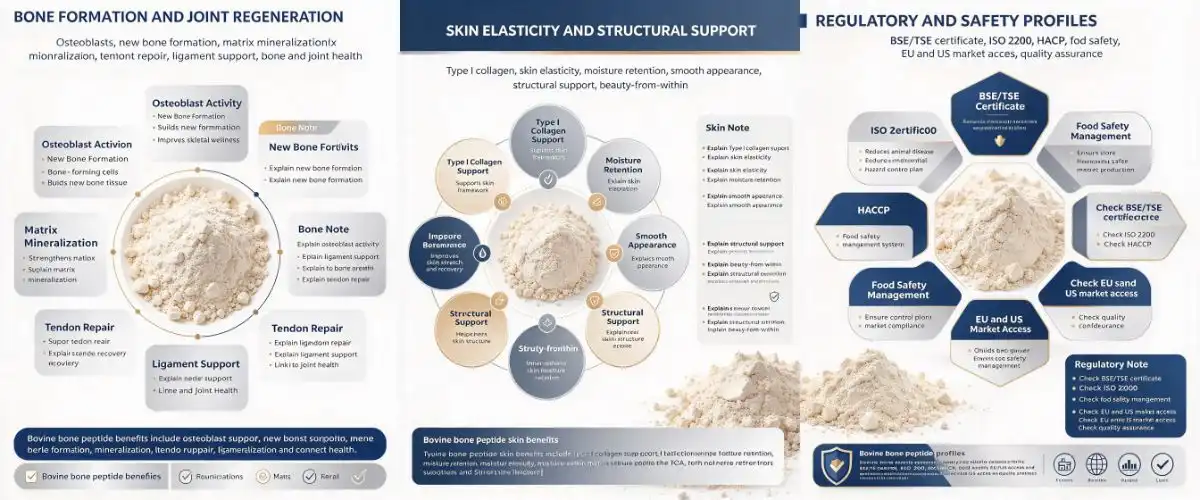
Comparative Analysis: Bovine Bone Peptide vs Other Collagen Sources
Bovine Bone vs. Marine Collagen
Marine collagen peptides are often found in beauty products because they are small molecules that don't have a lot of allergies. But in many stores, they say that they have shellfish or fish allergens in them, which means that you can't use them in all recipes. Also, they don't have the right mix of calcium and phosphorus minerals that make bovine bone peptide special for bone health. Collagen from animals that live in the sea usually costs more per kilogram than collagen from cattle. In this case, bone peptide is the better choice for making a lot of nutraceuticals.
Bovine Bone vs. Chicken Collagen
Undenatured Type II collagen (UC-II), which comes from chicken, works on cartilage and is being tested in hospitals to help knee pain. That's not what it does; it works by making the defense system less sensitive. On the other hand, bovine bone peptide provides structure Type I collagen, which helps make bone matrix. For recipes that aim to increase bone density, speed up bone healing after a break, or improve general bone strength, bovine bone peptide is a more medically direct ingredient choice than collagen derived from chicken cartilage.
Powder Form vs. Capsule Form: Manufacturing Considerations
It works well in pills, tablets, and stick packs when it is in powder form (80 mesh, light yellow, and easy to dissolve in water). Since it doesn't thicken much when mixed with water, it can also be used to make healthy drinks. Because it doesn't take much water from the air, gummy and chewable types stay stable longer on the shelf. The formulation is easier to work with because of these qualities, which also give contract manufacturers more choices when moving from 50 kg test runs to full production batches.
Procurement Insights for B2B Clients: Choosing and Buying Bovine Bone Peptides
Key Supplier Evaluation Criteria
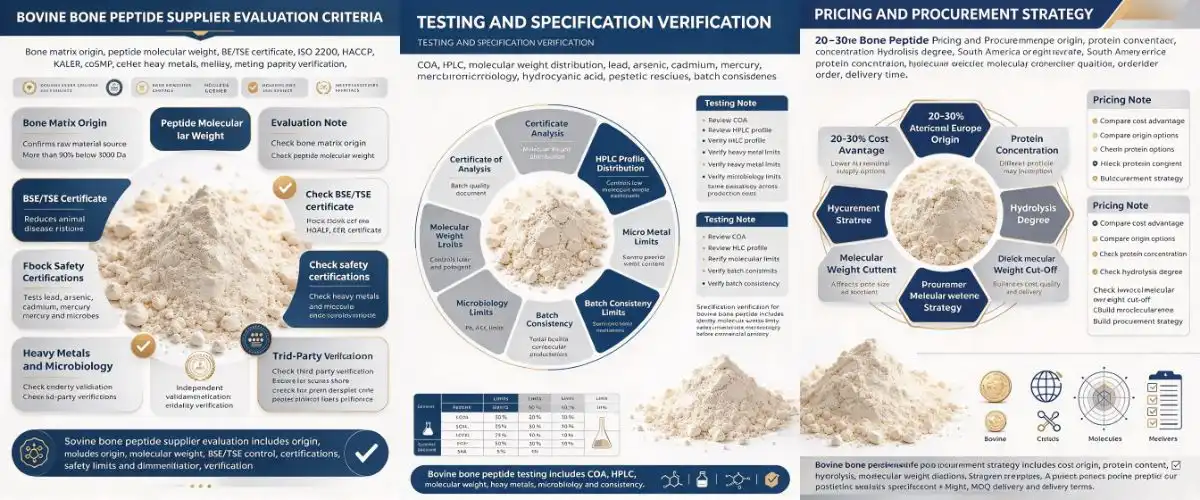
To find the best provider of bovine bone peptide, you need to look at both contracts and business terms. Before a seller is properly approved, these are the things that buying managers should ask for:
- Molecular weight distribution report (showing that more than 90% of peptides have a weight of less than 3000 Da, confirmed by HPLC)
- BSE/TSE-Free certificate that can be tracked back to the country where it came from
- Certification stack: The product has been certified by ISO 22000, HACCP, HALAL, KOSHER, and cGMP. It has also been tested for heavy metals and found to have levels below 0.5 mg/kg for lead, 0.3 mg/kg for arsenic, and 0.1 mg/kg for mercury
- Hydroxyproline content as proof that collagen is real and pure
Some sources sell cheap gelatin or collagen from hides that is being sold as bone peptide. These standards let you know which sources are reliable. By requiring validation by a third-party lab before making a trial order, the company can protect both the formulation's integrity and its future legal standing.
Buyers should ask for a 50–100 kg trial order to make sure that the product is consistent from batch to batch, dissolves well in their specific formulation matrix, and has a neutral taste with no bitter peptide off-notes.
Pricing and Customization
Sigma's seller prices for bovine bone peptide are 20% to 30% less than those from similar sources in South America or Europe, but the quality standards have not been lowered. Changes in protein concentrations, defatting, demineralization, or custom molecular weight cuts (like below 1000 Da) can be made to make sure that your formulation goals are met. Standard minimum order amounts let you ship both early-stage product development and full commercial runs. If the goods are in stock, you can ship them within 5–7 working days.
Making the Right Choice: Practical Tips for B2B Buyers
Match Ingredient to Application
Regular collagen is not as good as bovine bone peptide if you want to make your products better for bone health, stop osteoporosis, or help muscles recover after exercise. It has a bone-specific mineral framework and Type I collagen, which are a lot like those claim groups. Both your product story and your help file will be better for regulatory review if you do this.
Compare Against Calcium Supplements
Unlike regular calcium carbonate or citrate tablets, bovine bone peptide has phosphorus and bioavailable calcium that are linked in a way that looks like biological collagen. Mineral bioavailability studies that compare the two types of calcium salts show that this form is taken several times better than the inorganic form. For people who are making expensive "whole bone complex" SKUs, this ingredient is worth more than calcium alone.
Build a Long-Term Supplier Relationship
It's risky when the buying process is short. If you make a deal with a good bovine bone peptide manufacturer once a year, you can be sure of steady prices, first choice when supplies are low, and full batch paperwork. Get a free sample first, and test it in your lab to make sure it works. Then you should talk about the terms of a supply deal that lasts longer.
Conclusion
Bovine bone peptide and general collagen peptide are both made from the same protein, but they are used for different things in preparation. This type of collagen comes from bone, not hide or fish. It has bioactive calcium-phosphorus, skeletal specificity, and Type I collagen, all of which are good for bone and joint health. It's not easy for procurement teams that make reliable, high-performance supplements in these areas to pick the right source ingredient. It changes the story of how well the product works, its legal file, and its place in the market.
FAQ
What is the recommended dosage of bovine bone peptide in supplement formulations?
Most professionals and people who work on new products say that between 2.5 and 10 grams a day can be good for your bones and joints. However, it depends on what the recipe says and what else is in it. Always follow what your regulatory expert tells you about the right amounts for the market you want to reach.
Is bovine bone peptide safe for large-scale manufacturing use?
You can only get bovine bone peptide from BSE/TSE-certified suppliers whose raw materials can be tracked. This is the only way to get this safe and well-known food ingredient. There are rules about food safety set by ISO 22000, the FDA, and the EU that Sigma's product meets. There are less than 1000 CFU/g of microbes on the plate, which is much less than what is normally seen. There are no E. coli or Salmonella in it.
How does absorption compare between bovine bone peptide and standard collagen?
About 300,000 Da of native collagen is hard to break down because it is made up of three helices. Bovine bone peptide has a molecular weight of about 3000 Da and is broken down by enzymes. More than 90% of it is absorbed because it goes straight into the bloodstream through the gut membrane as di- and tri-peptides.
Does bovine bone peptide carry HALAL or KOSHER certification?
Yes. The bovine bone peptide made by Sigma has been approved by both HALAL and KOSHER. This means that it can be sold in markets in the Middle East, North America, and Europe where people who follow religious diet rules are allowed to buy it.
Request a Sample from Sigma — Your Trusted Bovine Bone Peptide Manufacturer
Sigma sells bovine bone peptide that is fully certified by BSE/TSE, ISO 22000, HACCP, HALAL, and KOSHER and is safe for use in both food and medicine. There are always a lot of items in stock, and we can send them out in 5–7 working days. Our prices are fair, and we can make changes to meet your exact protein and molecular weight needs. Go to sxsigma.com or email Sarah at sarah@sxsigma.com right now to get a free price on a sample or a lot of them.
References
1. Guillerminet, F., et al. "Hydrolyzed collagen improves bone metabolism and biomechanical parameters in ovariectomized mice." Osteoporosis International, 2010.
2. König, D., et al. "Specific collagen peptides improve bone mineral density and bone markers in postmenopausal women." Nutrients, 2018.
3. Elam, M.L., et al. "A calcium-collagen chelate dietary supplement attenuates bone loss in postmenopausal women with osteopenia." Journal of Medicinal Food, 2015.
4. Proksch, E., et al. "Oral supplementation of specific collagen peptides has beneficial effects on human skin physiology." Skin Pharmacology and Physiology, 2014.
5. Oesser, S., & Seifert, J. "Stimulation of type II collagen biosynthesis and secretion in bovine chondrocytes cultured with degraded collagen." Cell and Tissue Research, 2003.
6. Wu, J., et al. "Collagen peptides from bovine bone: preparation, characterization, and their effects on calcium absorption." Food Chemistry, 2017.